



Thomas Moran etchings are hand-worked prints pulled from copper plates the artist bit and inked himself, made by the same painter whose canvases helped persuade the United States Congress to create Yellowstone National Park. Moran was born in Bolton, Lancashire, on 12 February 1837, and his family sailed for America when he was seven, settling eventually in Philadelphia. There he was apprenticed to a wood engraver as a teenager, then spent a career moving between oil, watercolour and etching that ran until his death in Santa Barbara, California, on 25 August 1926. His paintings of the American West made him famous. The etchings, made in far smaller numbers and rarely discussed alongside them, are the more overlooked side of that career.
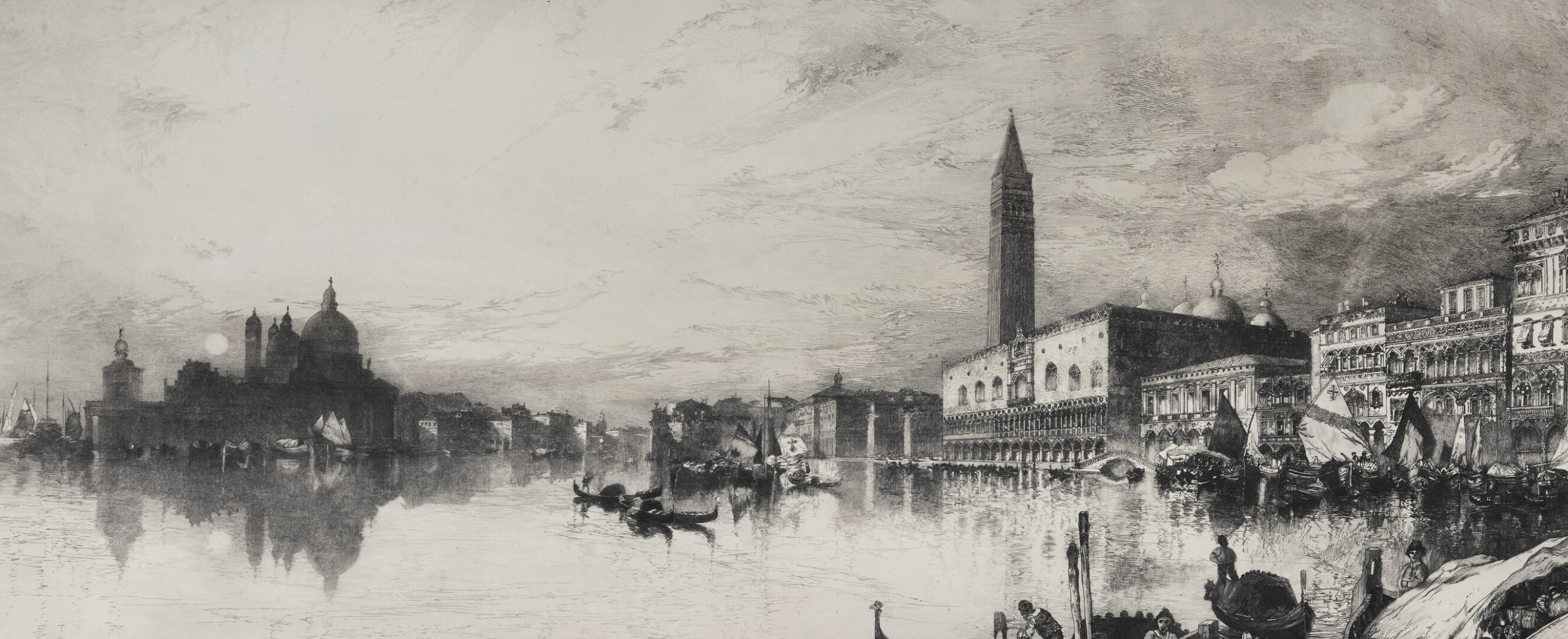
Unlike the studio-built oils, which Moran often composed from field sketches and photographs long after he had left a landscape, an etching came straight off a plate he had worked with a needle and acid. Soft copper wears fast under a printer’s press, and usually fewer than 100 clean impressions could be pulled from a single plate before its lines began to break down. Moran made more than 70 etchings in the 12 years after he returned to the medium in 1878, and fewer than 10 of them depict the West at all; most take their subjects from East Hampton, Venice and the English and Scottish coastline he had known since childhood. That combination, a limited physical print run and a name inseparable from Yellowstone, is what now draws collectors to them.
This guide looks at how Moran came to etching, what his prints looked like on paper, and what they have made at auction, as a starting point for anyone weighing up a Thomas Moran etching for a collection.
Discover all in our:
Thomas Moran etchings: the American landscape master behind Yellowstone’s fame
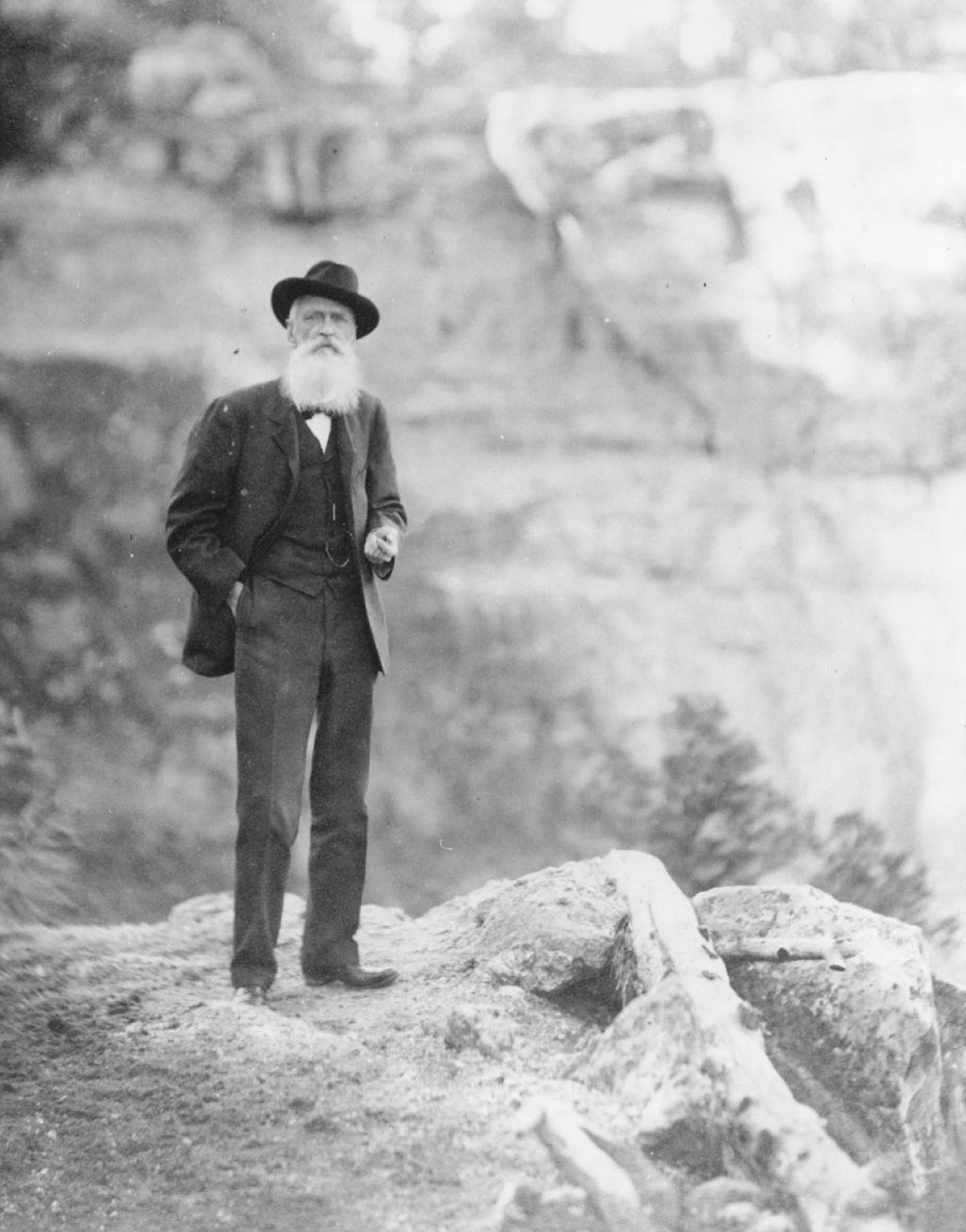
Credit: Grand Canyon National Park via Wikimedia Commons (CC BY 2.0)
From Bolton to the Hayden Survey
Moran’s route to Yellowstone began with magazine work rather than a survey posting. Illustrating pieces for Scribner’s Magazine brought his drawing to the attention of Ferdinand Vandeveer Hayden, who was organising a government survey of the Yellowstone region for 1871. The financier Jay Cooke backed Moran’s place on the trip, describing him to Hayden as “an artist of Philadelphia of rare genius”. Moran spent 40 days in the field, documenting more than 30 sites now familiar to park visitors, including the ground around what is today Old Faithful, and kept a diary of the expedition alongside his sketches. Earlier trips to London, where he had studied J. M. W. Turner’s paintings at the National Gallery, shaped the treatment of light and atmosphere he brought back from Wyoming.
The paintings that built a national park
Congress established Yellowstone as the United States’ first national park in 1872, and historians have long credited Moran’s images, shown alongside the survey photographs of William Henry Jackson, with tipping the argument in the park’s favour. The government itself signalled how much it valued the work: it bought Moran’s monumental canvas The Grand Canyon of the Yellowstone for $10,000 (about £2,050 at the exchange rate of the time) that same year. The connection stuck so firmly that Moran was known for the rest of his career as Thomas “Yellowstone” Moran, and the nickname still attaches to his etchings of the park’s canyons and hot springs, even though only a handful of his prints ever returned to the subject that made him famous.
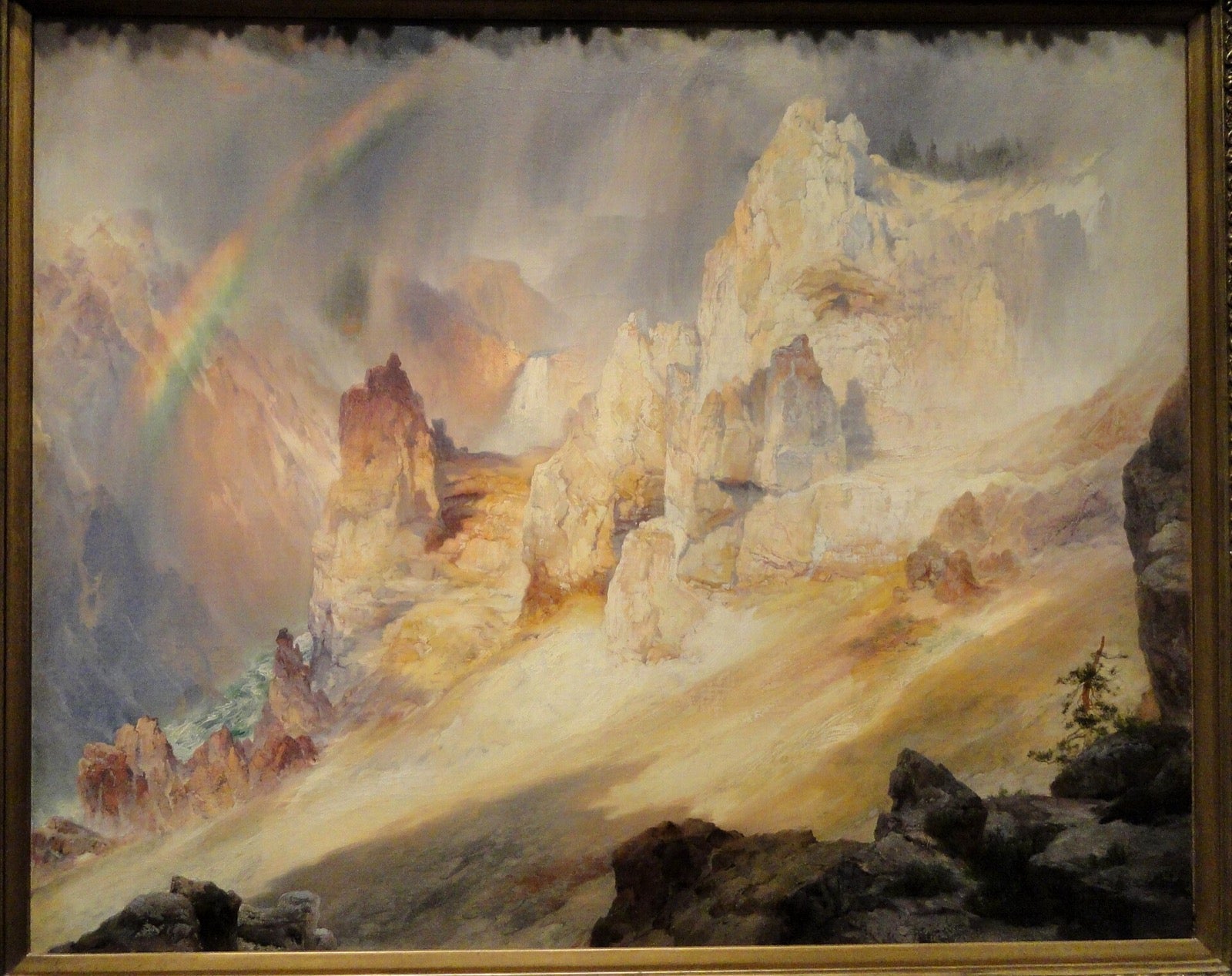
Credit: Thomas Moran, public domain via Wikimedia Commons
Learning to etch: Moran and the New York Etching Club
Moran had experimented with etching earlier in his career, but did not return to the medium in earnest until 1878, by which time the etching revival that had taken hold in France and Britain in the middle of the century was reaching American artists. He and his wife, the etcher Mary Nimmo Moran, whom he had married in 1862, joined the New York Etching Club, founded the previous year by the physician Leroy Milton Yale together with the artists Robert Swain Gifford and James David Smillie, and became two of its most prominent members. Thomas also belonged to the American Water Color Society and the Society of Painters Etchers in London. Mary worked at the same trade alongside him, and critics singled out her use of retroussage, wiping ink back across a plate to leave a soft haze over parts of a design, as a technical achievement in its own right.
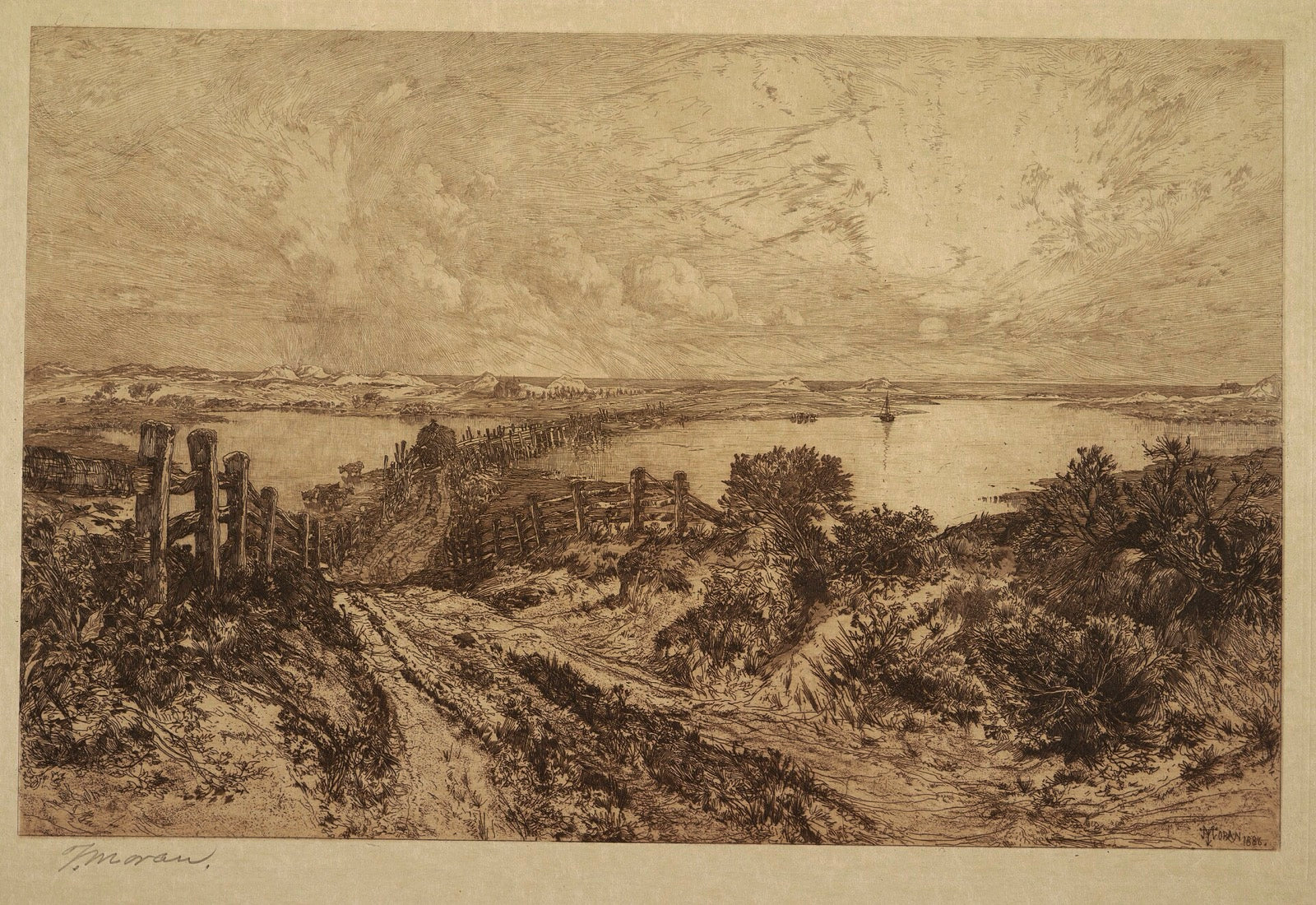
Credit: Thomas Moran, public domain via Wikimedia Commons
Inside the process: copper, Klackner and why originals are scarce
A Moran etching began life as a copper plate that he worked directly with a needle, biting the lines with acid rather than transferring a design from a painting. Formal print editioning did not become standard practice until the twentieth century, so Moran’s plates were never numbered into a fixed run. Instead, the copper itself set the limit: usually fewer than 100 impressions could be pulled before the finer lines began to wear down and blur. Many of his plates were published commercially by the New York dealer Christian Klackner, whose catalogue numbers still identify individual subjects today. A Bonhams sale in February 2026 offered an example of this: an 1881 etching titled Morning on the St. Johns, Florida, catalogued as Klackner 56, signed by Moran in pencil on thin wove paper, which made US$486.40 (about £360) including premium.
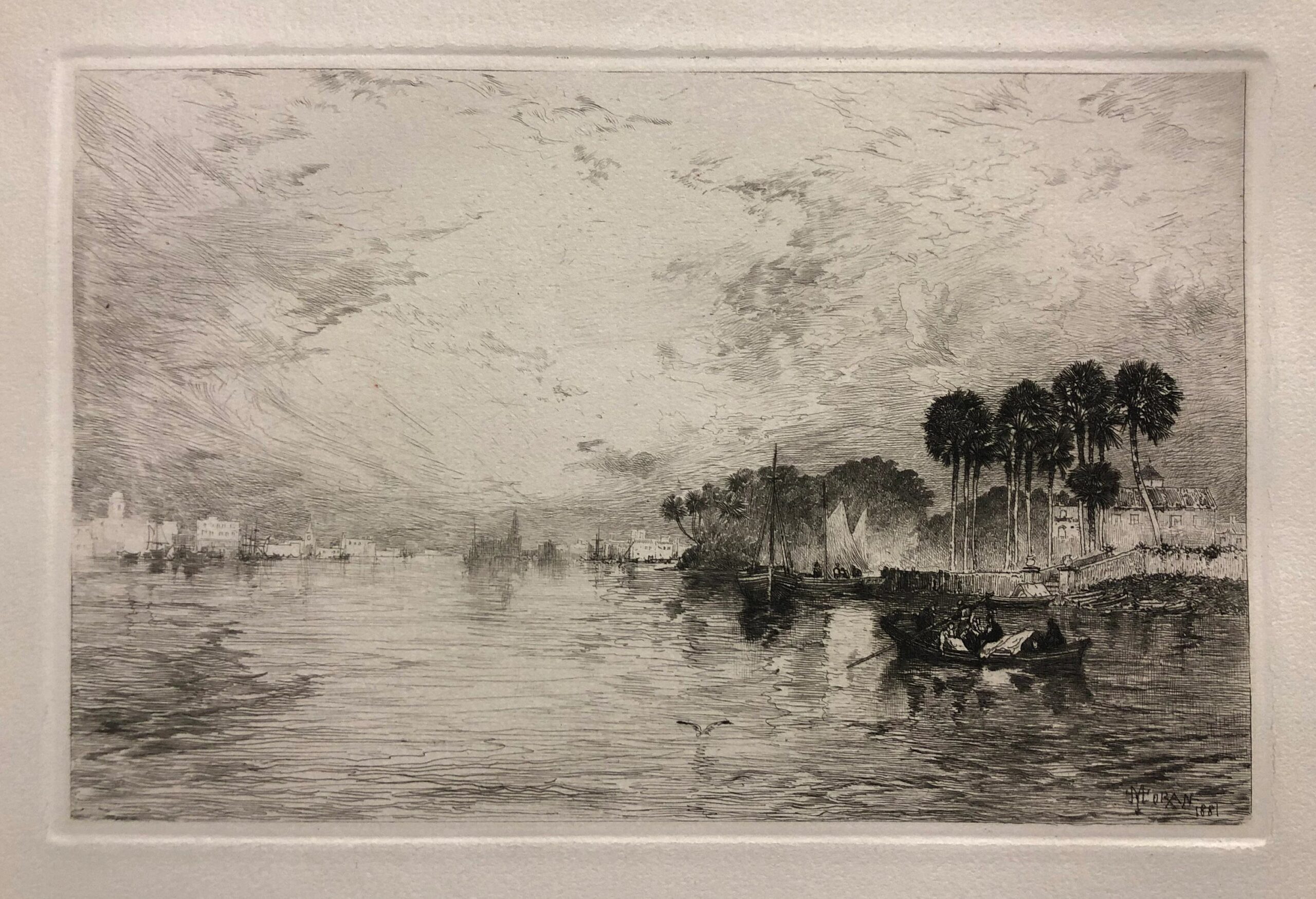
Credit: Bonhams
What collectors pay for a Moran etching today
Prices for Moran’s original etchings sit well below those of his paintings. Dealers currently ask roughly £185 to £2,600 for a signed impression, depending on the plate, its condition and how many clean pulls survive from it. His paintings occupy an entirely different market: the 1878 canvas Green River of Wyoming sold at Christie’s in New York on 22 May 2008 for $17.74 million, more than doubling the previous auction record for a 19th-century American painting. Converted at the exchange rate of the time, that hammer price came to roughly £9.0 million. No etching by Moran has approached that figure, and none is likely to, but the gap is part of what makes the etchings worth a look: they carry the same hand and the same eye for the Yellowstone light, at a fraction of the cost of entry.
The plates that keep Moran’s Yellowstone story within reach
Moran’s reputation was built on canvases most collectors will never own, but his etchings put an original, hand-worked object from the same career within reach of a modest budget. A signed impression of a plate he bit himself, published in his lifetime by Klackner and printed in numbers a copper plate could survive rather than a publisher’s edition size, is a tangible link to the artist Jay Cooke recommended to Hayden as a man of “rare genius”, and to the images that helped push Yellowstone through Congress in 1872.
For a beginner, that makes the etchings a sensible starting point: check the Klackner number against the subject, look for a pencil signature and clean, unbroken lines that show the plate was pulled before it wore, and expect to pay closer to the low hundreds of pounds than the low thousands for most subjects. The paintings will keep making headlines. The etchings are where most new collections of Thomas Moran’s work actually begin.