




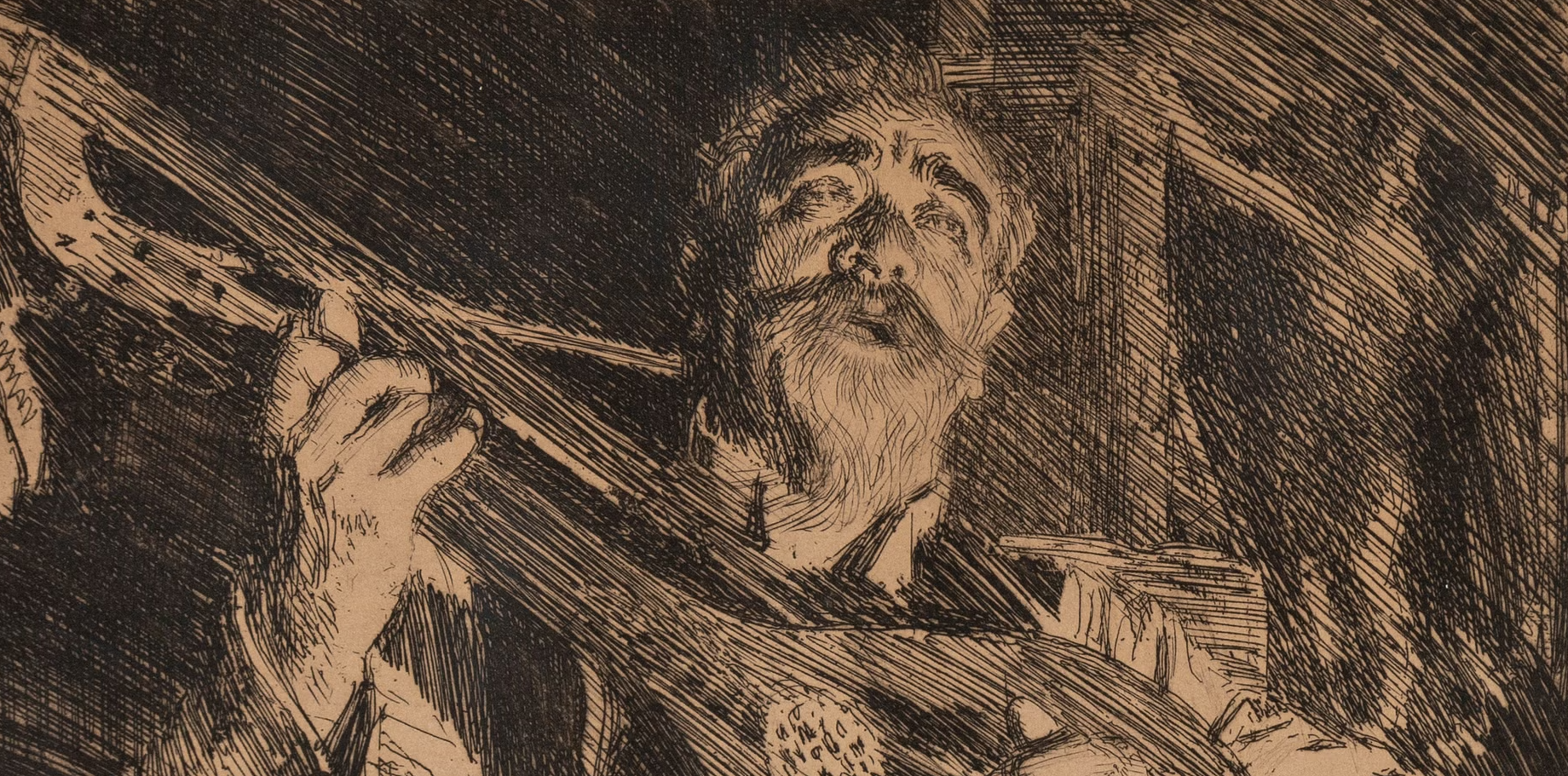
Anders Zorn etchings turn up at auction far less often than his oil paintings, and when they do, the results tell a consistent story: steady, unglamorous demand rather than headline prices. Zorn, born in the small Dalarna town of Mora in 1860, built his early reputation as a portrait painter, winning a first-class medal and France’s Legion of Honour at the 1889 Paris World’s Fair. Etching, though, occupied him just as seriously across his career, and it is this smaller, more affordable corner of his output where today’s collectors are quietly buying.
He did not come to the medium casually. Zorn learned to etch in London in the early 1880s under Axel Herman Haig, a fellow Swede some 25 years his senior, and spent several years testing the plate before settling on the loose, confident crosshatching that became his signature. He admired Rembrandt above any other printmaker and assembled a personal collection of around 180 Rembrandt impressions, a scale of collecting that says as much about his ambitions for the medium as his own etchings do. Alongside contemporaries who styled themselves “painter-etchers”, he argued that etching deserved to be judged as an art form in its own right, not a reproductive trade serving painting.
That history is part of what keeps interest alive now. Sales handled by Bonhams show signed, lifetime impressions of Zorn’s etchings changing hands for consistent low four-figure sums, even as his major paintings sell for vastly more, and it is precisely that gap which has drawn a steady, unhurried stream of print collectors towards his etched work.
Discover all in our:
Anders Zorn etchings: the Swedish master collectors are quietly chasing
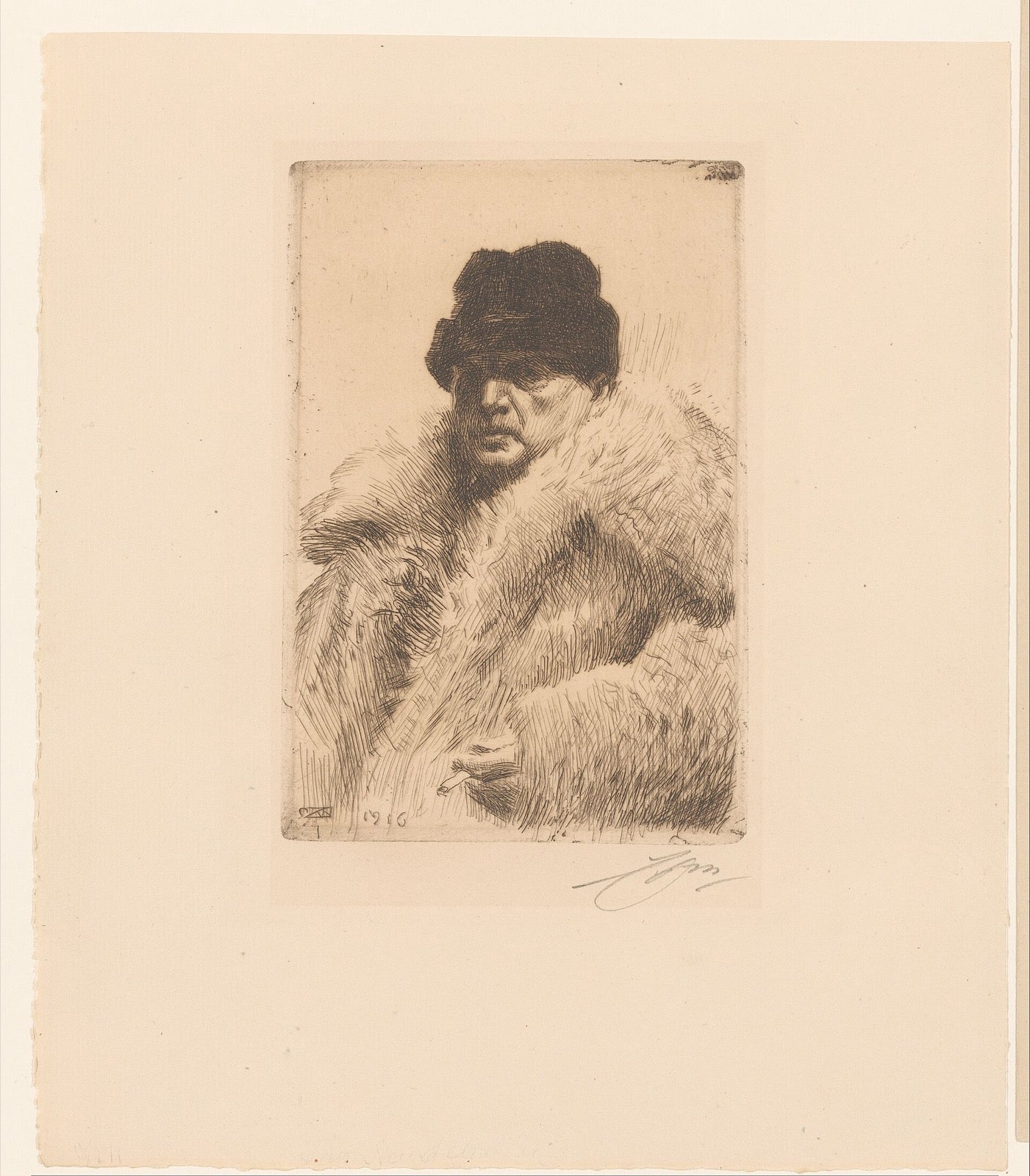
Credit: Anders Zorn, public domain via Wikimedia Commons
How Zorn learned to etch
Zorn’s first plates were, by his own later account, tentative. Working under Haig’s guidance, he began with careful, descriptive lines closer to his teacher’s architectural manner than to anything distinctly his own. Over the following decade that caution disappeared. Zorn began working with rapid, overlapping strokes of the needle, letting bare paper stand for light and building shadow out of dense, criss-crossed hatching rather than tone. Writers on his prints have since described the effect as a kind of binary language, translating the colour of his paintings into black and white without losing a figure’s exact fall of light.
This was never a private experiment. Zorn exhibited his etchings publicly and sold them alongside his paintings, treating each print as a finished work rather than a study. The subjects ranged widely: formal portrait commissions, domestic interiors, nudes out of doors, and genre scenes of Dalarna life. That range is one reason the etchings reward close looking rather than a glance at a signature.
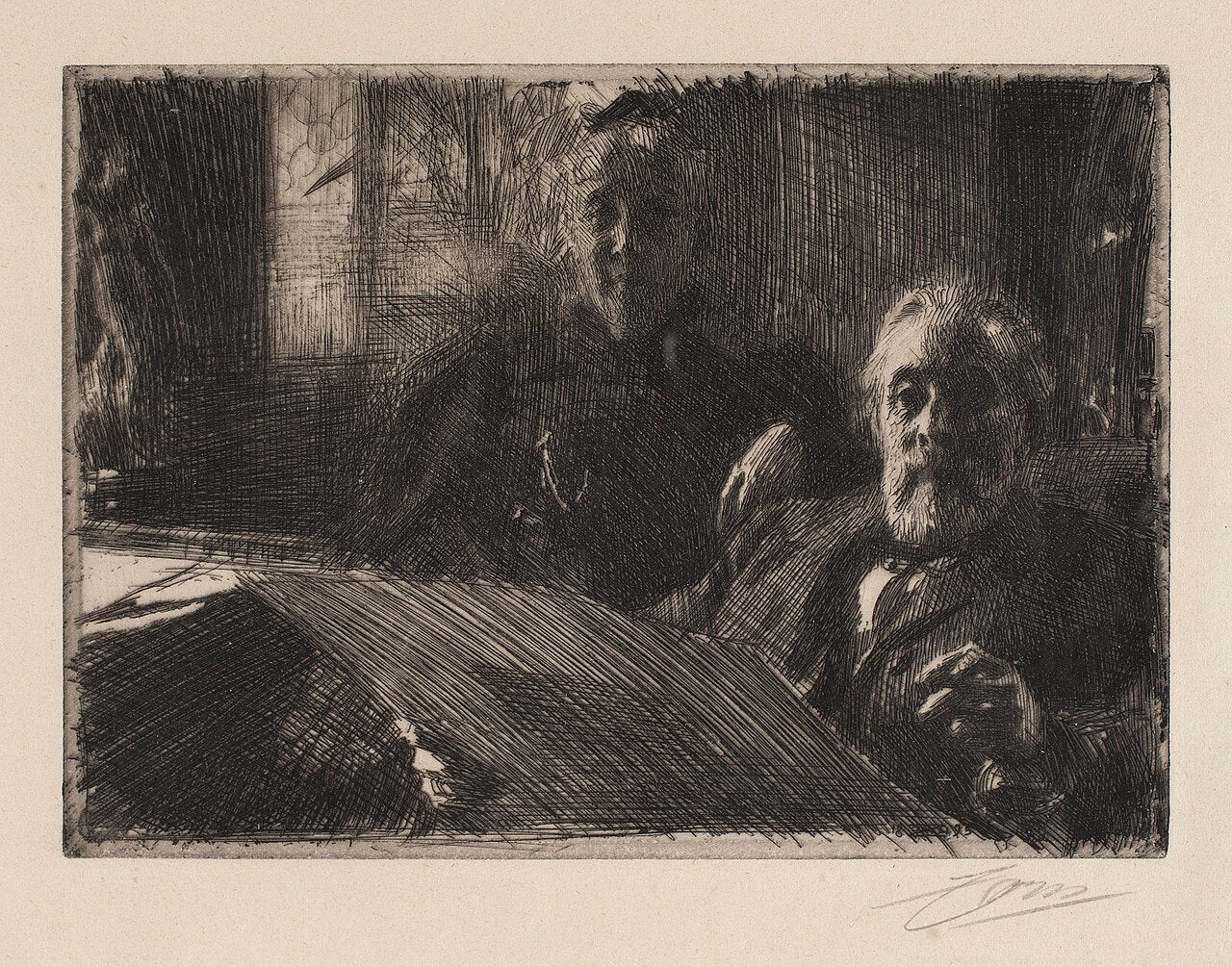
Credit: Bonhams
What the auction record actually shows
Bonhams has handled several signed Zorn etchings in recent years, and the pattern is narrow and consistent. Mr & Mrs Furstenberg, an 1895 double portrait etching signed in pencil, sold for £1,000 in February 2014. The Cabin, a first-state impression from 1917, made £1,500 in March 2018. The Letter, a small 1913 plate in its second and final state, sold for £625 in February 2013, and a fifth-state impression of Elin made £900 in 2008. A group of three etchings from the Jacob Collection, including Balance and Berserk, made £637.50 in July 2020, and two further Jacob Collection groupings of three, built around further states of Elin, made £1,211.25 and £1,275 at the same sale.
None of these are dramatic sums next to the six- and seven-figure prices his portraits and Dalarna landscapes reach at the top of the market, and that is rather the point. A collector with a few hundred to a couple of thousand pounds can still buy a genuine, signed, lifetime impression by an artist Rembrandt scholars take seriously, and that combination of accessibility and pedigree has kept the category quietly busy rather than fashionable.
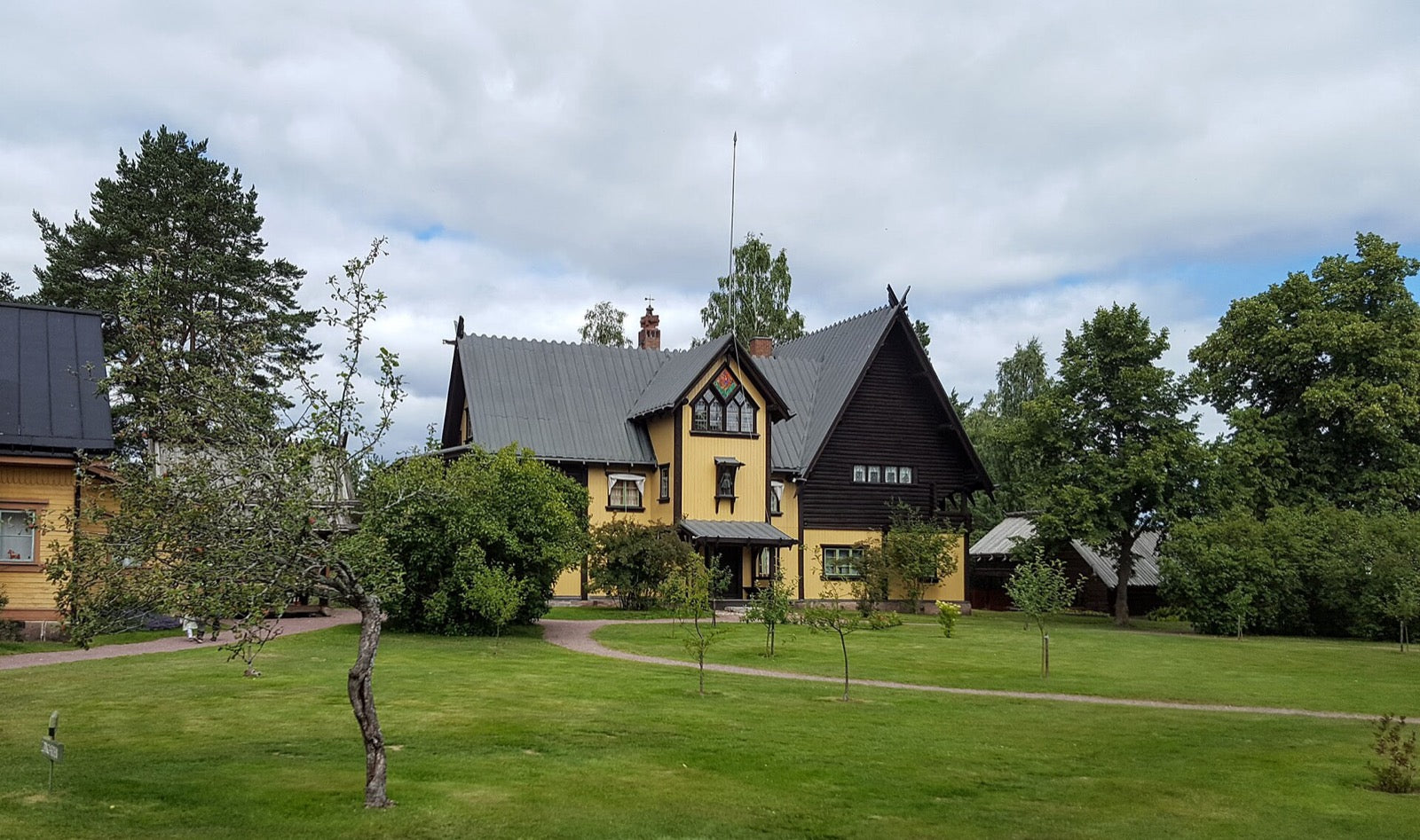
Credit: Ingimar E via Wikimedia Commons (CC BY-SA 4.0)
Why prices vary so much from plate to plate
The Bonhams results also show how much detail affects value within what looks, at first glance, like one narrow price band. State matters: Zorn reworked a plate several times over, and a first state before additional shading, as with The Cabin, can be treated differently from a worn later state of the same image. Paper matters too, since Zorn printed on both laid and wove sheets, and a crisp early pull with strong contrast tends to outperform a later, greyer one. Provenance carries some weight too: the three Jacob Collection lots, each traceable back through Stockholm and New York sales in the early 1990s, sold at broadly similar levels to unattributed single lots, suggesting buyers were paying for the etchings themselves rather than for their paper trail.
Condition is the detail most likely to catch out a new buyer. Cataloguers routinely note faint staining or toning on paper more than a century old, exactly as they did on the 2008 Elin impression, and this is factored into the price rather than treated as grounds to withdraw a lot. None of the group above carried a note of foxing or margin loss serious enough to affect authenticity, which is a reasonable baseline to expect from a Zorn etching sold through a major auction house.
What to look for before buying
A pencil signature in the margin is the first and most basic check, since Zorn signed the impressions he approved for sale during his lifetime. Beyond that, it pays to compare any prospective purchase against the Asplund catalogue numbers, first compiled by Karl Asplund in 1920 and still cited on every Bonhams lot, since they identify the exact plate and state under discussion. The Zorn Museum in Mora, built around the artist’s own house and studio, holds the fullest reference collection of his etchings and remains the standard place to study genuine impressions before buying elsewhere.
New collectors are usually better served starting with a single, well-documented print in a late but clean state, in the £600 to £1,000 range, rather than chasing a rare first state on a first purchase.
Credit: ColinMB via Wikimedia Commons (CC BY-SA 4.0)
Why the pursuit stays quiet
Nothing about the numbers above suggests a market about to break into headlines. What they suggest instead is a small, informed group of buyers who understand exactly what they are getting: a genuine plate by an artist who treated etching as seriously as he treated oil paint, priced well below the reputation that made him one of Europe’s most sought-after portraitists. That gap between his standing and the price of his prints depends on wider recognition of etching as a collecting category, not just on Zorn’s own name, so it is unlikely to close quickly.
For as long as that gap holds, the etchings will keep changing hands quietly at Bonhams and similar houses rather than making news, bought by people who have weighed a five-figure painting against a four-figure print and chosen the print as the more honest way into Zorn’s own working practice.