



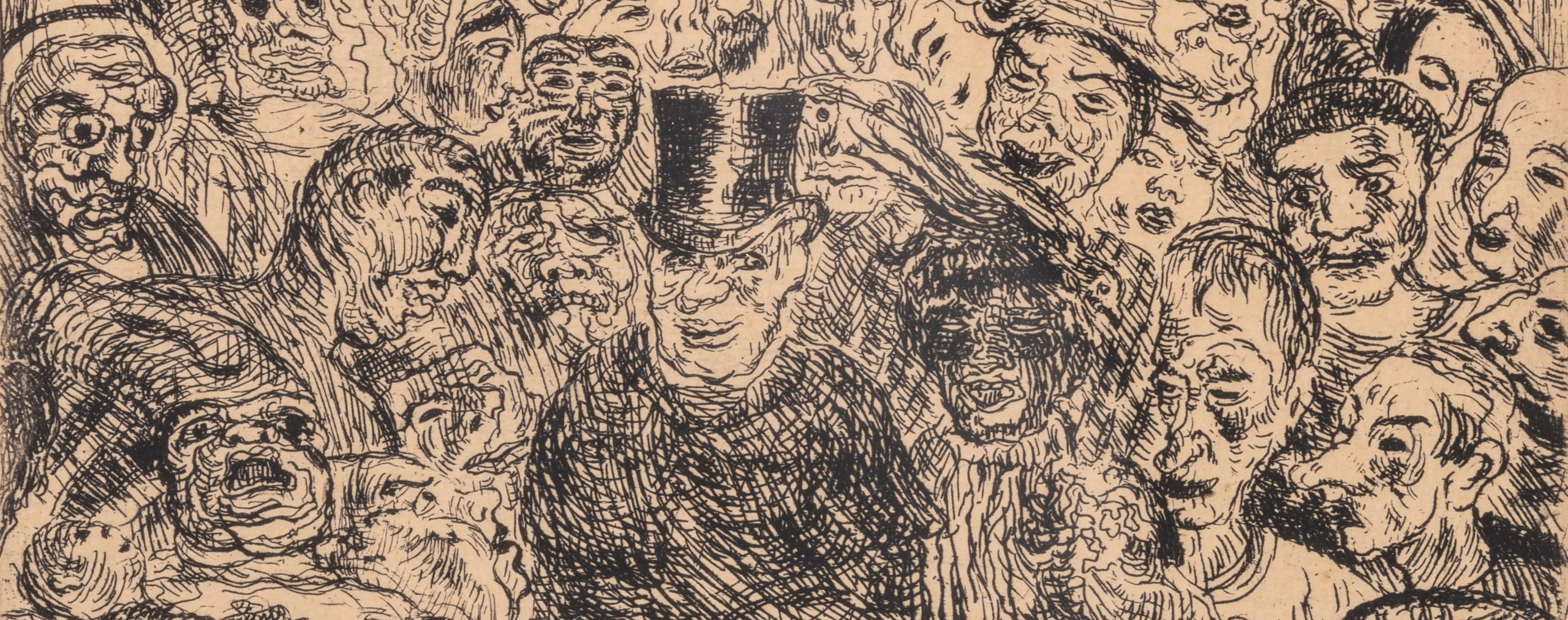
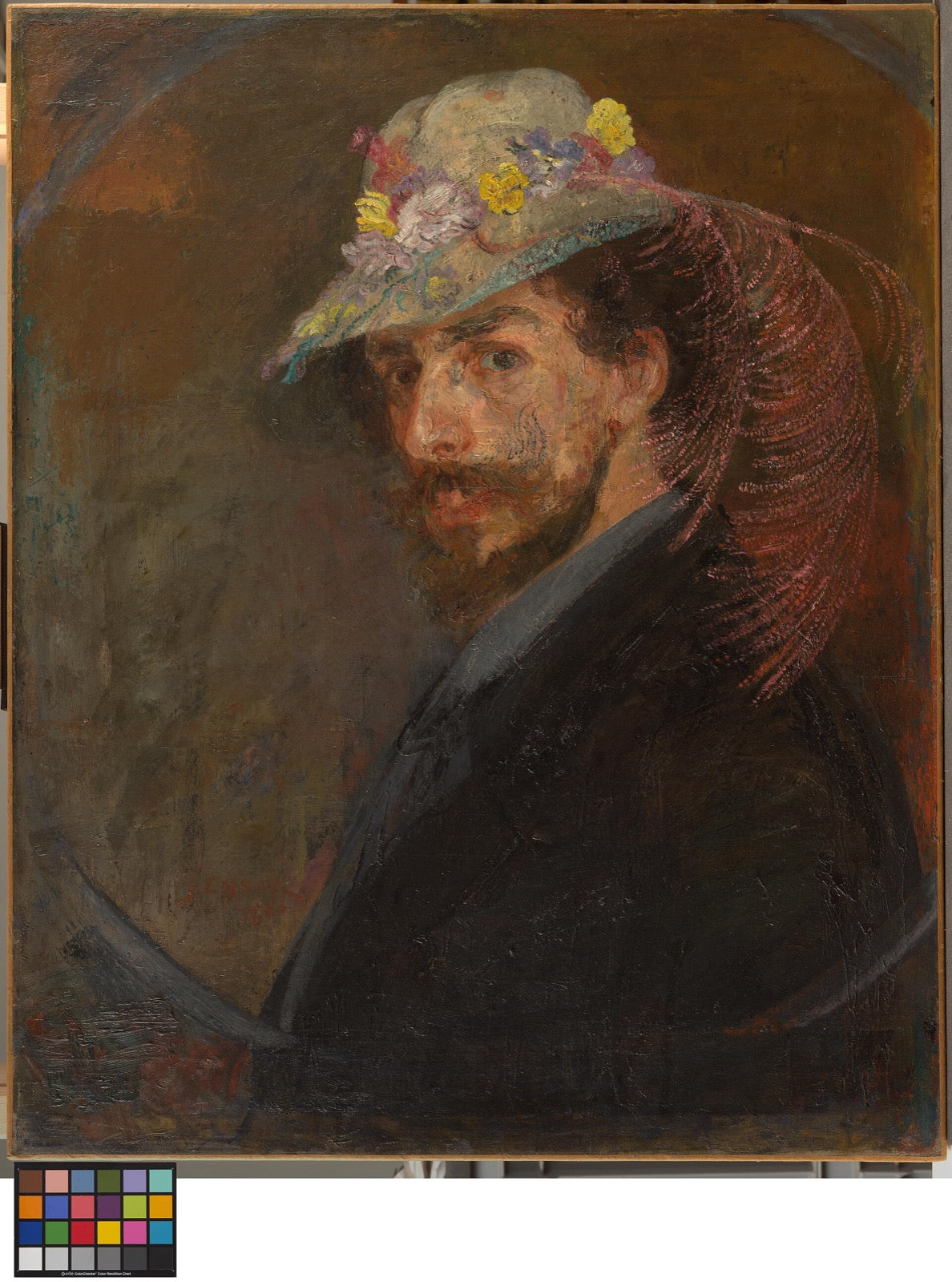
James Ensor’s etchings exist because his paintings were not selling. In 1886, twenty-six years old and working from the seaside town of Ostend, he picked up a needle and a copper plate for the first time, looking for a medium that cost less to make and moved faster off the wall. What came out over the next eighteen years was Belgium’s most disturbing body of prints: skeletons signing their own self-portraits, a king reduced to a joke about excrement, and crowds rendered as masks with nowhere left to hide.
His first plate, Christ Mocked, borrowed its composition directly from Rembrandt’s Christ before Pilate, a debt he had earned during four years of academy study copying Rembrandt, Goya and Turner. The same year he etched The Cathedral, his first attempt at the crowd scenes that would define him, and The Infernal Cortège, which leaned on Hieronymus Bosch for its visual logic. Over half of his eventual output of roughly 130 prints was made in the five years that followed, a concentrated burst running from 1886 to 1891.
The prices these etchings carry now stretch a long way. Two small satirical plates attacking the Belgian monarchy have each carried a Sotheby’s estimate of £30,000 to £50,000, while a hand-coloured proof of one of his skeleton self-portraits made £22,440 at Bonhams. Elsewhere, a signed impression from the same decade has sold for a little over £2,400. The gap has less to do with the image than with what state, edition and colouring a particular sheet happens to be.
Discover all in our:
James Ensor etchings: inside the Belgian master’s macabre visions
A cheaper way to be seen
Ensor was not an outsider experimenting with a minor medium. He treated etching as seriously as painting. His graphic work went on show alongside his canvases and drawings at Les Vingt, the Brussels society that gave Belgium’s avant-garde its platform through the late 1880s and 1890s. Unlike contemporaries such as Félicien Rops, he was not working to illustrate other people’s books; every plate was his own project.
The debts he owed were old ones. Rembrandt supplied the chiaroscuro and, in The Hunter, an entire landscape composition adapted from a plate of 1653. Goya and Japanese woodcuts fed the flattened, graphic quality of his later work, and Pieter Bruegel’s crowded panoramas gave him a template for the masked, faceless mobs that recur through the etchings. What he built from those borrowings now ranks, in the words of the Flemish Art Collection, among “the best and most original objects modern printing art has produced.”
Credit: Mu.ZEE, Ostend
The king made to defecate on his subjects
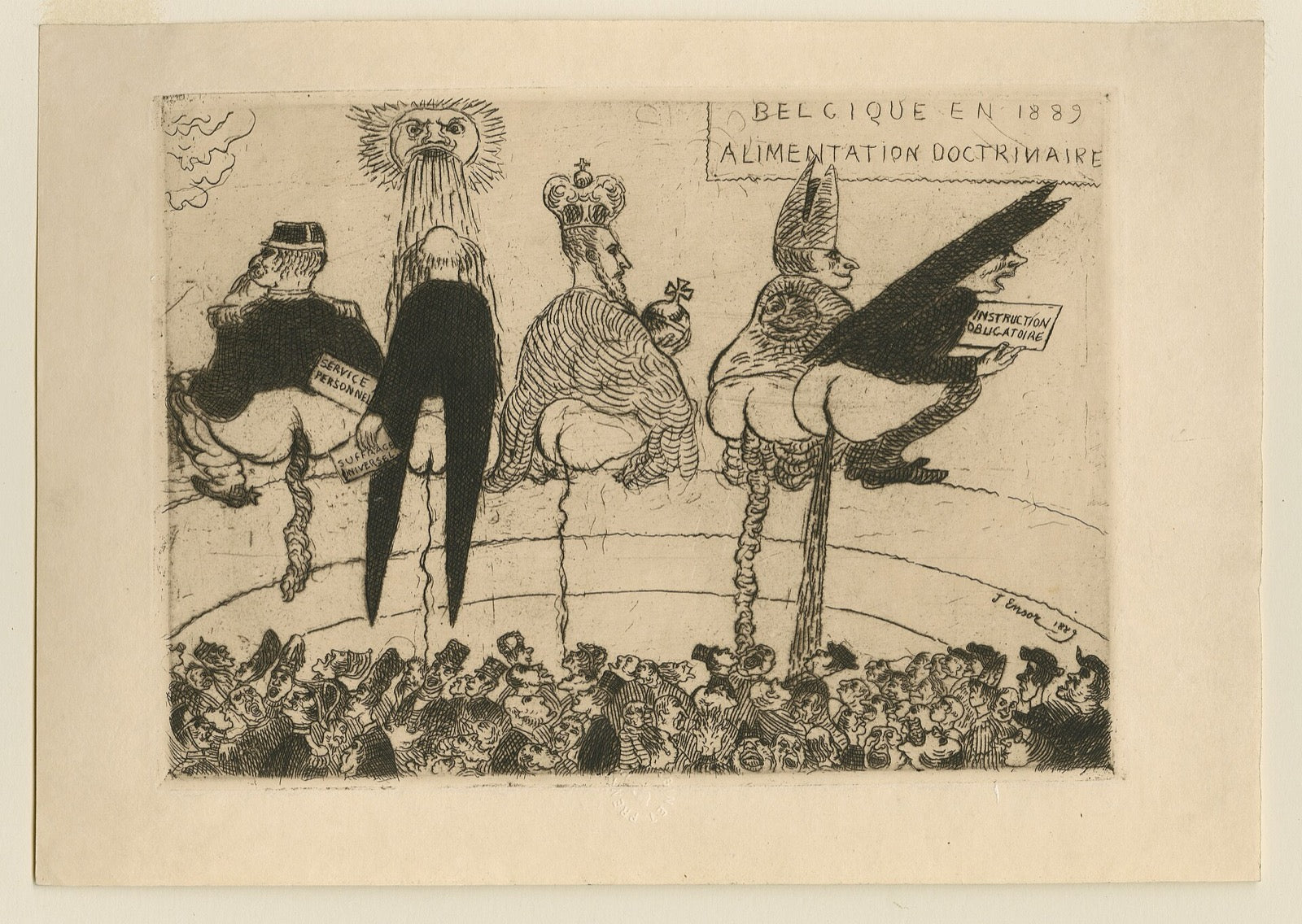
Ensor’s most political prints leave no room for subtlety. Alimentation Doctrinaire, made in 1889, shows Belgium’s ruling classes, headed by a grotesque King Leopold II, perched above a crowd and defecating into its open mouths. Sotheby’s catalogued the print, in its rarest surviving state, as arguably Ensor’s scarcest, citing only a handful of known impressions; a counterproof from that first state carried an estimate of £30,000 to £50,000 when it came up for sale in London in September 2016.
Its companion, La Belgique au XIXe siècle, made the same year, put Leopold above a demonstration being cleared by soldiers, while a protester in the crowd tries to raise a banner demanding universal suffrage, compulsory education and national service. It carried the same £30,000 to £50,000 estimate at the same sale. Both prints stayed largely out of circulation for decades: Ensor withdrew them himself in 1929, the year he was finally made a baron by King Albert I.
Credit: Museum Plantin-Moretus, Antwerp
A skeleton signs the self-portraits
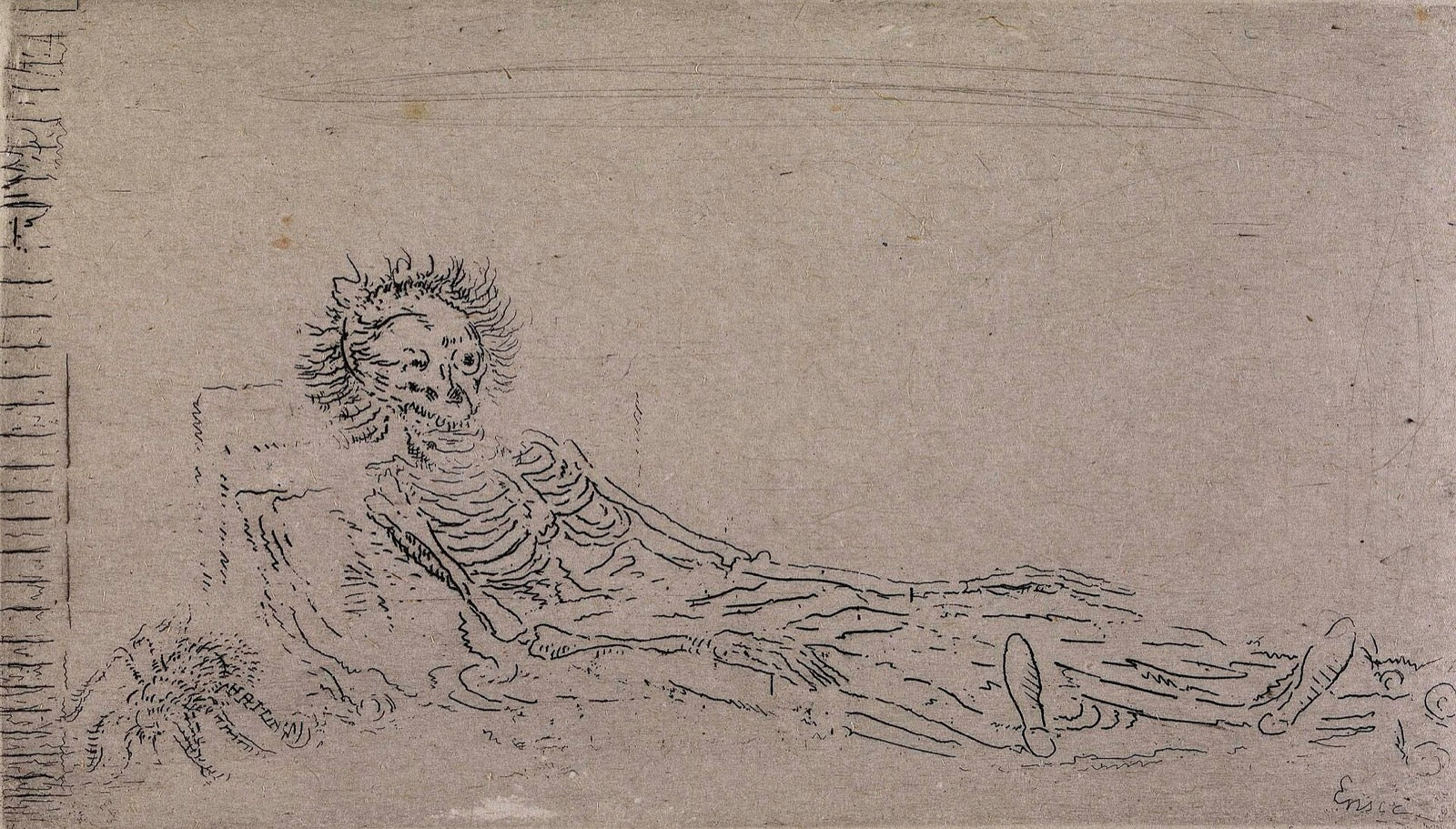
Ensor turned the self-portrait into a joke about his own mortality more than once. Mon portrait en 1960, etched in 1888, shows him as a reclining skeleton still wearing his shoes, a spider crawling beside him, imagining what he might look like at the age of a hundred. It is a small plate, barely the size of a postcard, and examples now sit in university museum collections in Iowa and Kansas.
A rarer variant of the same idea, Mon portrait squelettisé, went further: an etching and drypoint that was then coloured by hand in watercolour. Bonhams catalogued the surviving example as an unrecorded proof, extremely rare, and traced its ownership through the Paris dealer Artemis Fine Art. It had also been shown at London’s Wellcome Collection, in an exhibition on death in self-portraiture. It sold in New York in May 2023 for US$28,050, around £22,440 at the exchange rate then.
Credit: Museum of Fine Arts, Ghent
Le Pisseur: one plate, no fixed price
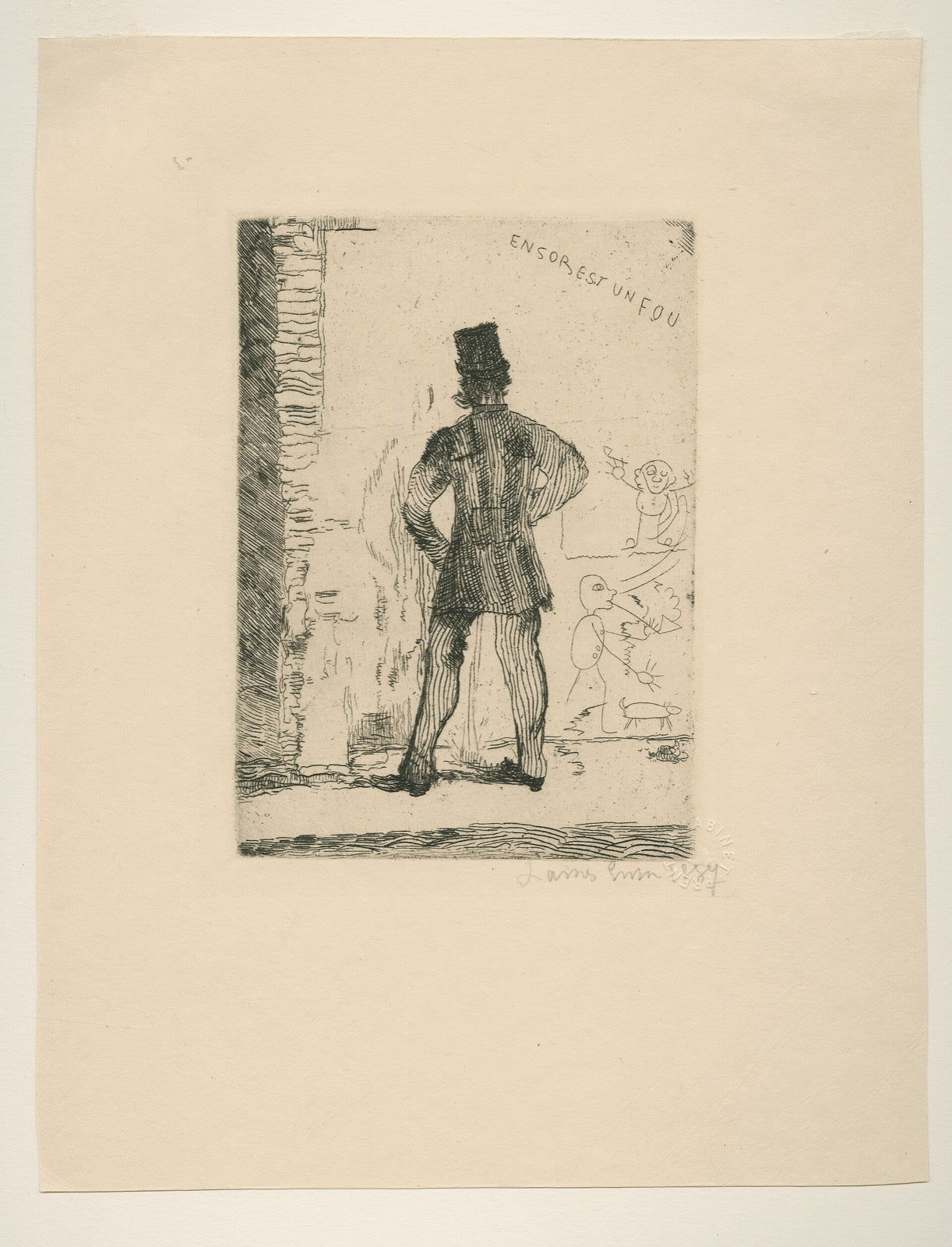
Not every plate is a horror. Le Pisseur, etched in 1887, is a parody of a drawing by the seventeenth-century printmaker Jacques Callot, held at the Uffizi in Florence, and shows nothing worse than a man relieving himself against a wall. It exists in only one state, which ought to make pricing straightforward. It has not.
Sotheby’s estimated an impression at $10,000 to $12,000, roughly £8,000 to £9,600, when it came up in its October 2020 day sale. Four years later, in June 2024, Bonhams sold a different impression of the same plate for £7,040 including premium. Ink strength, paper tone and how crisply the plate mark still bites into the sheet move the price as much as the joke does.
Credit: Museum Plantin-Moretus, Antwerp
Two prints under £3,000
Below the six-figure political prints and the rare hand-coloured proofs sits a market most collectors can enter without much difficulty. Prise d’une Ville Étrange, a fourth and final state impression from 1888, made £2,422.50 at Bonhams in December 2020. L’Ange Exterminator, an etching and drypoint from 1889 pairing the apocalypse’s destroying angel with a Flemish proverb about fear, made £2,750 at Bonhams in July 2012.
Both are genuine, signed, catalogued impressions of a working printmaker’s plates, not reproductions. The gap between those prices and the £30,000-plus estimates on the Leopold II prints is a matter of rarity and subject rather than authenticity: a common signed etching and an unrecorded political counterproof are both, equally, James Ensor.
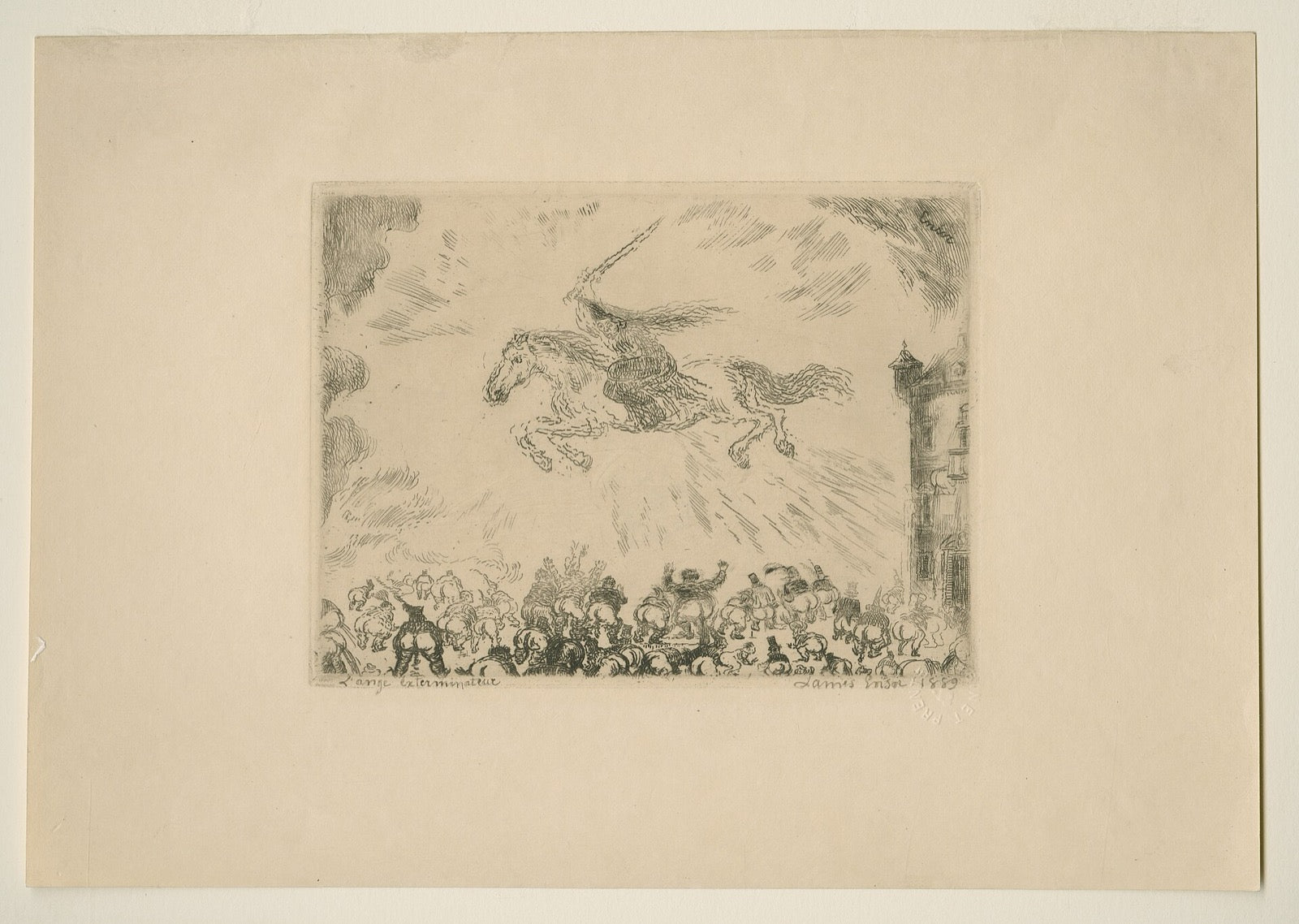
Credit: Museum Plantin-Moretus, Antwerp
The baron who buried his own satire
Ensor spent the late 1880s making some of the most openly hostile political prints Belgium’s monarchy has ever inspired. He did this while European museums were already taking him seriously, years before the domestic controversy around plates like Alimentation Doctrinaire had settled: the Royal Library in Brussels bought a batch of his etchings in 1893, Dresden’s print room followed in 1894, and Vienna’s Albertina in 1899.
By 1929, that same provocateur wanted the title of baron badly enough to seek Belgian naturalisation to get it, and he pulled his own most pointed satires from circulation once King Albert I granted it. The prints that survive from that withdrawal are rarer for exactly that reason, and the market now prices Ensor’s self-censorship as carefully as it prices his subject matter.