



Rare German stamps collect a country that did not exist as a single nation for the first three decades of stamp collecting. Before unification in 1871, more than twenty kingdoms, duchies and free cities issued their own stamps, each through its own printer and paper stock, and that fragmentation gives German philately its deepest rarities.
Some of the issues collectors chase hardest were never meant to survive in the form they did. A colour mix-up at the printer, a naval officer short of the right denomination, a design withdrawn before a single sheet reached the post: each left behind a small population of stamps that a catalogue number alone cannot explain.
Interest in this material has held up well as German and Swiss specialist auctions keep bringing old-states and Reich collections in front of a wider audience, and demand often follows a stamp’s story as much as its printed value. Here is what makes the issues below the ones German philately keeps coming back to.
Discover all in our:
Rare German stamps: the issues collectors want most
Credit: Johann Peter Haseney, public domain via Wikimedia Commons
Before there was a Germany: the old states’ classics
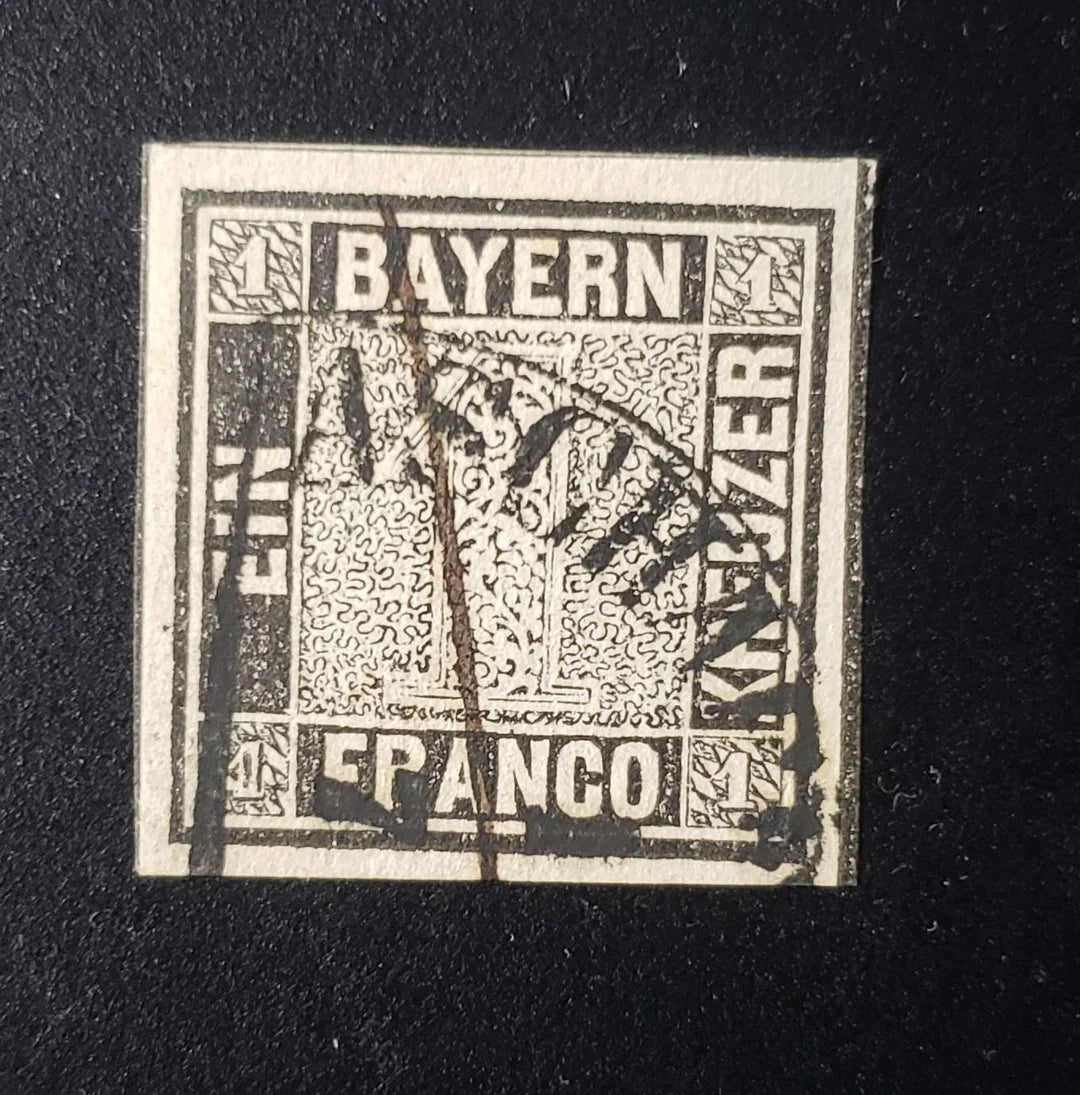
Bavaria issued the first stamp used anywhere in what became Germany on 1 November 1849: a one-kreuzer black printed at Munich’s LMU press. Its designer, Johann Peter Haseney, hid his own initials inside the floral border as a defence against forgery, and around 832,500 copies were printed on handmade paper before the design was withdrawn in October 1851.
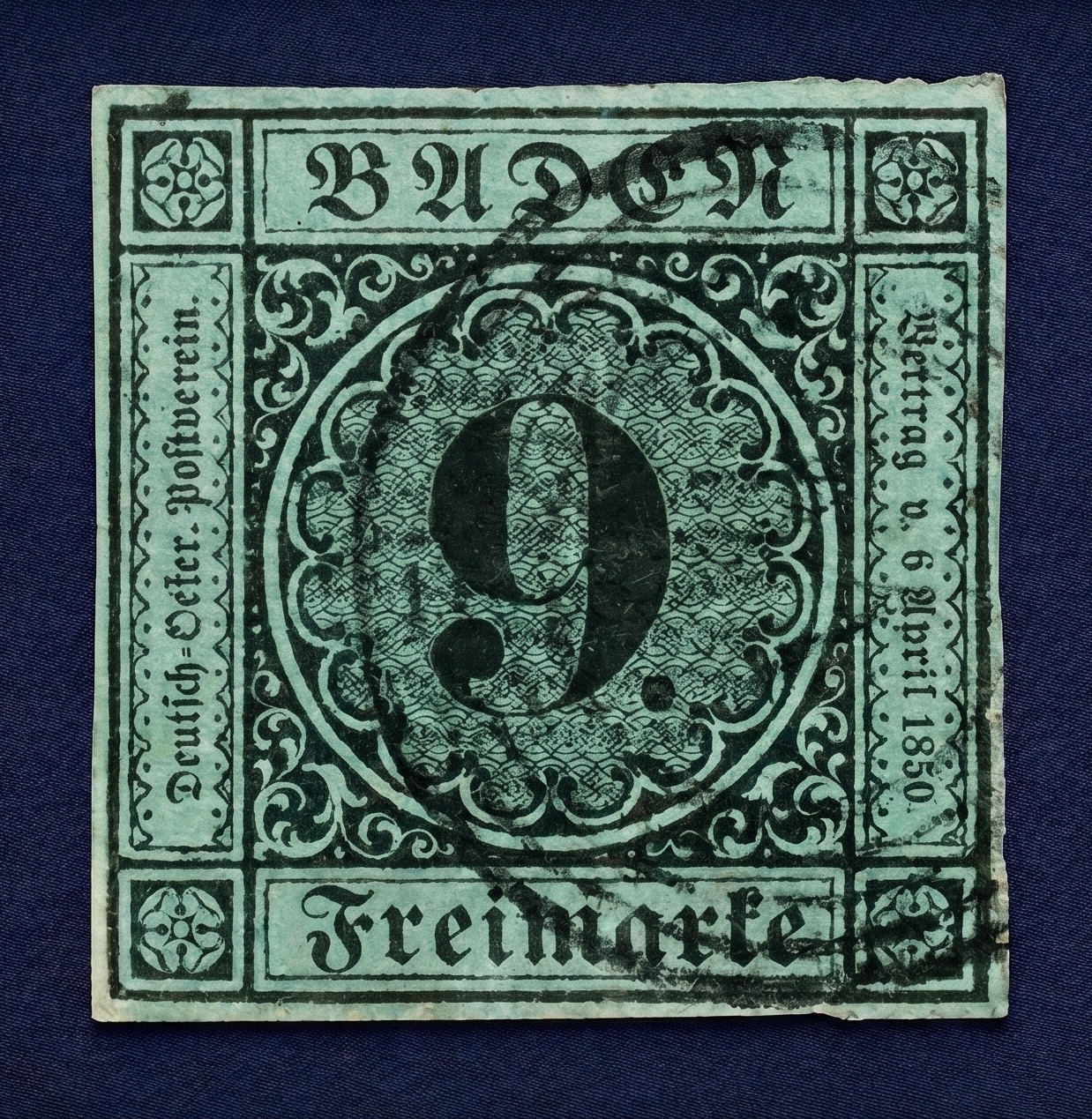
Saxony followed in 1850 with its own three-pfennig red, printed across eight runs totalling 500,000 stamps. Only 463,118 were sold; the Saxon post office burned the rest, and no more than three or four thousand examples of the “Sachsendreier” are thought to survive today. Baden’s contribution is a printing accident: in 1851, a batch of nine-kreuzer stamps was struck in the green ink meant for the six-kreuzer value, on mismatched paper. Nobody noticed for 44 years. Three used copies and one unused example are recorded, one of which now sits in Berlin’s Museum of Post and Communication.
Credit: Post of Baden, public domain via Wikimedia Commons
Improvised issues: a warship and a colonial surcharge
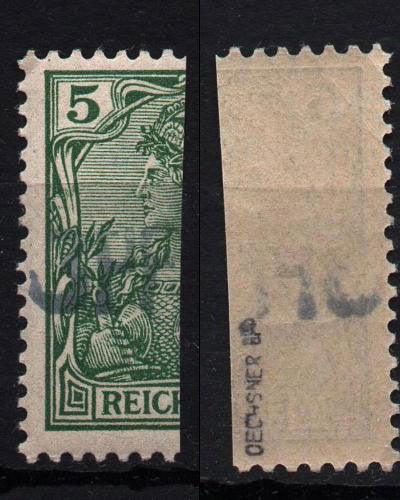
Not every rarity began on a printing press. On 13 April 1901, the postal officer aboard the cruiser SMS Vineta ran out of three-pfennig Germania stamps for outgoing mail. His solution was to cut five-pfennig stamps in half and hand-stamp each piece “3 PF”. Only around 600 of these Vineta provisionals were made, and mail bearing them reached Germany from Pernambuco within days. The Michel catalogue briefly listed the stamp as an official issue, numbered 67, before philatelists objected that a self-made bisect was not one, and the number was withdrawn. Forgeries followed soon after, and collectors now have to rule those out before anything else.
Germany’s colonial post offices produced their own oddities by hand-surcharging stamps for local currency. A New Guinea stamp with its new one-penny value struck 5mm out of alignment, catalogued as a German New Guinea error surcharge, sold for £6,240 at Spink London as part of the “Lionheart” Collection of Great Britain and British Empire.
Credit: Paul Waldraff, public domain via Wikimedia Commons
Empire, inflation, and an airship overhead
The Germania design that anchored German definitives from 1900 to 1922 is the longest-running series in the country’s philately. Its plain, unnamed female figure was chosen because it favoured none of the royal houses still reigning within the Empire. The colonies used their own “Yacht” design instead, while Germania itself was overprinted for German post offices in China, Morocco and Turkey before the First World War, and later for occupied territories, giving collectors an entire sub-genre of overprints to work through.
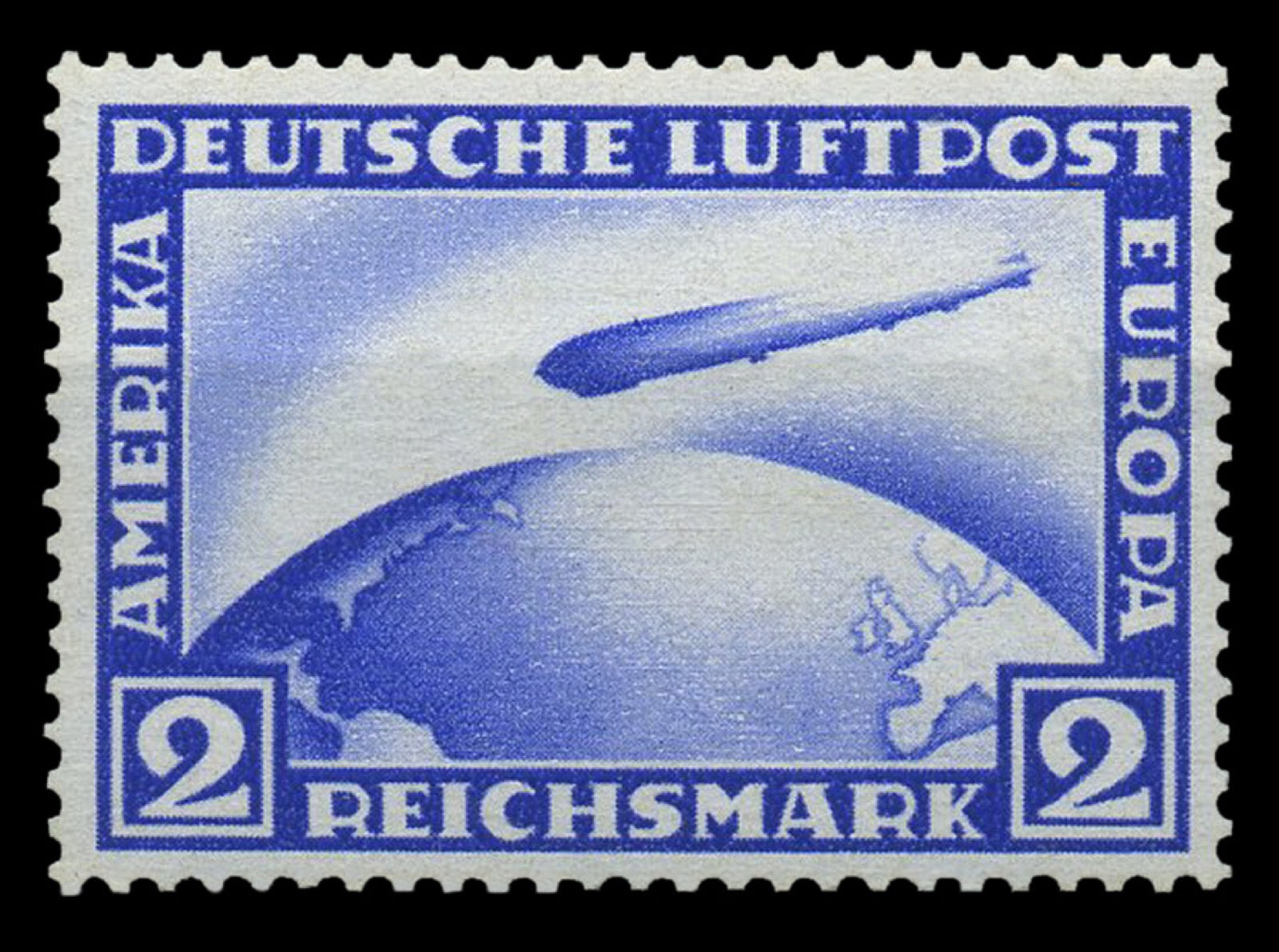
The 1923 hyperinflation years pushed the Reichspost to issue stamps valued at up to 50 billion marks, printed faster than the currency could be spent. Germany’s first Zeppelin airmail stamps followed in 1928, and further issues helped fund the airship’s 1931 polar expedition, carrying German philately into a field shared with aviation history as much as postal history.
Credit: Reichspost of the German Empire, public domain via Wikimedia Commons
A divided nation’s stray issue: the Yellow Cathedral
When the western occupation zones launched a “building series” of definitives on 1 September 1948, the five-pfennig design showing Cologne Cathedral was meant to appear in blue, and the issued version, Michel number 75, duly did. A batch printed in yellow reached proof stage instead, and almost every copy was destroyed before the correct stamp went on sale. Only 103 examples of the “Gelber Dom”, or Yellow Cathedral, are known: one sheet of 100 and three single stamps.
The surviving sheet, held by the Philatelic Archive in Bonn, carries an insurance valuation of one million euros and has been shown publicly only once, at a Cologne stamp and coin fair in September 2007. So few people have handled a genuine example that the Yellow Cathedral tests a collection’s documentation as much as its stamps.
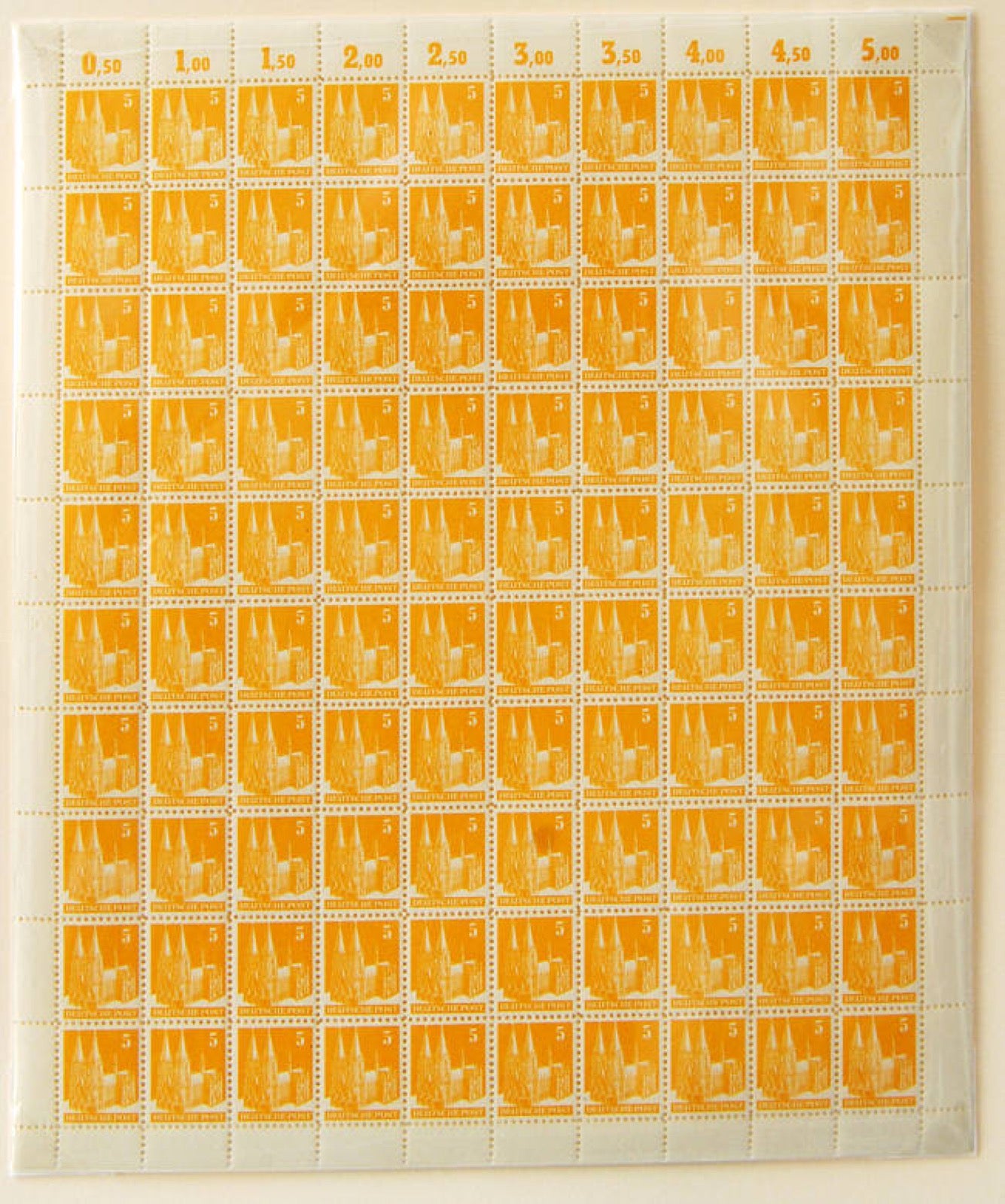
Credit: Deutsche Post
Why a certificate matters more than a catalogue number
Michel and Stanley Gibbons catalogue prices are a pricing convention, not a record of what a stamp has sold for, and the gap between the two widens sharply at the top of the old-states market. Condition language is not interchangeable either: centring, perforation count, gum condition and cancellation type each move a price, and a lot described as “fine used” is a different object from one described as “superb unmounted mint”.
For anything approaching the rarities above, a certificate from a body such as the Royal Philatelic Society London or the Philatelic Foundation separates a genuine rarity from a forgery. The Philatelic Foundation alone holds a database of more than 622,000 certificates and recommends resubmitting anything over 25 years old, since detection methods keep improving. Reprints, proofs and essays are worth ruling out too: many are sold openly as such, at a fraction of the issued stamp’s price.
What Germany’s fractured postal history left behind
None of the issues above became rare because a post office planned it that way. A print run was miscoloured, a design was pulled overnight, a naval officer ran out of the right stamp and improvised with a knife and a hand stamp. What collectors are really chasing is the moment each of these left behind: a specific, dateable point where a stamp stopped being routine mail and became evidence of how one of the many postal administrations inside Germany actually worked.
That is also why the field keeps expanding rather than settling. Old-states errors, colonial surcharges, inflation issues and the survivors of divided postwar Germany sit under one heading, but each answers to a different story, and each still turns up new certificates and, occasionally, a stamp nobody had recorded before.