



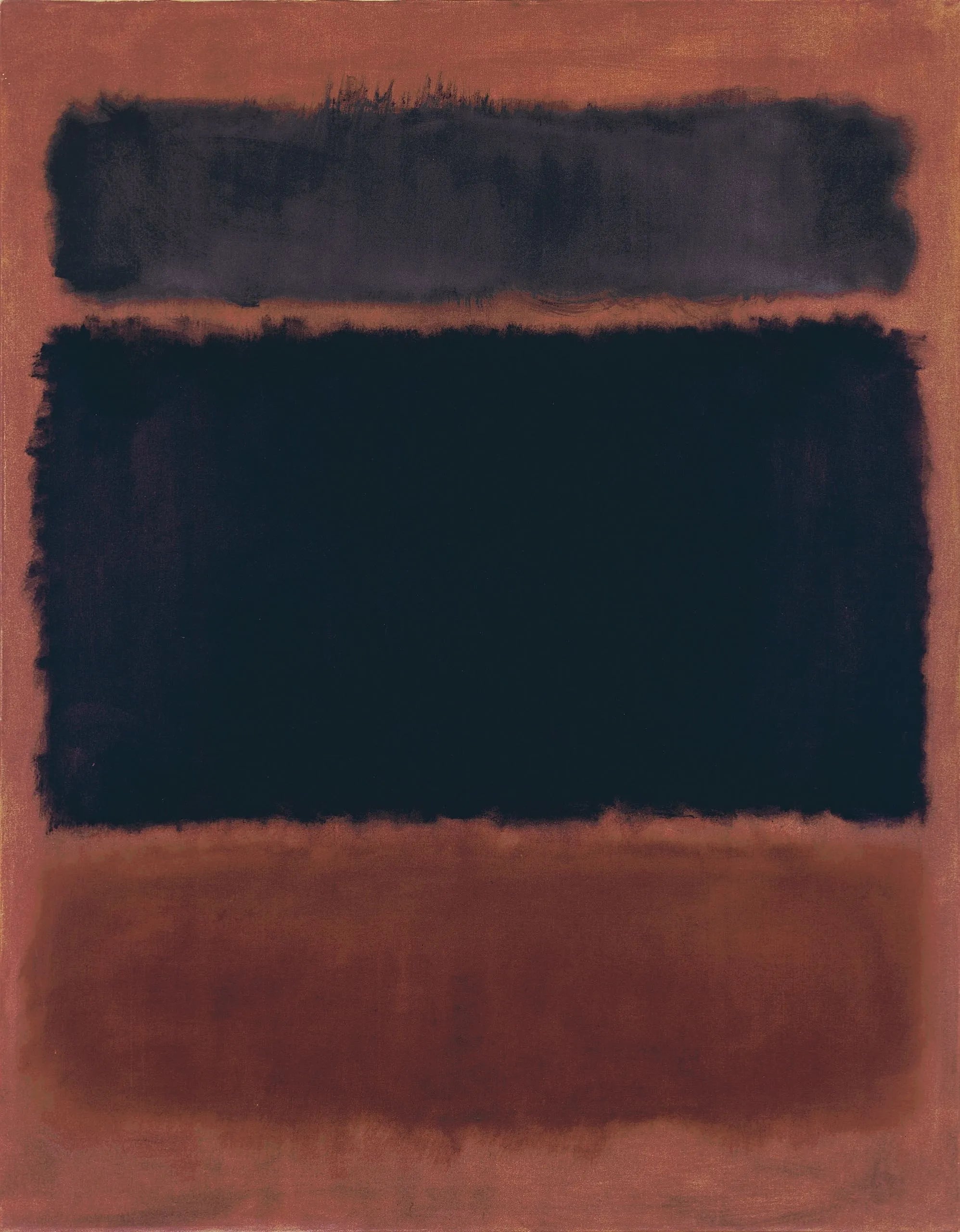
Mark Rothko’s colour field paintings look, at first glance, like the simplest works in modern art: two or three soft-edged rectangles of colour floating on a stained ground. Yet in November 2012 one of them, “No. 1 (Royal Red and Blue)”, made $75.1 million (about £46.9 million) at Sotheby’s in New York, and several more Rothko canvases have sold for eight-figure sums since. The gap between what the canvas shows and what collectors pay for it is worth examining properly.
Rothko did not paint this way from the start. He trained at the Art Students League in New York, and his work through the 1930s and 1940s was figurative, then Surrealist, closer to myth and symbol than to glowing rectangles. A Bonhams sale in November 2022 of “In Limbo”, an oil from 1941 to 1942 showing two distorted figures, one propped against fragments of a Doric column, made $164,175 (around £139,000). That is a fraction of what his mature canvases now attract.
The technique concealed under that apparent simplicity, the way Rothko insisted his paintings be encountered, and the auction record itself all repay a closer look once the verified prices are lined up against each other.
Discover all in our:
Mark Rothko’s colour fields: the secret behind their million-dollar valuations
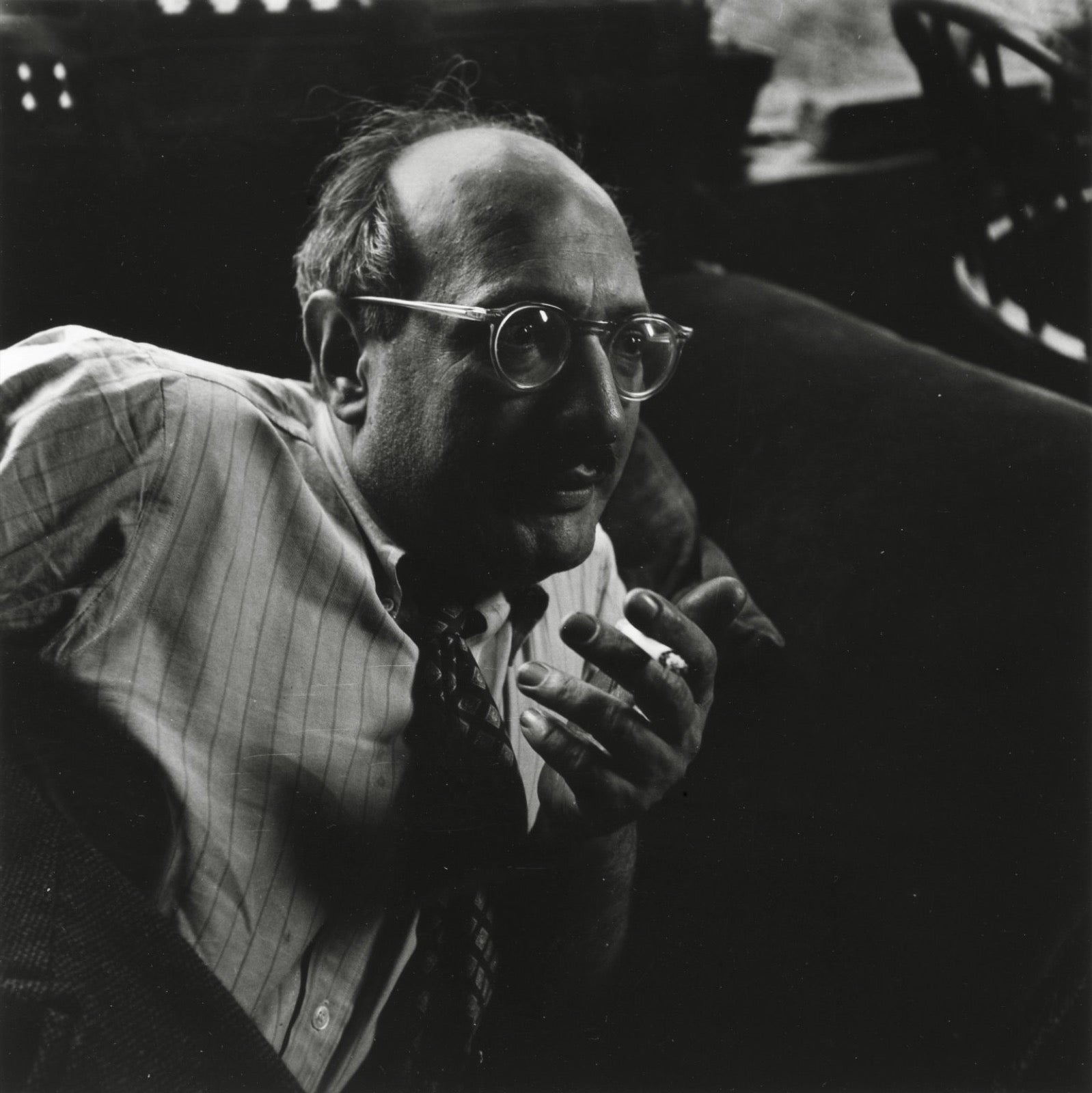
Credit: Consuelo Kanaga, Brooklyn Museum (no known copyright restrictions)
From figurative painter to the rectangles
Rothko was born in 1903 in what is now Latvia and emigrated to the United States that same year, settling with his family in Portland, Oregon. He won a scholarship to Yale, left without taking a degree, and moved to New York, where the Art Students League gave him his only formal art training. His first show was a group exhibition at the Opportunity Gallery in 1928, alongside Milton Avery, and through the Depression he worked for the Works Progress Administration.
None of that pointed towards the paintings he became known for. Through the 1940s Rothko worked through Surrealism and mythological subject matter, and it was only in the 1950s that the rectangles appeared, hovering in stacks over a luminous ground. Tate, which defines colour field painting as work “characterised by large areas of a more or less flat single colour”, traces the term back to about 1950 and to three painters working in New York at the same time: Rothko, Barnett Newman and Clyfford Still.
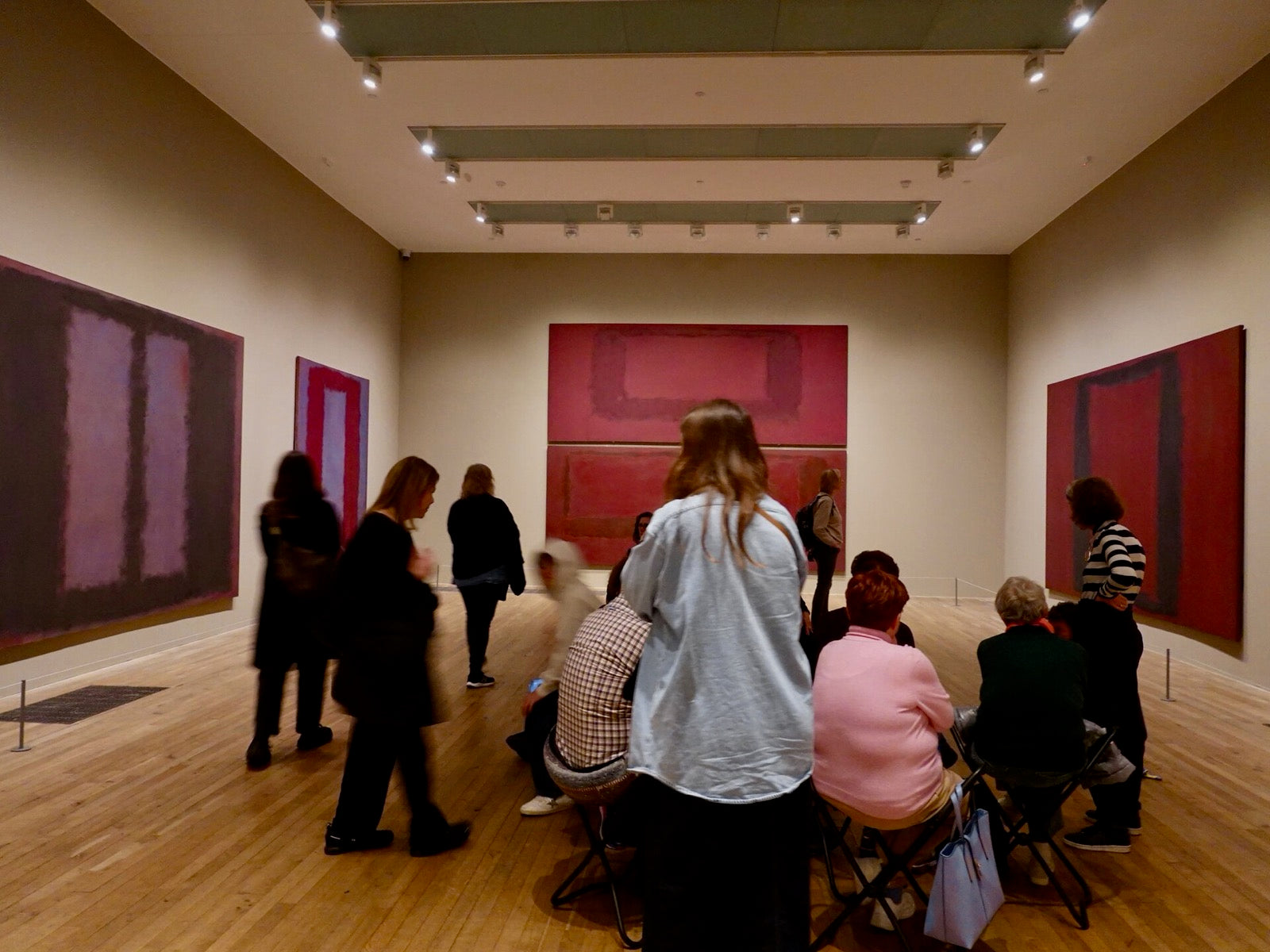
Credit: Bonhams
The technique hidden inside the simplicity
Rothko was notoriously secretive about his methods, hiding them even from his own studio assistants. Conservators who later examined his canvases under ultraviolet light found he mixed egg, glue, formaldehyde and acrylic resins into his pigments, applied as thin, translucent layers rather than solid blocks of colour. Phillips’ own catalogue note for “Untitled (Red, Blue, Orange)”, a 1955 canvas sold at its New York evening sale in May 2014, describes the effect as “building color through multiple thin layers of pigment to create luminosity that appears to emanate from within the canvas itself”.
That layering is why photographs flatten the effect. A reproduction turns the soft-edged rectangles into blocks of flat tone, while in front of the actual canvas the edges seem to move and the colour appears to hover slightly off the surface, shifting with the light in the room.
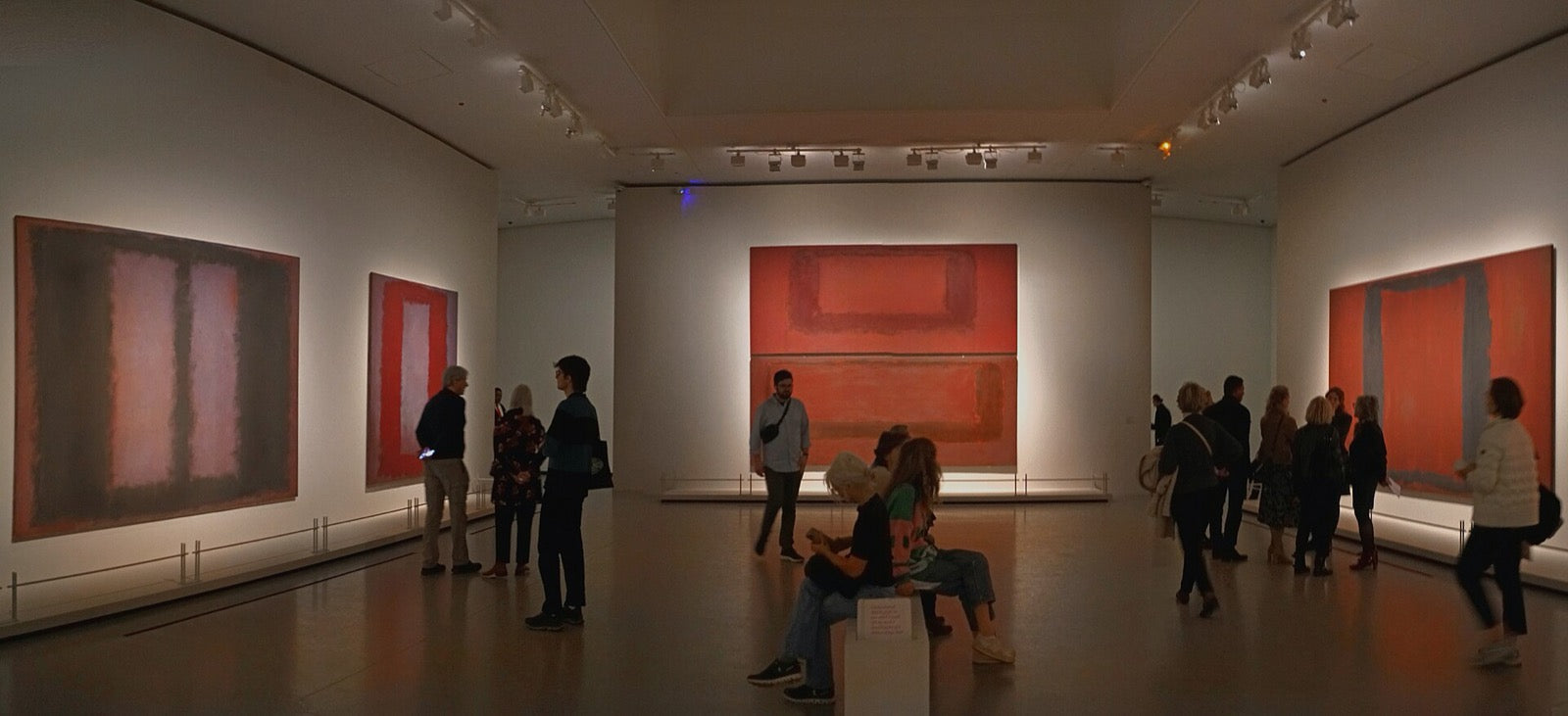
Credit: Robert-brook, public domain via Wikimedia Commons
Paintings built to be stood inside, not looked at
Rothko gave unusually precise instructions for how his mature paintings should be encountered. He wanted viewers to stand 18 inches from the canvas, close enough, in his words, to find “the intimacy, immediacy, authority of the individual, and a sense of the unknown”. He asked that the paintings be hung low, so that they met the viewer’s body rather than sitting above eye level, and that only one or two people occupy the room at a time.
The aim was immersion, not decoration: a picture large enough, and viewed close enough, to fill the edges of a person’s vision rather than hang on a wall like an object assessed from across a room. Collectors buying a mature Rothko are, in effect, buying that engineered encounter as much as the paint itself.
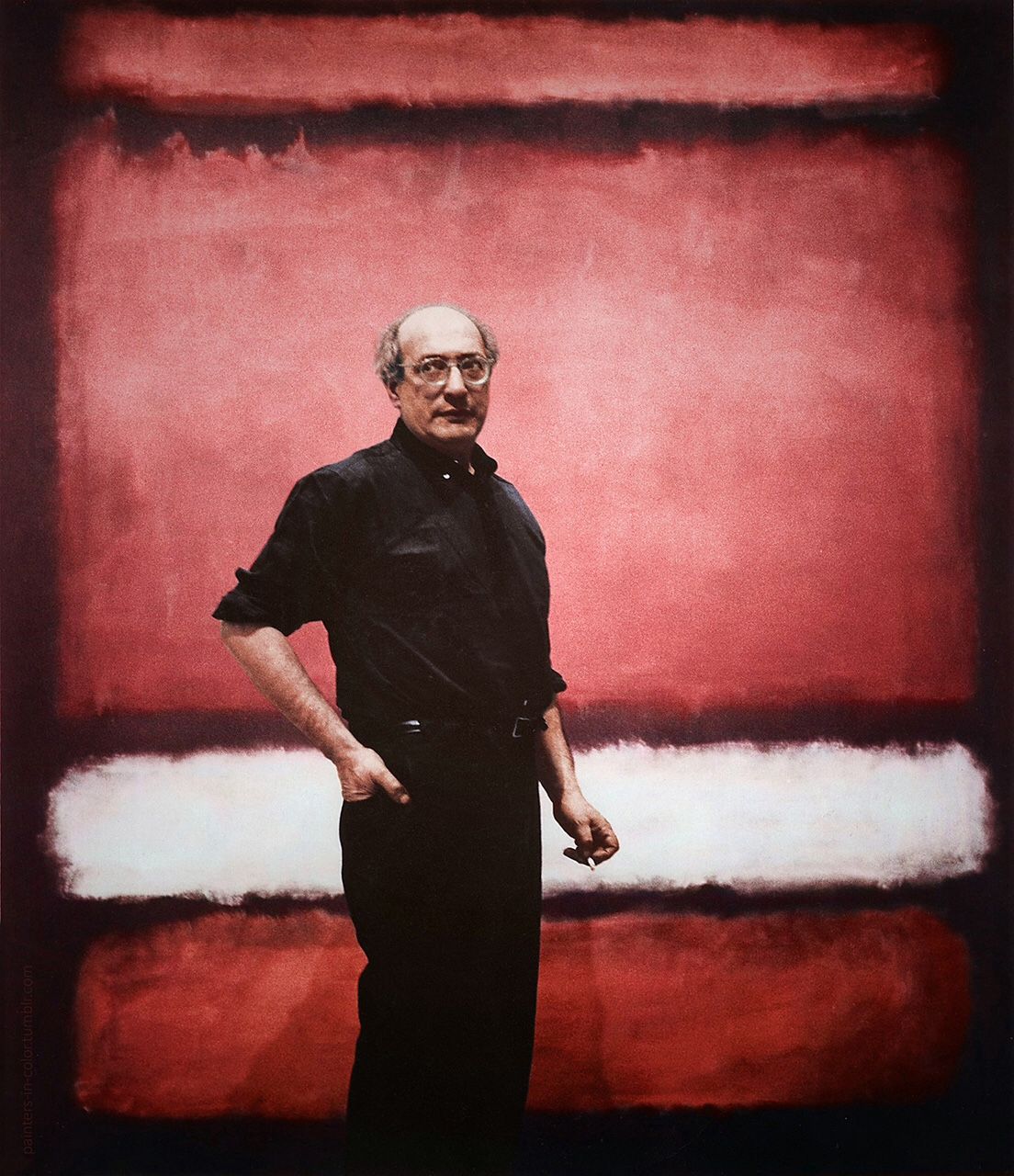
Credit: artshortlist.com
The Seagram murals and the chapel that followed
In 1958 Rothko accepted a commission to paint murals for the Four Seasons restaurant in New York’s Seagram Building. As the series progressed his palette darkened towards maroon, dark red and black, work Tate has since described as “seemingly simple, but actually quite complex” in its compositional scheme. According to Tate, “As his ambitions for the works grew, he no longer saw the restaurant as an appropriate location for his paintings.” He cancelled the contract in 1960 and later gave a group of the murals to Tate in 1969, a gift Tate attributes largely to his admiration for JMW Turner.
Rothko died in 1970, the same year a similar ambition was still being realised elsewhere. In 1964 the Houston collectors John and Dominique de Menil commissioned him to paint a chapel of their own, inspired by the idea that a master given a free hand in a religious building could “exalt and uplift as no one else”. He spent more than two years on it, completing 14 canvases in 1967, seven of black rectangles on maroon grounds and seven in purple tones, and did not live to see the chapel open in 1971.
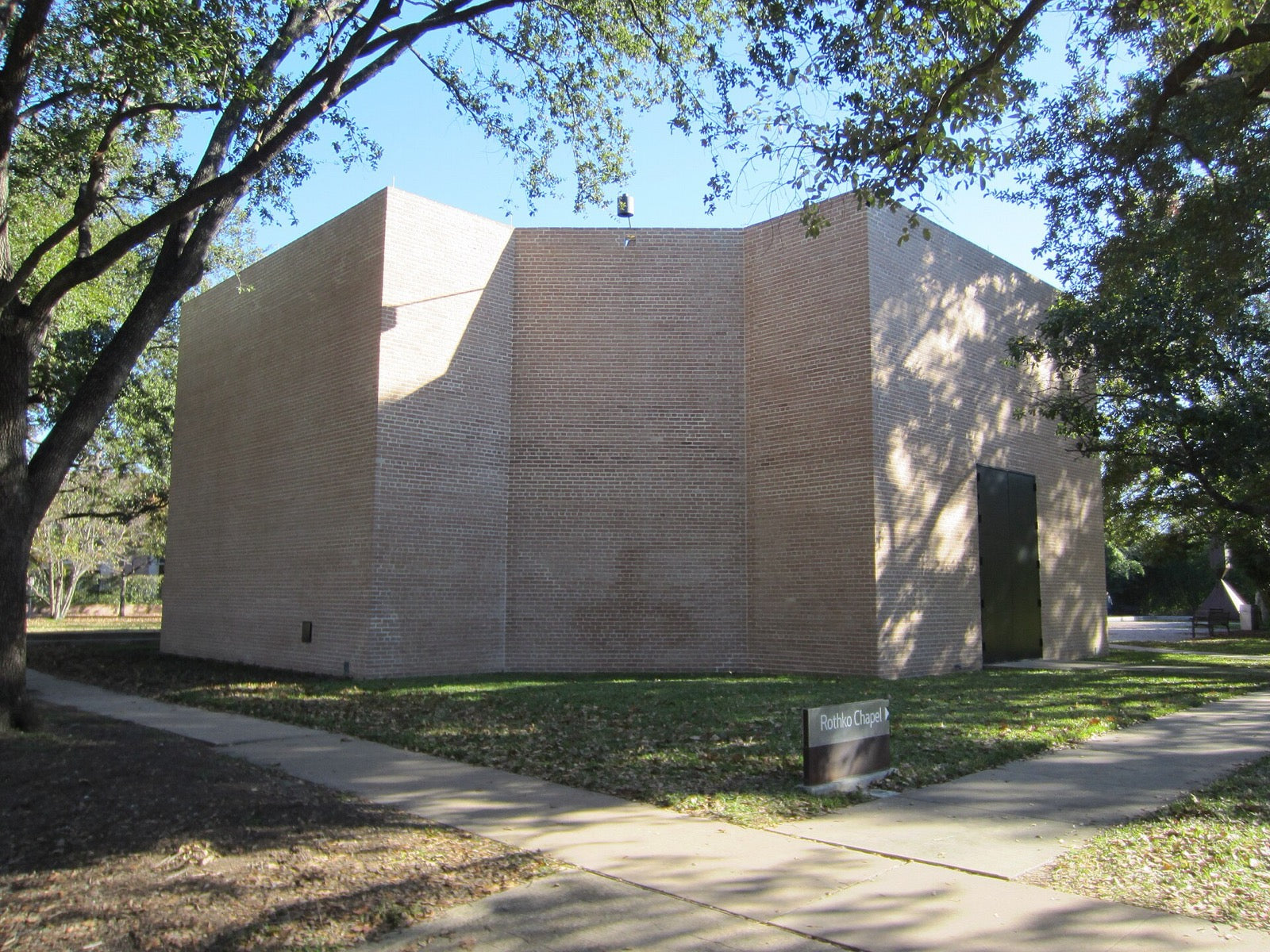
Credit: Another Believer via Wikimedia Commons (CC BY-SA 3.0)
What the saleroom record actually shows
Line up the verified sales and the pattern holds. Bonhams took $164,175 (around £139,000) for the early “In Limbo”. Every mature canvas from the 1950s and 1960s verified for this guide did far better: Sotheby’s took $75.1 million (about £46.9 million) for “No. 1 (Royal Red and Blue)” in 2012 and $18.9 million (about £14 million) for a 1969 work in 2018; Phillips took $56,165,000 (about £33.4 million) for “Untitled (Red, Blue, Orange)” in 2014; and Sotheby’s took $20.4 million (about £13.4 million) for “Untitled (Lavender and Green)” in 2015.
Sotheby’s own market data backs this up over time: Rothkos resold at auction between 2003 and 2017 produced an average compound annual return of 16.8 per cent, and all 31 such resales sold for more than their previous price. Most mature, colour field-period canvases are already in museums or long-term private collections, so each one that reaches a saleroom is competed for by buyers who may not see another for years.
What the price is actually paying for
None of this makes a Rothko easy to value. The flat rectangles that look, from a distance, like the simplest thing in the world to copy are the product of a technique Rothko refused to explain, sized and hung to instructions he insisted on, and mostly held today in museums or a handful of collections that rarely sell. The $75.1 million paid for “No. 1 (Royal Red and Blue)” is a price for that specific, non-repeatable combination, not a general licence to charge millions for a few blocks of colour.
It is also why the range is so wide. “In Limbo”, an early Surrealist canvas, still carries Rothko’s name and still made $164,175 at Bonhams, well above what most twentieth-century paintings fetch. But it is not the work he spent the 1950s and 1960s refining, and the saleroom draws that line clearly every time a mature canvas comes up for sale.