



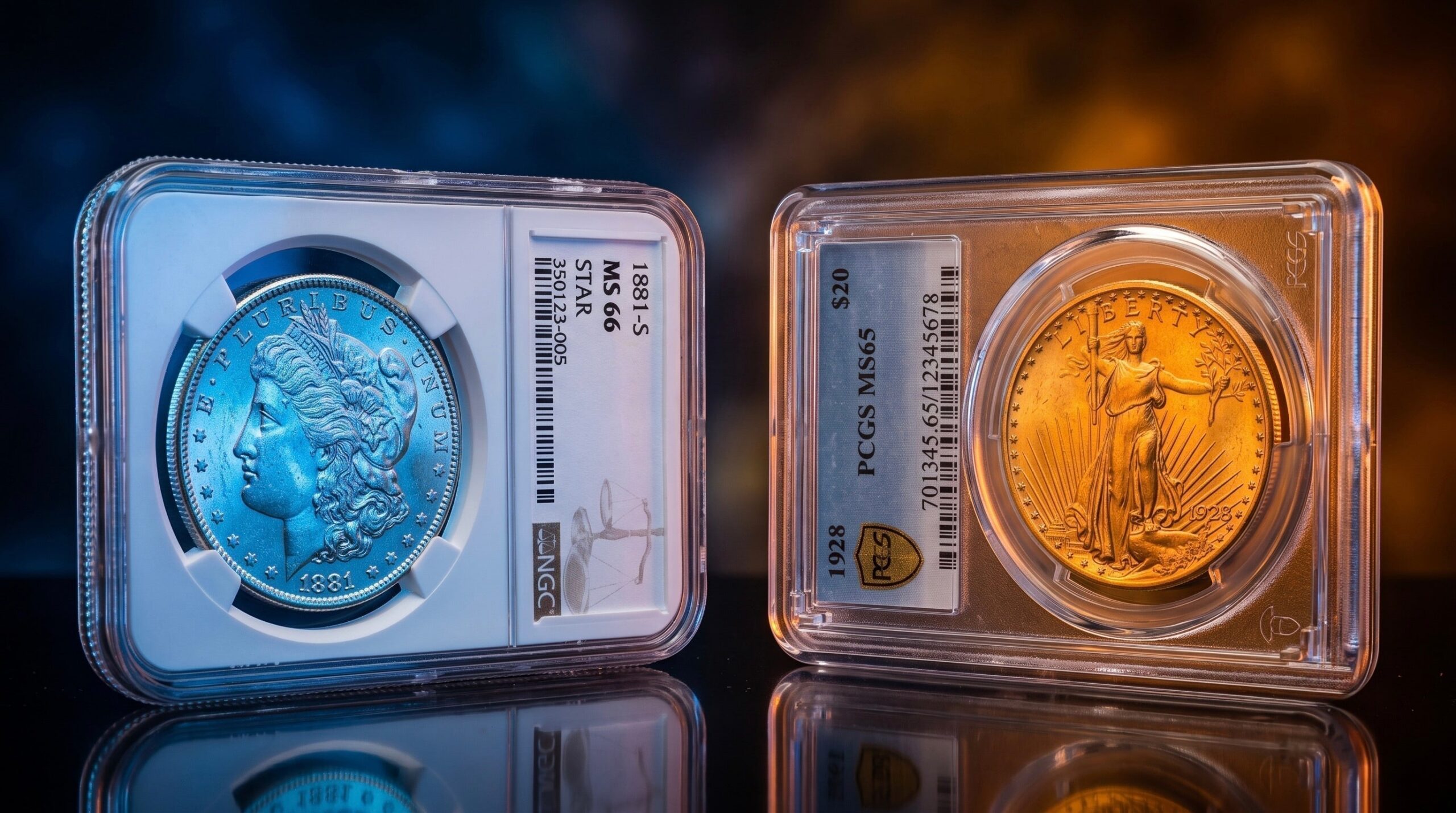
Coin collectors weighing up NGC vs PCGS are comparing the two dominant names in third-party coin grading. Before these companies emerged, judging a coin’s condition was entirely subjective and often caused disputes. Today, third-party grading services use independent experts to assess and guarantee both condition and authenticity, giving buyers confidence in what they are paying for.
PCGS and NGC are now the leading names in coin certification, with each having graded millions of coins. Both use the 1-70 scale and seal coins in tamper-proof holders, a shared approach the market has come to rely on. Most guides stop there and describe the choice as purely down to personal preference, which understates the case. Genuine differences exist between the two services, and once they are understood, one is usually the smarter pick for a specific coin.
In practice, graded coins sell for higher prices than ungraded ones. The market accepts both services, but auction data, population reports and years of collector debate point to a clear “home turf” for each, and knowing which is which can genuinely change what a coin fetches at sale.
The scorecard. Both services are scored out of 70 across the five factors that matter most to collectors. Nobody gets a perfect 70; the table below shows how close each one comes.
| Category (out of 70) | PCGS | NGC |
|---|---|---|
| Grading strictness at the top of the scale | 68 | 64 |
| Resale value on classic US coins | 68 | 60 |
| World, modern & ancient coin expertise | 58 | 67 |
| Holder design, security & population data | 65 | 65 |
| Membership cost, fees & turnaround | 58 | 66 |
| Overall grade | 63.4 → PCGS-63 | 64.4 → NGC-64 |
Best for, in a nutshell:
PCGS: classic pre-1933 US coinage, key dates, Registry Set building, and any coin where a 5 to 15 per cent auction premium matters more than the grading fee.
NGC: world coins, modern issues, ancient and speciality submissions, and collectors who want strong, consistent grading without paying the PCGS premium.
It’s a narrow margin overall. For most mid-range collections, either service serves collectors well. But narrow doesn’t mean identical, and the sections below explain exactly where each point on the scorecard came from, so collectors can weigh up which factors matter most for their own collection.
NGC vs PCGS coin grading: which is better?
Origins and history
The 1-70 grading scale that both NGC and PCGS use today traces its origins to Dr William Herbert Sheldon. In 1949, Sheldon created the scale for Early American Large Cents in his book Early American Cents, 1793-1814, choosing 70 as the top grade because he believed a perfect coin would be worth about 70 times a worn basal state coin. The American Numismatic Association adapted this scale for all US coins in the 1970s, and that version is still the basis for grading today.
The Numismatic Certification Institute launched in 1984 as one of the first private grading services, but went out of business after an FTC investigation found it was inflating grades. According to Forbes, the FTC required Heritage to include disclaimers with every NCI-graded coin stating they had been graded according to loose standards. That failure helps explain why PCGS and NGC still matter today: they are the two survivors that proved third-party grading could be trusted.
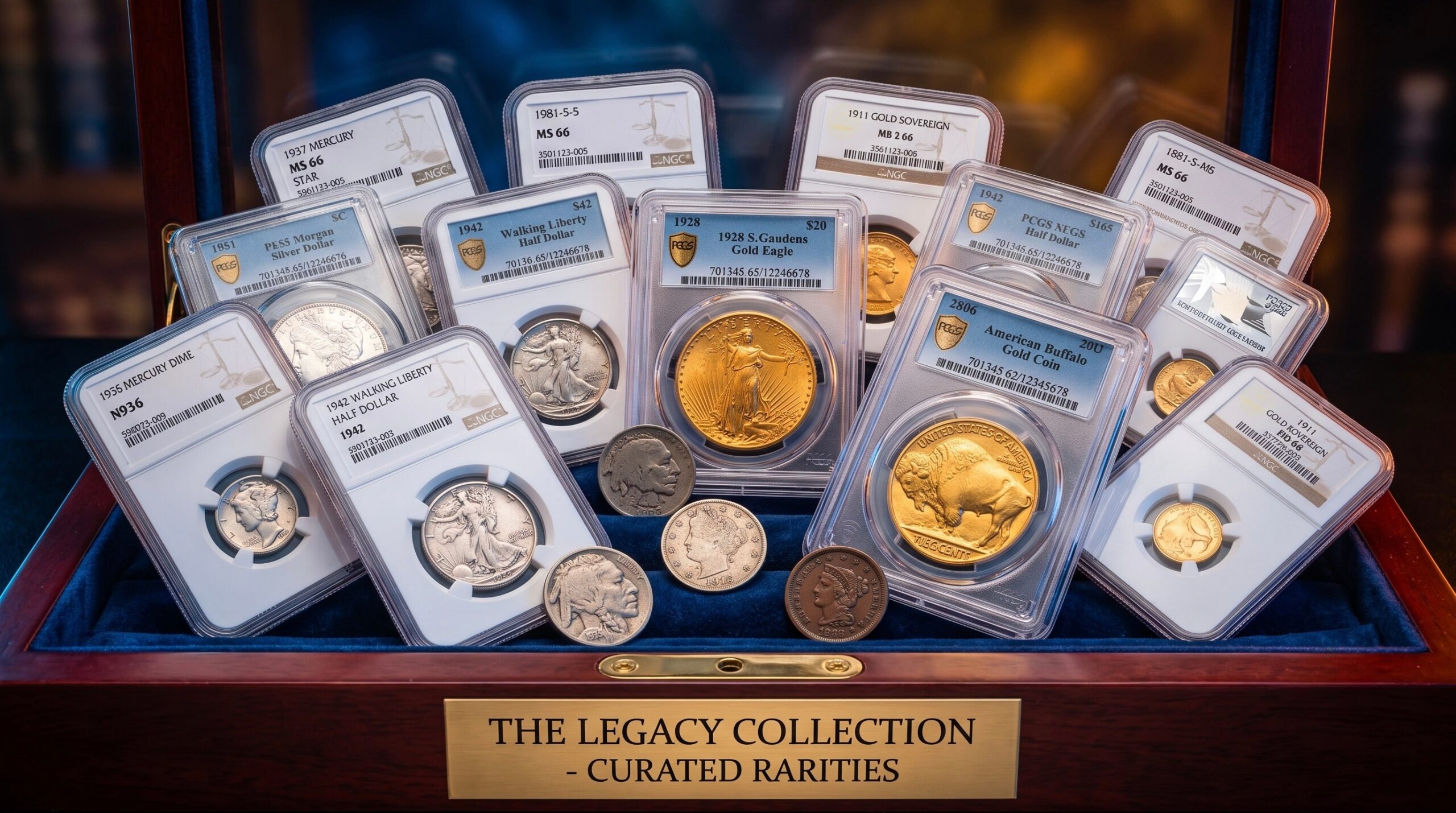
PCGS, the Professional Coin Grading Service, launched in 1986 with founders including David Hall and John Dannreuther. They introduced the system of encapsulating coins in tamper-proof plastic holders with a grade from 1 to 70, where 70 indicates a perfect coin. NGC, the Numismatic Guaranty Corporation, began operations in 1987 under founder John Albanese and has since grown to become the largest third-party grading service by volume. Both companies built their reputations on accuracy, impartiality and strict oversight that addressed the failures of earlier services.
Grading standards and consistency
NGC and PCGS both employ the same 1-70 scale, with 70 representing a perfect coin with no flaws visible under magnification. This shared scale enables direct comparison between coins graded by either service, and it’s a large part of why the market trusts both names.
Heritage Auctions reports that today NGC and PCGS produce virtually identical grades on the vast majority of submissions. Where collectors do notice a gap, it tends to appear right at the top of the scale: long-running forum debates among graders and dealers consistently describe PCGS as the more conservative grader on Mint State and Proof coins from MS/PF-65 upward, while NGC is seen as marginally more generous in the same range. The takeaway: for everyday collecting, this difference is too small to build a strategy around. But for a five-figure key date at MS-67 or better, it’s exactly the kind of edge worth knowing about before submission.
Population reports and market data
Both services maintain population and census reports that track every coin they have graded. These databases show how many coins exist at each grade level for each type. Auction listings often display both sets of data, such as a Morgan dollar listed as PCGS Population (83/1) and NGC Census (46/5), indicating that PCGS has certified 83 coins at this grade with 1 finer, while NGC has certified 46 with 5 finer.
This data helps collectors understand true rarity within the graded population. A coin might have had a large original mintage but few survivors in top condition. Auction records show instances where PCGS has five examples at a certain grade with one finer, while NGC has five at the same grade with none finer. These variations come from different submission patterns and subtle grading differences between the services. The takeaway: for Registry Set builders, the population number matters more than the logo on the slab; a coin with a genuinely tiny population at the top grade is the real prize, whichever company’s holder it happens to be sitting in.
Specialisation and service differences
While both companies handle most modern and classic US coins, there are important specialisations. Heritage Auctions states that NGC does not typically certify Ancient Indian gold coins, which matters for collectors of these specific pieces. For these categories, collectors must use alternative services or accept uncertified examples.
Regarding ancient coins more broadly, PCGS entered this market in August 2025, when it began authenticating and grading Qing Dynasty Chinese cash coins through its Shanghai office, on a newly created 10-point scale built specifically for ancient coinage. It’s a genuinely significant expansion for PCGS, though for now it’s limited to that one category of Chinese cash coins. NGC, with its longer track record across world and ancient coins more broadly, remains the safer default for most ancient and non-US submissions.
Beyond basic grading, both offer additional services that add value: variety attribution, special designations for exceptional quality such as cameo or deep cameo for proof coins, and signature labels for coins linked to notable figures. NGC’s exclusive hand-signed label agreement with Mike Castle (the former Delaware governor and congressman behind the 50 State Quarters programme, known in the hobby as “the Coinage Congressman”) is a good example of the kind of collector-appeal extra that can genuinely lift a coin’s desirability.
Market reputation and collector preference
Both NGC and PCGS have earned strong reputations in the numismatic community, and are widely regarded as the standard in third-party coin grading. Paul Fraser Collectibles notes that collectors rely on the regular population figures published by both companies, and that transparency helps build market confidence across the board.
For classic US series such as Morgan and Peace dollars, and for high-grade classic gold, PCGS-graded coins consistently command a premium of roughly 5 to 15 per cent over equivalent NGC coins at auction, which usually makes PCGS worth the extra cost for that category. Step outside that lane (world coins, modern bullion, ancient issues, or high-volume grading) and NGC’s lower membership and submission costs, combined with grading that’s every bit as rigorous, make it the more sensible choice. The coin’s own quality still matters more than either logo, but “it depends on personal preference” undersells just how predictable that split actually is.