



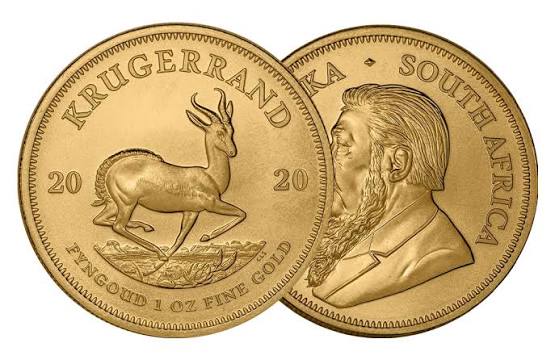
The Krugerrand is the coin that turned South Africa’s gold reserves into something an individual investor could hold, and since its first strike on 3 July 1967 it has become one of the most recognised gold coins in the world.
It takes its name from Paul Kruger, the nineteenth century president of the old South African Republic whose portrait sits on the obverse, and the rand, the country’s currency. Rand Refinery and the South African Mint launched it during the apartheid era specifically to market the country’s gold abroad, at a time when private ownership of gold bullion was still restricted or banned outright across much of the West.
This guide sets out how the coin was designed, why its fortunes were tied so closely to international politics, and what genuinely drives a Krugerrand’s price today, from the ordinary bullion coin trading a little above the gold price to the rare early strikes and one-off patterns that collectors chase at auction.
Discover all in our:
Krugerrand gold coin guide: History, value, and why collectors want it
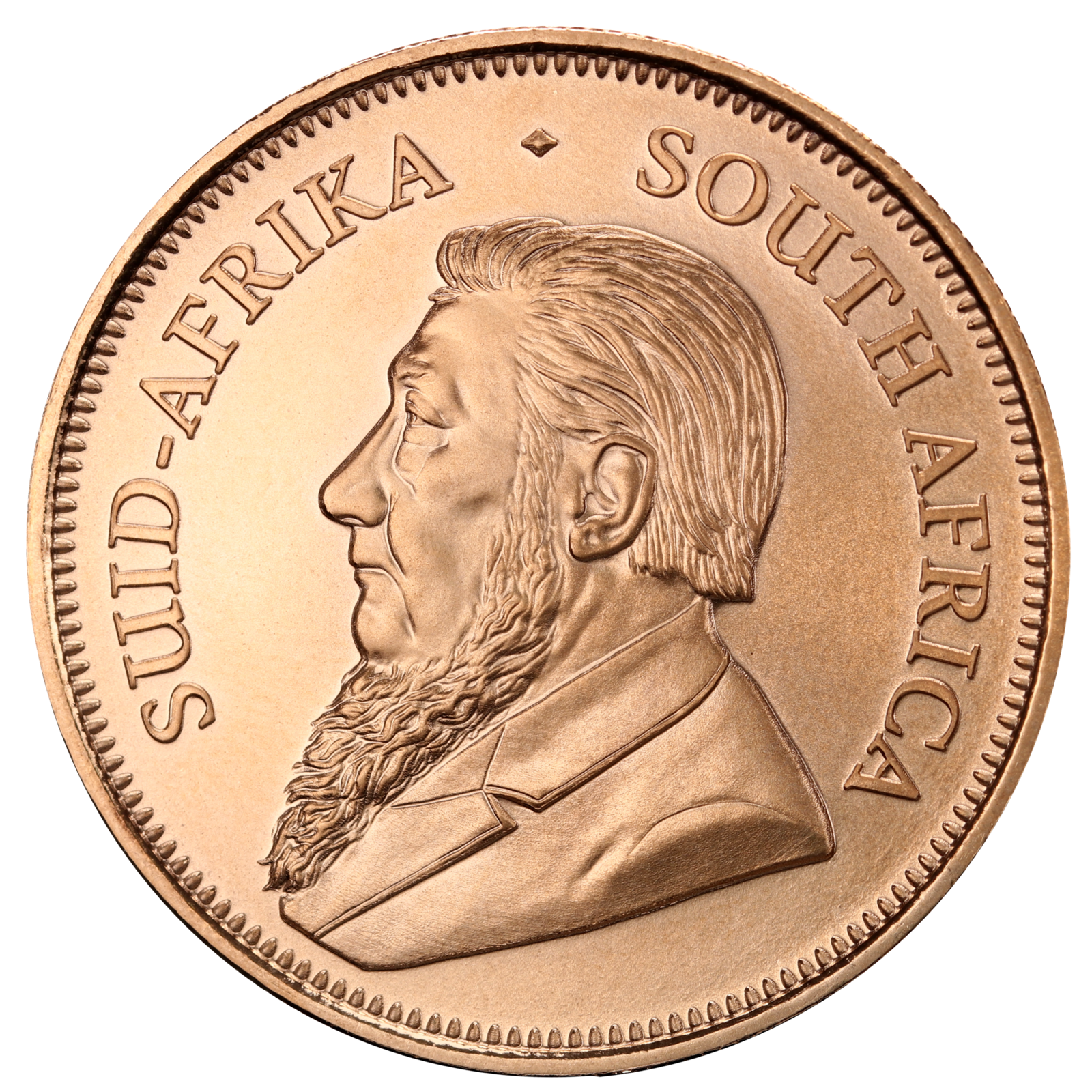
Credit: Gruener Panda via Wikimedia Commons (CC BY-SA 4.0)
A coin designed to sell South Africa’s gold
The Krugerrand’s obverse carries a profile of Paul Kruger, modelled by the sculptor Otto Schultz during Kruger’s own lifetime. Its reverse shows a springbok, a design by the artist Coert Steynberg that had already appeared on South Africa’s five shilling coin between 1947 and 1951 and 1953 and 1959, and its fifty cent coin between 1961 and 1964.
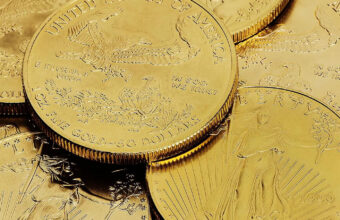
The coin itself was designed as gold anyone could spend or trade rather than lock away. It is struck in 22 carat gold, 91.67 per cent gold to 8.33 per cent copper, giving a total weight of 33.93 grams while still containing exactly one troy ounce, 31.103 grams, of pure gold. The copper is what gives a Krugerrand its faint rose tint and its unusual durability for a coin handled and traded as often as this one is.
From nine in ten gold coins sold worldwide to a banned import
By 1980, the Krugerrand accounted for more than 90 per cent of the global gold coin market, and over 36 million had been struck in the 1970s alone. That dominance made it a target once Western governments moved against apartheid South Africa. President Reagan ordered a ban on Krugerrand imports into the United States in September 1985, by which point more than $600 million of the coins had been sold there the previous year alone.
The ban, and similar restrictions elsewhere, cut South African gold coin sales sharply until most of the sanctions were lifted in 1991. It is unusual for a bullion coin to carry a documented political history at all, and it is why the Krugerrand still comes up in conversations about sanctions and gold markets rather than only in coin catalogues.
Fractional coins, and the versions that followed
South Africa introduced half ounce, quarter ounce and tenth ounce Krugerrands in 1980, aimed at buyers who wanted gold in smaller, cheaper units. Early fractional strikes are scarce: a trio of 1980 half, quarter and tenth ounce Krugerrands made $9,775, around £4,804 at the time, at a Heritage Auctions sale on 28 September 2007, well above their combined bullion value even then.
In 2017, fifty years after the original coin, South Africa added platinum and silver Krugerrands, both struck in .999 fine metal, alongside a run of gold proof sets marking the anniversary. The name now covers four metals rather than one, though the 1oz gold bullion coin remains what most people mean when they say Krugerrand.
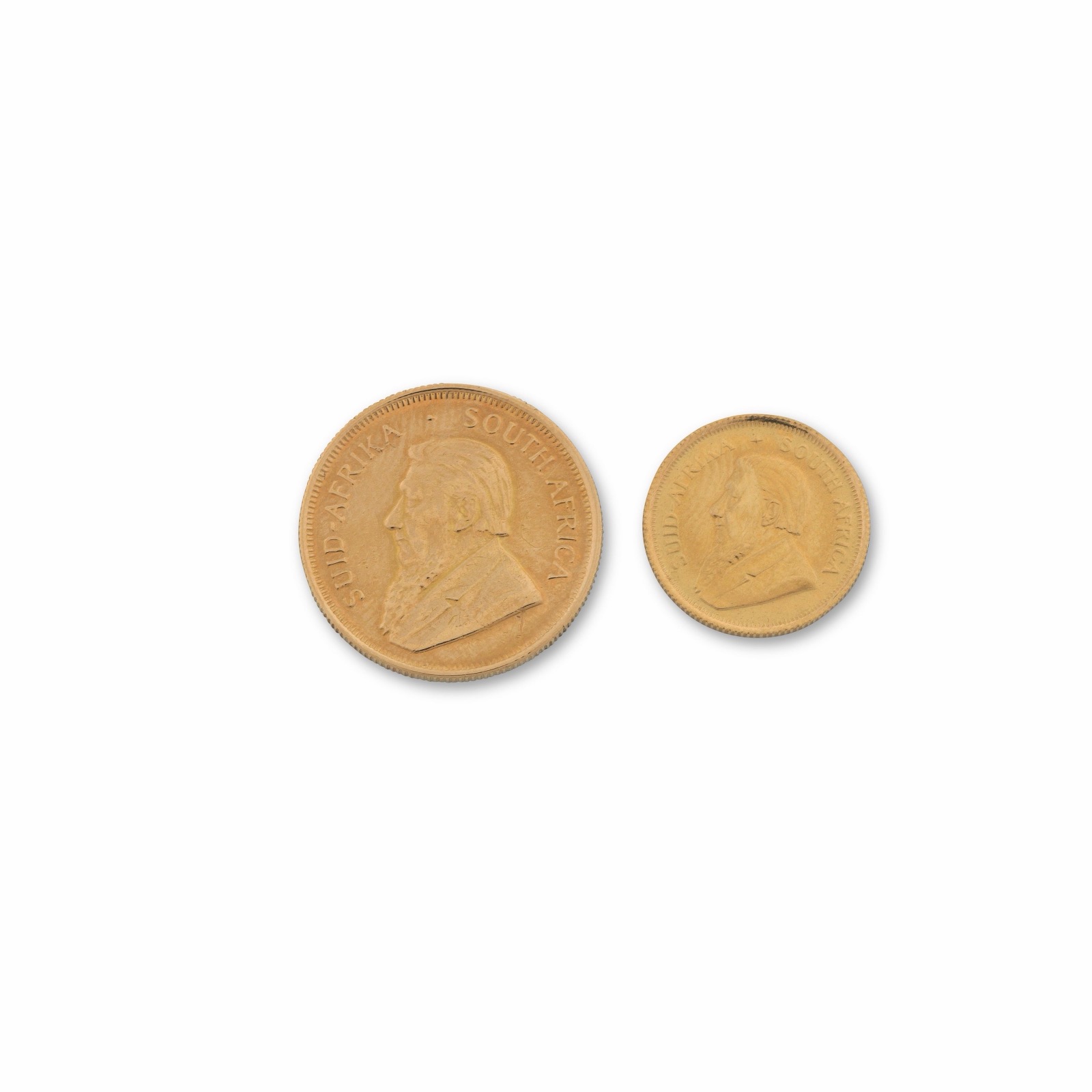
Credit: Bonhams
What moves a Krugerrand’s price
Most Krugerrands trade close to the gold price. A standard 1976 1oz coin made $1,170, about £875, at a Bonhams sale on 11 December 2017, in line with an ordinary bullion coin of no particular rarity. That is the fate of the great majority of the tens of millions minted since 1967.
The exceptions are what collectors chase. A unique silver pattern Krugerrand, struck in 1967 with the coin’s official dies but never issued in gold, made $31,200, about £25,750, at Heritage Auctions on 13 January 2025, a price with nothing to do with its metal content. A 1968 proof graded PR68 Deep Cameo made $1,403, roughly £709, at Heritage on 1 June 2007, well above a circulated coin of the same date. A 1977 Krugerrand recovered near Ground Zero after the 11 September 2001 attacks made $1,320, about £1,051, at Heritage on 14 December 2018, its price built on provenance rather than rarity.
The coin has also found its way into jewellery. Corum built an 18 carat gold quartz wristwatch around a 1978 Krugerrand as its dial; one example sold for £1,680 at Bonhams on 23 November 2010, evidence that the coin’s appeal has never stopped at numismatics.
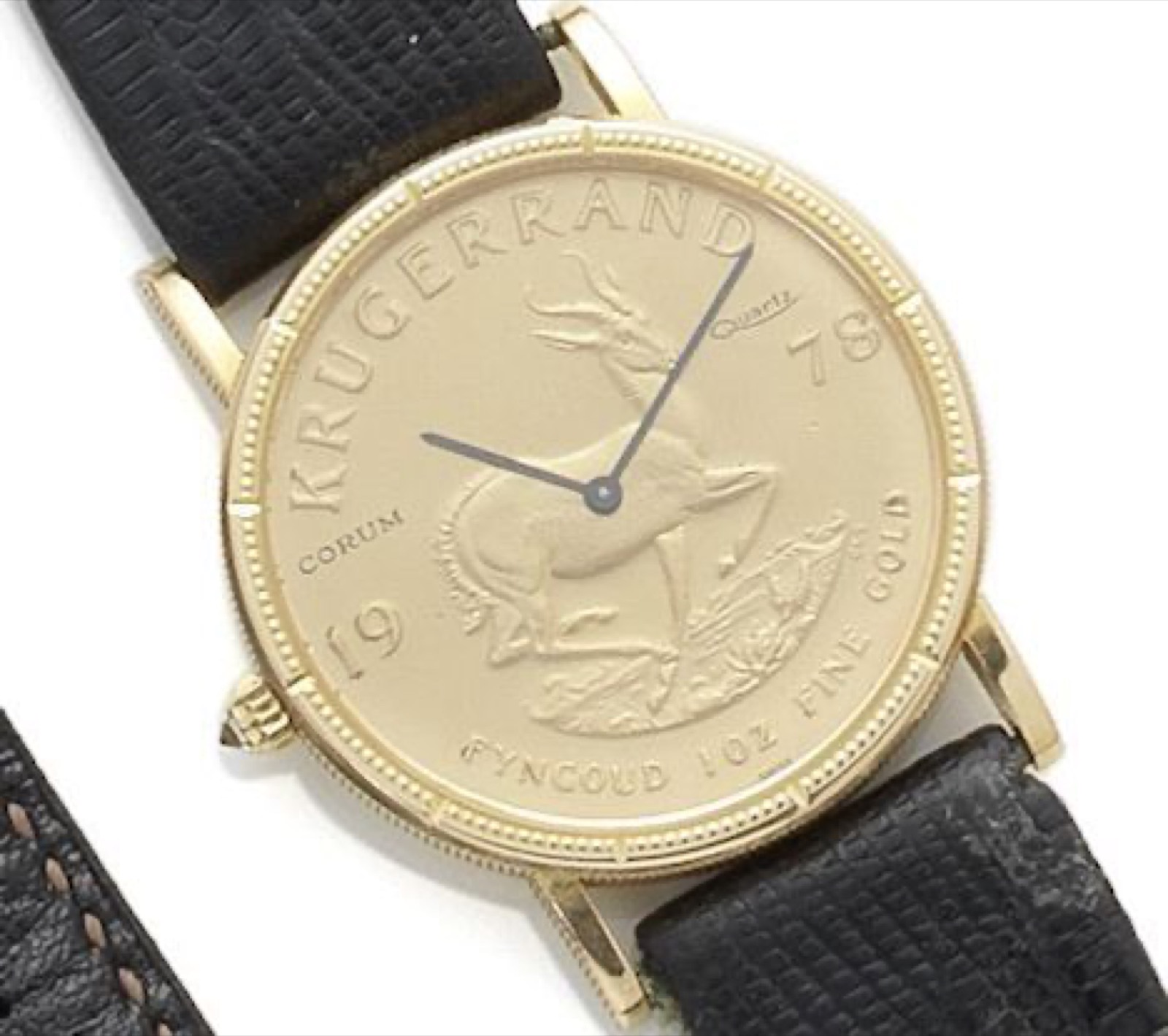
Credit: Bonhams
Buying a Krugerrand today
A genuine 1oz gold Krugerrand always weighs 33.93 grams, and that weight, together with its diameter and its milled edge, is the first thing a dealer checks. Rarer proof and pattern issues are usually certified by NGC or PCGS, whose grading and encapsulation, PR68, PR65 and so on, are what a buyer is really paying for once a coin moves beyond bullion value.
Ordinary bullion coins are bought from dealers and bullion houses at a small premium over spot gold; the scarcer dates, patterns and jewellery pieces turn up instead at auction houses such as Bonhams and Heritage Auctions, where the price reflects rarity and story rather than weight alone. In the UK, gold coins struck to at least 900 fine that are legal tender, which includes the Krugerrand, are exempt from VAT on the hammer price, a detail more than one saleroom catalogue notes explicitly.
The two-tier market behind one gold coin
The Krugerrand is really two markets wearing one design. The tens of millions of ordinary coins struck since 1967 trade for close to their gold content, exactly as their designers intended when they built a coin for spending rather than hoarding. The small number of exceptions, patterns, early proofs, sanctions-era survivors and coins with a documented history, are what turn up at Bonhams and Heritage Auctions for multiples of their metal value.
That split traces back to the coin’s own history. A design meant to move South African gold as widely and anonymously as possible ended up banned from the world’s largest gold market for six years over the country’s politics, and it is that history, as much as any grade or mintage figure, that gives the rarest Krugerrands their value at auction today.