



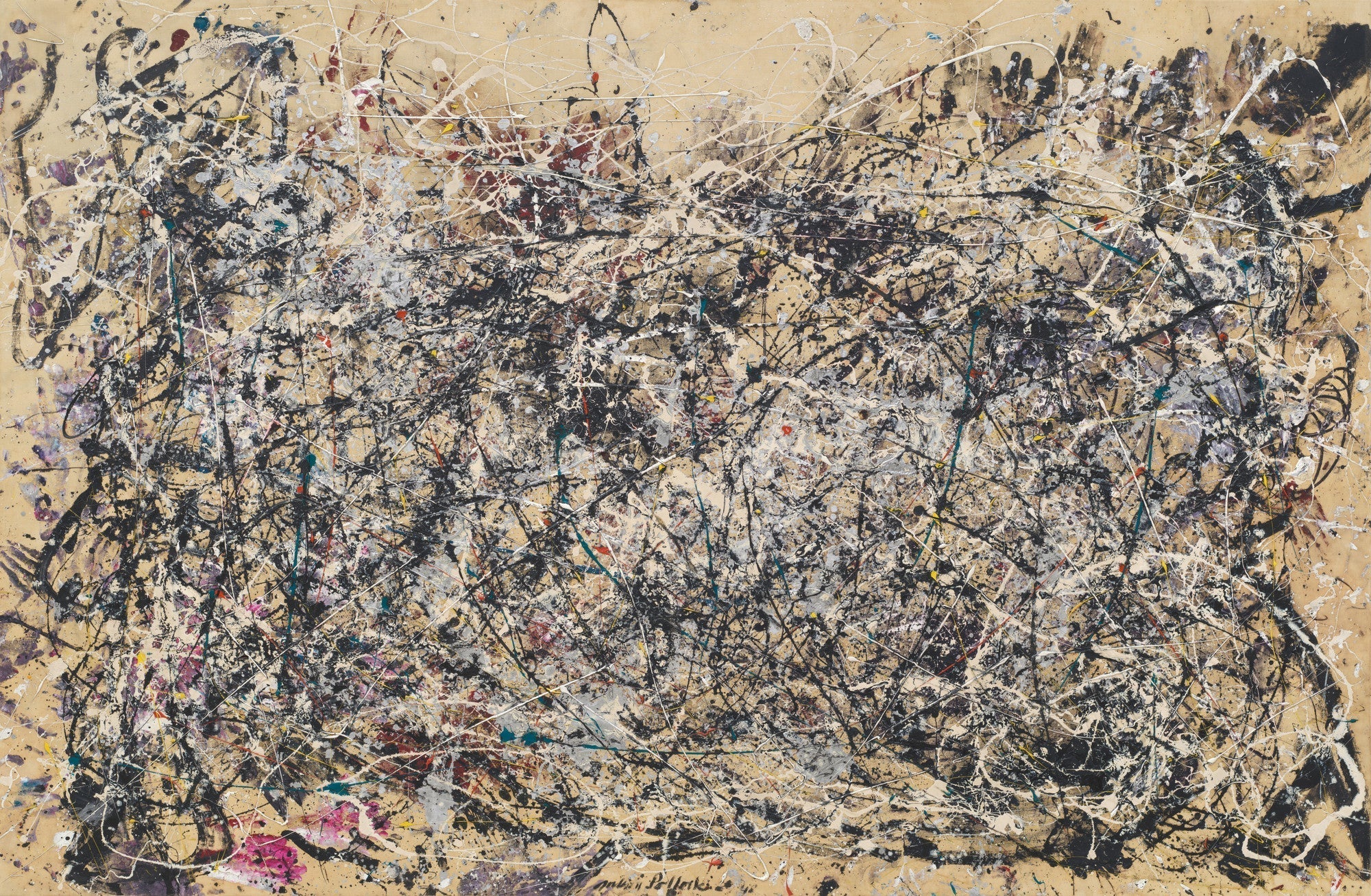
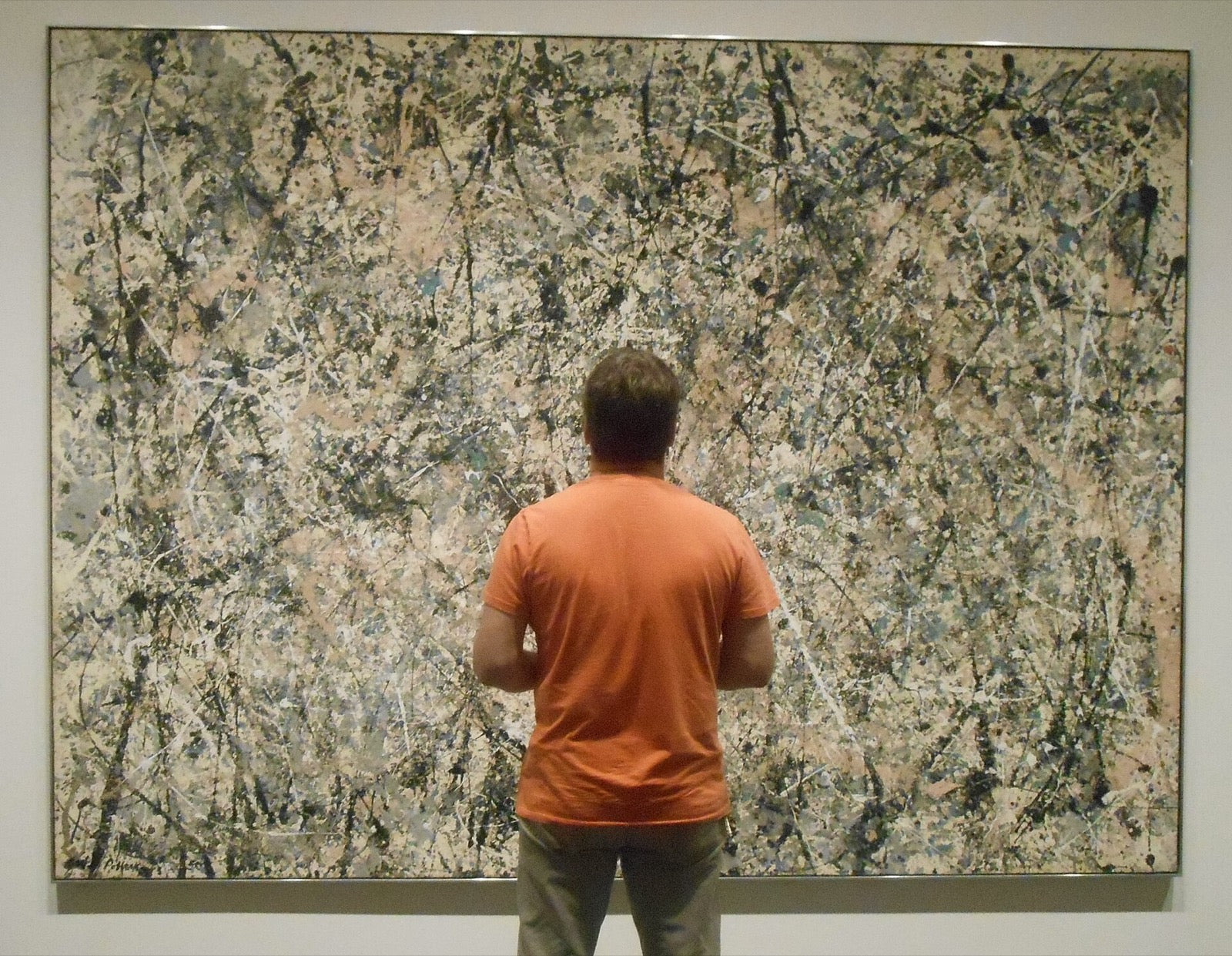
The Jackson Pollock technique is simple to describe and hard to fake convincingly: paint poured, flicked and dripped onto a canvas laid flat on the floor, built up in layers until the surface holds a kind of controlled chaos. Pollock worked this way for barely a decade, from 1947 until his death in 1956, yet paintings from those years now carry some of the highest prices in art, and with that value comes a market thick with disputed attributions.
The difficulty starts with the paintings themselves. A portrait carries a visible hand for a connoisseur to study; Pollock’s poured canvases offer no brushwork in that sense, only the record of gravity, momentum and paint meeting canvas. That absence is why sophisticated fakes have fooled experienced dealers, most notably at Knoedler & Company in Manhattan, which faced a wave of civil lawsuits after one of its paintings, a purported Pollock priced at £12.6 million ($17 million), was exposed as the work of a Queens-based forger.
Demand has only sharpened the problem. On 18 May 2026, Pollock’s Number 7A, 1948 sold at Christie’s in New York for £134.8 million ($181.2 million) including buyer’s premium, a new auction record for the artist reached in barely seven minutes of bidding. At that level, the people asked to tell a genuine drip painting from a convincing fake rely on paper trail, laboratory science and, more recently, computer analysis of the paint itself.
Discover all in our:
The Jackson Pollock technique: how appraisers authenticate a drip painting masterpiece
Credit: Pollock-Krasner House and Study Center
How Pollock actually made a drip painting
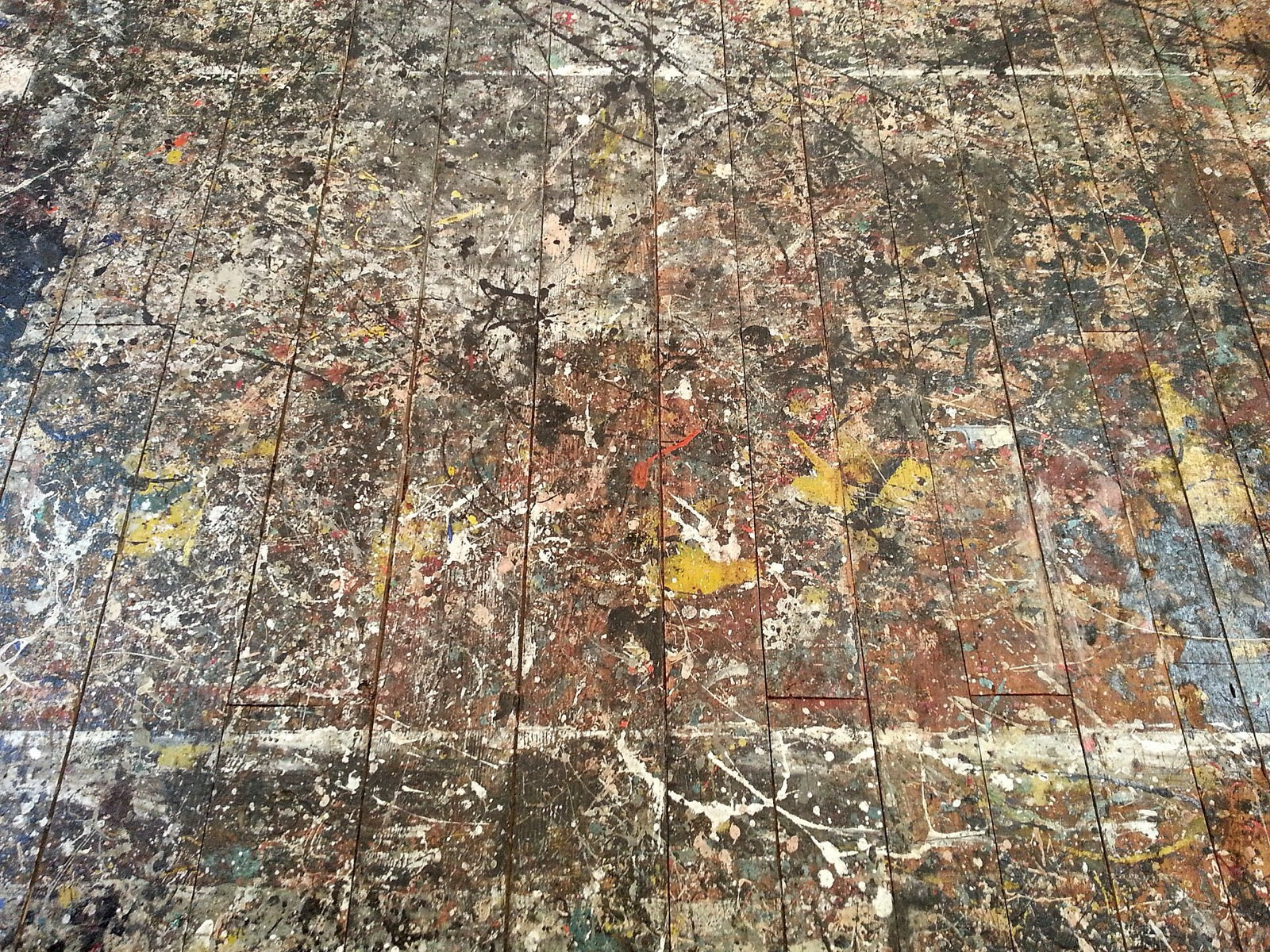
Pollock’s method had its roots in a 1936 workshop in New York run by muralist David Alfaro Siqueiros, where he first worked with liquid enamel paint rather than traditional oils. The technique now associated with him matured after he and his wife, the painter Lee Krasner, moved to Springs, on Long Island, where he began working with canvases laid flat on the studio floor rather than upright on an easel.
He used household and industrial materials rather than a conventional palette: synthetic resin-based alkyd enamels, applied with sticks and basting syringes rather than brushes, sometimes worked further with trowels, knives, sand or broken glass. Pollock described the shift in physical terms: “I need the resistance of a hard surface. On the floor I am more at ease… since this way I can walk around it, work from the four sides and literally be in the painting.” That process is what forensic examiners try to detect, or fail to find, in a disputed canvas.
Credit: Ned Hartley via Wikimedia Commons (CC BY-SA 4.0)
Provenance and the paper trail
Before any scientific test, appraisers start with documentation: gallery records, exhibition history, old photographs, correspondence, and the catalogue raisonné compiled by Eugene V. Thaw and Francis V. O’Connor. Published by Yale University Press in 1978 after nearly six years of work, it catalogues Pollock’s known paintings and drawings; Thaw’s own gallery agreed contractually not to trade in Pollock’s work until the book was finished and available to the rest of the market.
A painting with no documented history before it surfaces at a garage sale or in a storage unit is treated with far more caution than one with an unbroken ownership record, whatever the canvas itself seems to show. Provenance is often the first and cheapest test a disputed Pollock fails, long before anyone reaches for a microscope.
What the laboratory looks for
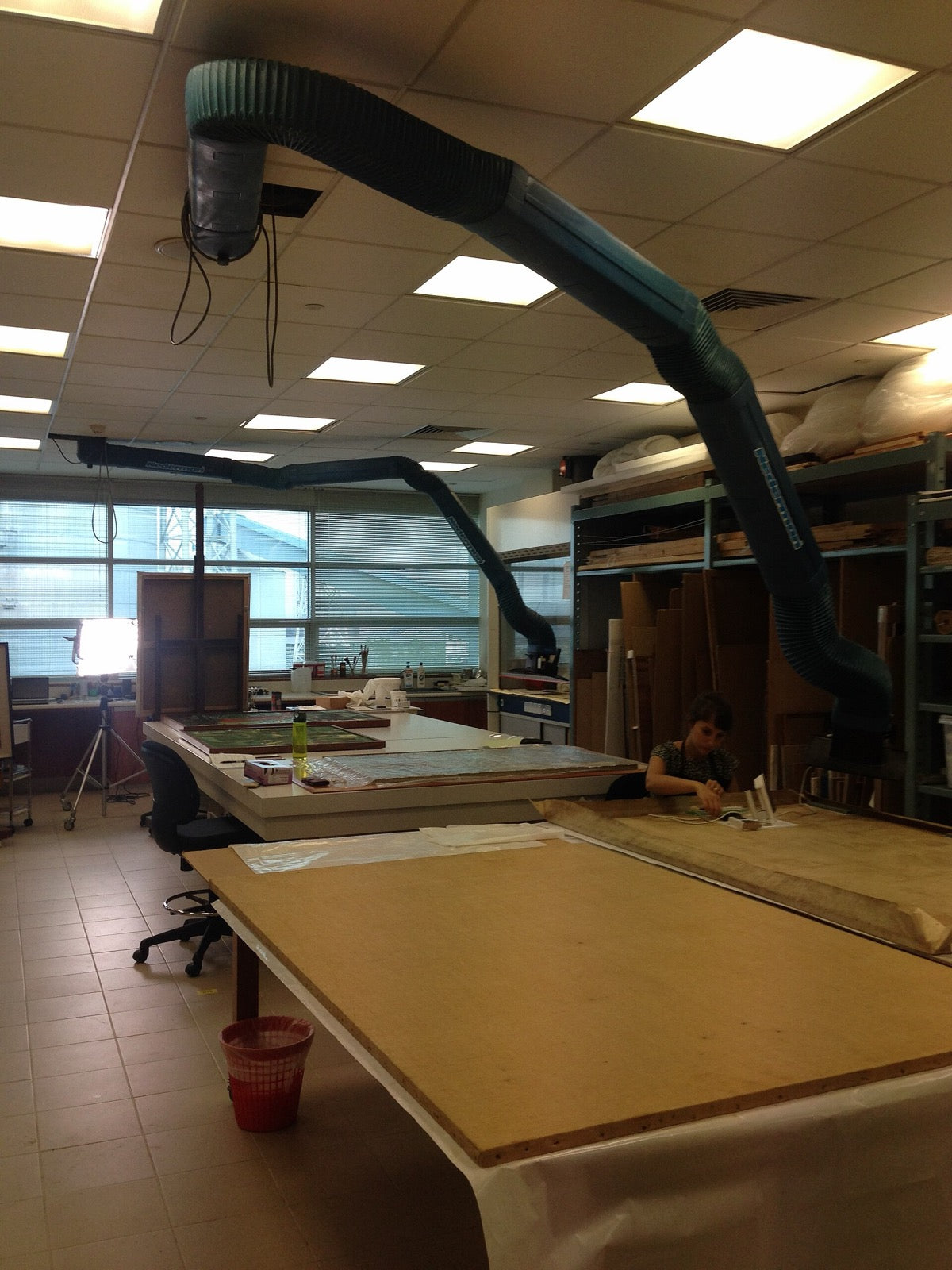
Once a painting has enough of a paper trail to be worth testing, conservation scientists turn to instruments rather than the naked eye. Fourier-transform infrared and Raman microspectroscopy identify the chemical make-up of pigments and binders, while gas chromatography-mass spectrometry breaks a paint sample down to its molecular components. A single compound that did not exist commercially during Pollock’s lifetime is enough to end the argument.
That is what happened with two dozen or so small paintings found wrapped in brown paper in a Long Island storage locker in 2002, believed by their finder to be Pollock’s gifts to family friends in the late 1940s. Harvard University’s chemical analysis detected a pigment in the paint layers, including the lowest ones, not patented until after Pollock’s 1956 death, meaning the paint could not have been applied while he was alive. A separate case turned on a synthetic compound commercially available only since 1970, fourteen years after the artist died.
Credit: Smuconlaw via Wikimedia Commons (CC BY-SA 4.0)
Fingerprints, fractals and the limits of science
Chemistry is not the only forensic tool tried on Pollock’s work. In the case of a painting bought at a California thrift shop by former truck driver Teri Horton, forensic examiner Peter Paul Biro matched a partial fingerprint on the canvas to a print on a paint can recovered from Pollock’s studio, and to fingerprints on two authenticated Pollock paintings, describing separate paint evidence as a three-point match. The finding did not persuade the wider art establishment: two forensic experts, and later journalist David Grann in The New Yorker, raised doubts about Biro’s methodology.
A newer approach reads the pattern of the paint itself rather than any trace evidence within it. Physicist Richard Taylor argues that Pollock’s poured compositions are fractal, repeating similar patterns at different scales, and has built an artificial intelligence tool, trained on more than six hundred paintings, that he says distinguishes genuine Pollocks from imitations with 99 per cent accuracy. Physicists have pushed back, doubting whether Pollock’s patterns are reliably fractal at all, which is why the method is now offered as a supplement to connoisseurship and chemistry, not a replacement.
Credit: Christina Irakleous via Wikimedia Commons (CC BY-SA 4.0)
Who does the authenticating now
No single body retains the authority to declare a painting a genuine Pollock. Since the artist’s own foundation stepped back from ruling on attributions, collectors and dealers turn chiefly to the International Foundation for Art Research, an independent New York body. Disputed Pollocks, among them the storage-locker group and a separate scheme uncovered in 2017 that had already fooled at least three buyers, have instead fallen to independent researchers, university laboratories and collectors’ own hired experts.
The scarcity of senior expertise makes each new case harder. With Thaw and O’Connor, the scholars behind the standard catalogue of Pollock’s work, now both dead, O’Connor in 2017 and Thaw in 2018, fewer people remain who spent a working lifetime studying his paintings before having to rule on one.
Why no single test settles a Pollock attribution
Every method described here has a limitation its own practitioners acknowledge. A fingerprint and paint match did not convince the wider market in Teri Horton’s case. The fractal test has been publicly challenged by physicists who doubt Pollock’s patterns are reliably fractal at all. And a documented ownership history can be invented, sometimes more convincingly than a brushstroke can be forged, as the storage-locker paintings and the Knoedler scandal each showed in their own way: one through a mistaken family story about a friend’s gift, the other through a collector who never existed.
That is why appraisers now treat paper trail, chemistry and computation as three separate votes rather than one test to pass. A Pollock attribution that survives all three has genuinely earned it, and how few disputed paintings manage that says less about the paintings than about how carefully the technique itself now has to be checked.