



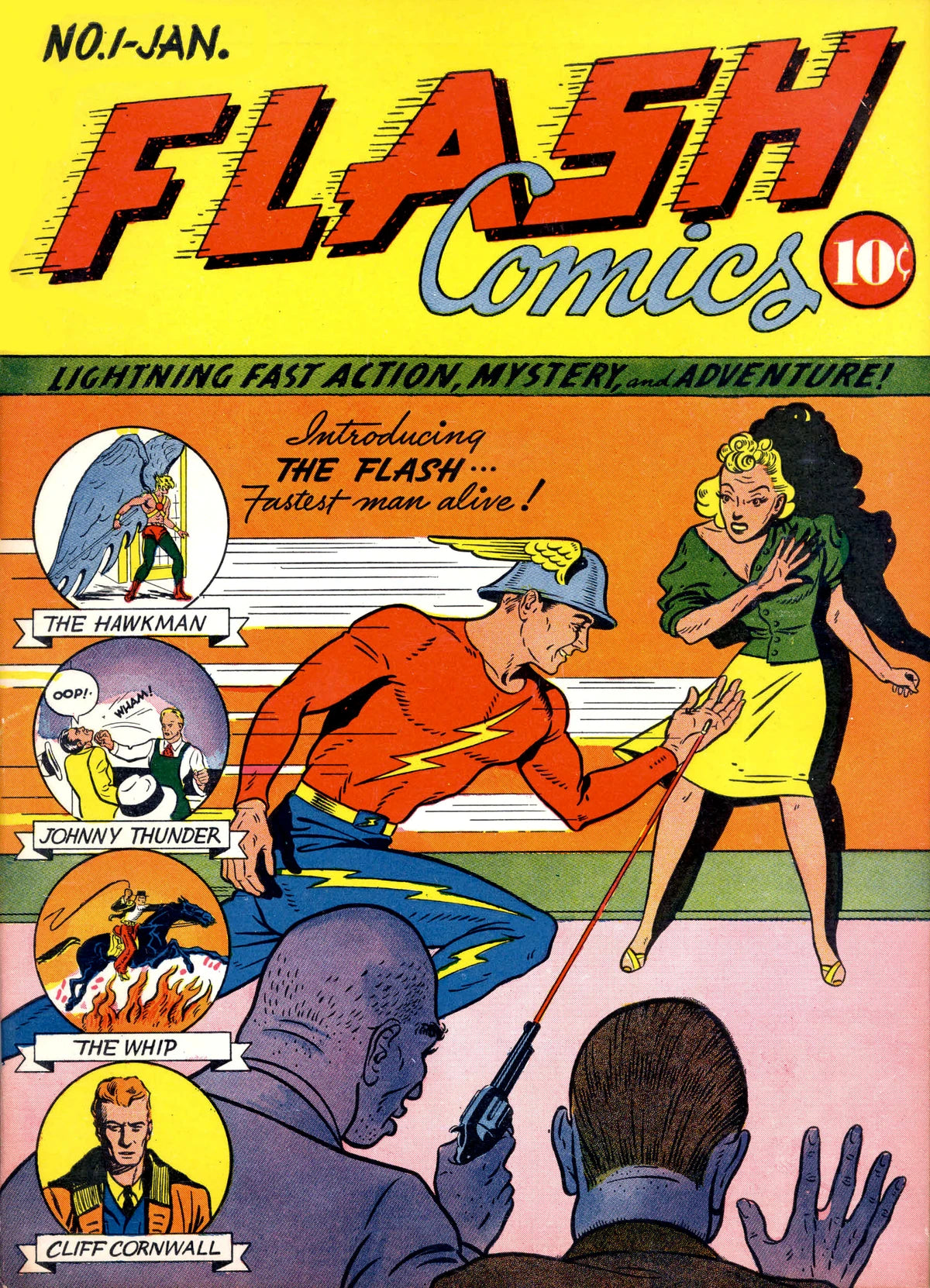
Flash Comics #1 from January 1940 is a landmark Golden Age issue that introduced Jay Garrick as the original Flash, together with Hawkman, Johnny Thunder, and The Whip.
Original copies command strong prices because of their historical importance and extreme rarity. These are not mass-market reprints but the genuine articles that established DC’s superhero lineage.
Demand for Golden Age keys remains steady, and Flash Comics #1 consistently appreciates regardless of grade.
Discover all in our:
What is the first Flash comic worth to collectors today?
Understanding Flash Comics #1
Flash Comics #1 appeared on newsstands on 20 November 1939 with a January 1940 cover date. All-American Comics, Inc. released the 68-page issue shortly before merging with DC Comics.
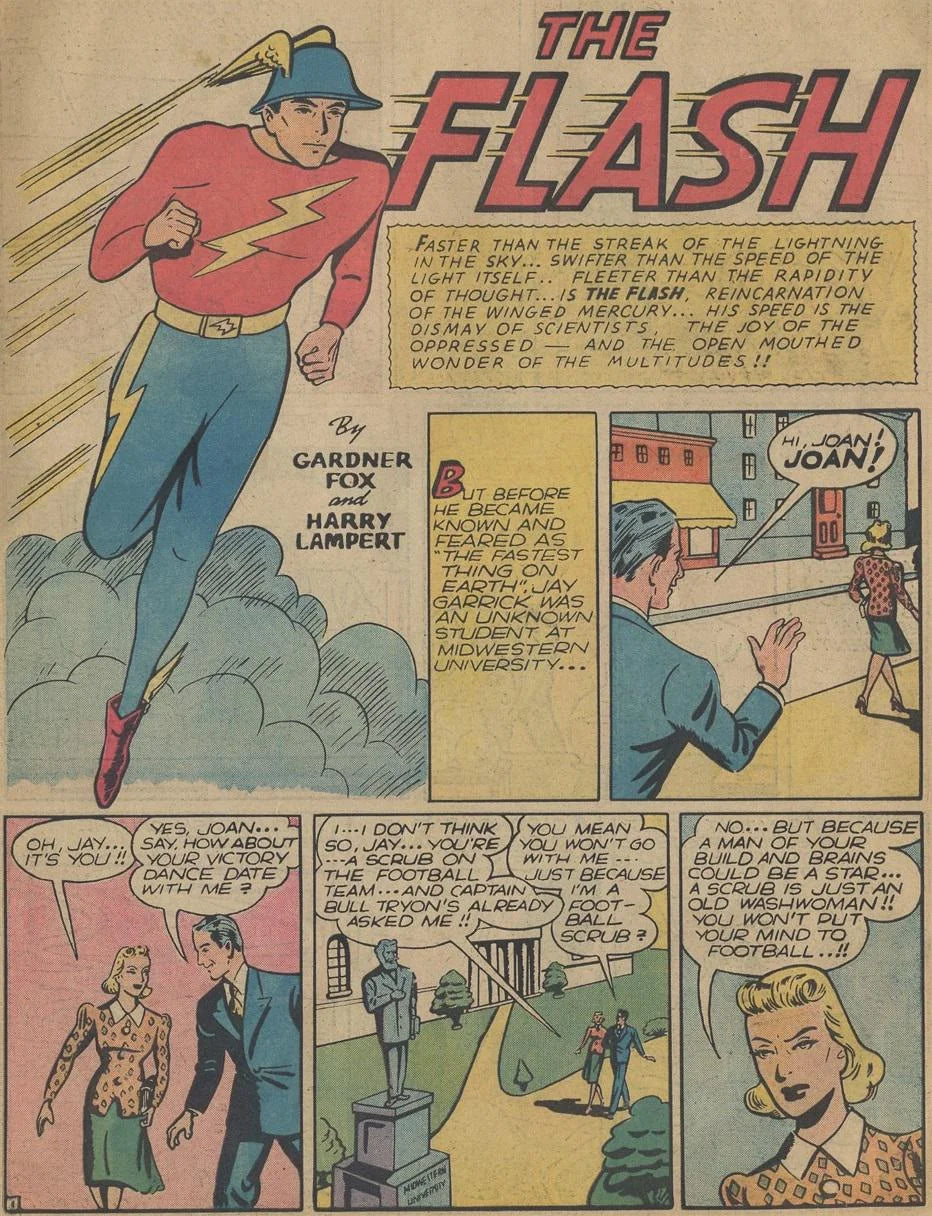
The comic introduced several characters who became DC staples: Jay Garrick as the Flash, a Midwestern University student who gained super-speed after inhaling “hard water gas” fumes in a laboratory accident; Hawkman (Carter Hall), whose backstory revealed him as the reincarnation of Egyptian Prince Khufu, utilising anti-gravity “Ninth Metal”; and Johnny Thunder, who could summon an invisible, magical Thunderbolt using the phrase “Cei-U”. The issue also featured the first appearances of The Whip (Rod Gaynor) and FBI agent Cliff Cornwall.
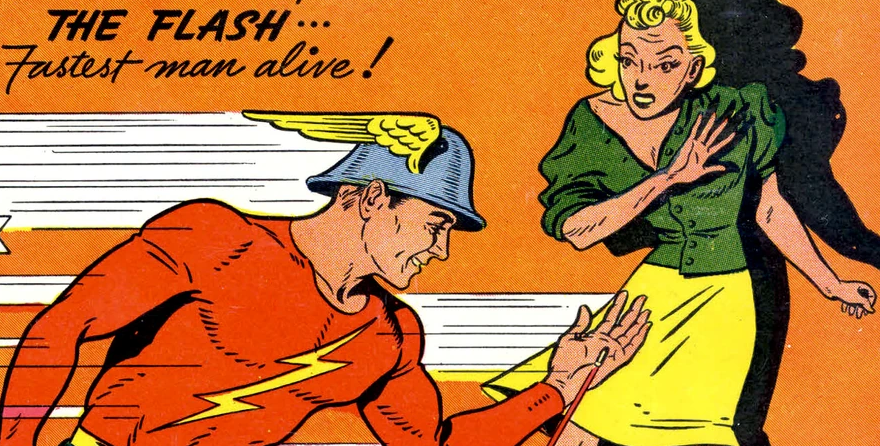
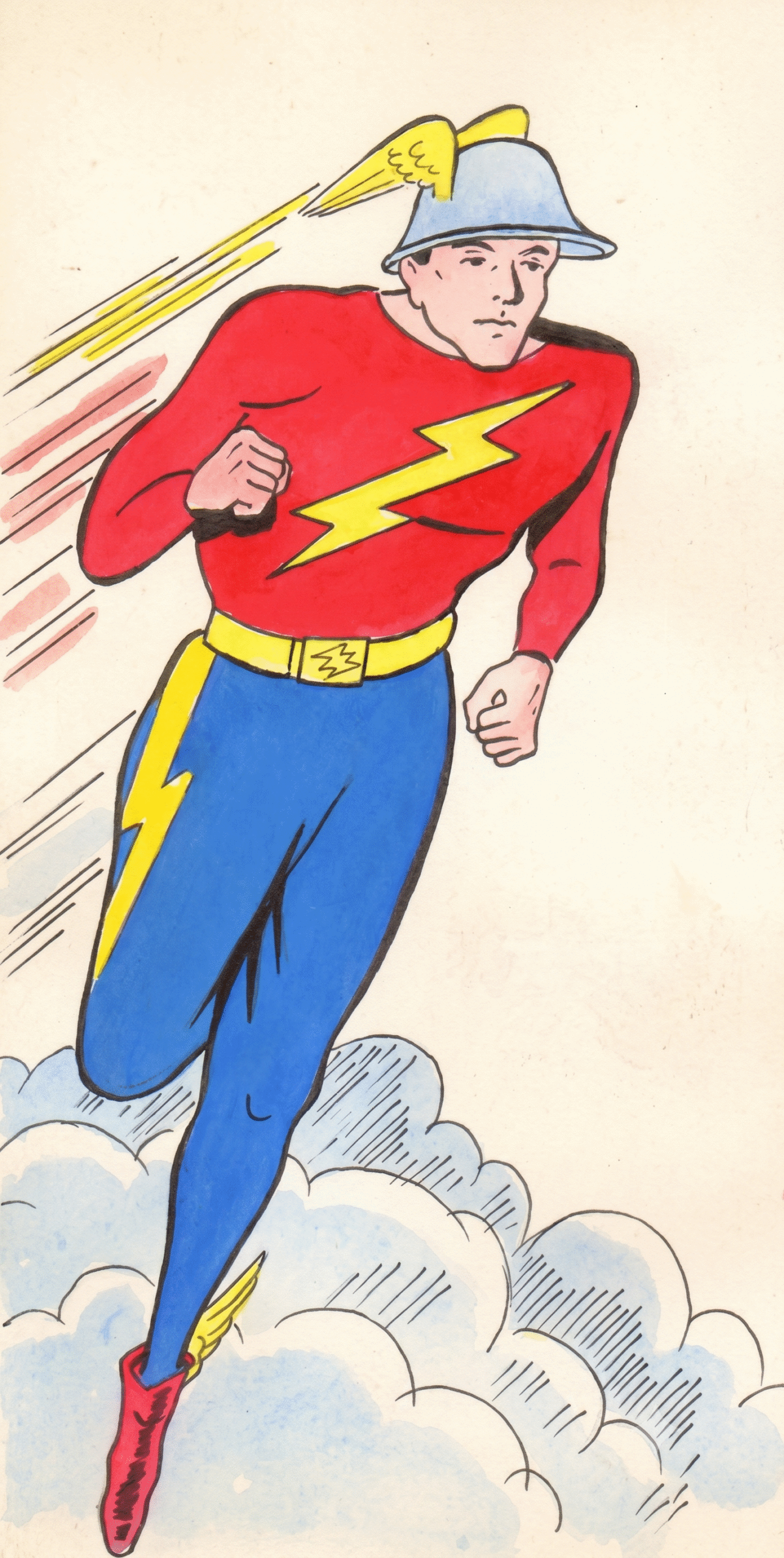
Sheldon Moldoff’s cover tackled reader scepticism about super-speed by showing the Flash in motion with motion lines, racing to intercept a bullet alongside text promising “Lightning fast action, mystery, and adventure!”.
Credit: DC Comics
Why Flash Comics #1 commands premium prices
Flash Comics #1 commands high prices because of its historical weight and scarcity.
First appearances are the foundation of comic collecting, and this single issue delivers multiple major debuts: the Flash, Hawkman, Johnny Thunder, and The Whip. Having several major introductions in one book makes it far more important than a typical first issue.
Scarcity keeps demand high. The CGC Census lists fewer than 100 graded copies, with only 45 classed as Universal Grade. This means high-grade examples are extremely hard to find, which pushes prices up over time.
The comic’s COMIC BOOK IMPACT rating is 9 out of 10. It helped All-American Comics compete in the superhero trend that Superman had started, and it created a model for DC’s future titles.
Credit: Reddit/Electrical-Aspect-13
Current market values by grade
Flash Comics #1 sells across the full grade range, from affordable lower-grade copies to near-mint investment pieces.
A CGC G-: 1.8 copy from the Ruben Blades Collection sold for $37,490 in October 2024, roughly £29,192. The fact that even a restored low-grade copy reaches this level shows the strength of historical demand.
A CGC FA/GD: 1.5 copy went for $85,000 in September 2022, about £68,000. The same auction noted a CGC 2.0 copy had recently sold for $92,000 (approximately £73,600), proving collectors will pay more for better condition.
A CGC FN: 6.0 copy with white pages made $97,000 in December 2018, around £73,000. This was more than double the Overstreet Guide value of $49,000 for the grade, showing the market pays well over guide for quality.
At the top end, a CGC VF/NM: 9.0 copy, the second highest graded and from the Atlantic City pedigree, sold for $147,000 in March 2013, approximately £93,000. This set the standard for near-mint regular copies.
| CGC Grade | Sale Date | Sale Price (USD) | Approx. Price (GBP) | Notes |
|---|---|---|---|---|
| 1.5 (FA/GD) | September 2022 | $85,000 | £68,000 | Unrestored |
| 1.8 (G-) | October 2024 | $37,490 | £29,192 | Ruben Blades Collection (Restored) |
| 2.0 (GD) | Circa 2022 | $92,000 | £73,600 | Unrestored |
| 6.0 (FN) | December 2018 | $97,000 | £73,000 | White pages |
| 9.0 (VF/NM) | March 2013 | $147,000 | £93,000 | Atlantic City pedigree |
What drives value beyond grade
While CGC grade is the main price factor, other elements make a real difference to value.
Page quality matters. Copies with white or off-white pages sell for more than those with brittle or toned pages. Original staples rather than replacements add value, as does a complete wrap and spine.
Pedigree adds a lot. The Atlantic City Copy from the VF/NM: 9.0 sale came from a well-known collection stored before the Second World War. This kind of history gives a book authenticity that collectors prize.
Restoration is worth watching. The G-: 1.8 copy had colour touch, piece fill, added staples and tape on the cover and interior. Despite these issues, it still reached nearly £30,000, though an unrestored copy in the same grade would likely sell for more.
The rarity factor
The CGC Census shows fewer than 100 copies of Flash Comics #1 have been graded.
With only 45 copies at Universal Grade, the supply of genuinely collectible examples is limited. Every auction appearance creates strong competition among collectors who may have waited years for a chance to buy one.
This mix of extreme scarcity and historical importance means prices stay firm even when the wider collectibles market softens.
Credit: ComicLink
Where to buy and sell Flash Comics #1
Anyone looking to buy or sell Flash Comics #1 should stick to reputable auction houses.
ComicConnect regularly has copies in different grades, with full descriptions, high-resolution scans and CGC grading details. Their approach works well for both sides of the transaction.
Heritage Auctions runs a dedicated comics division that has handled many major sales. Their records provide useful market reference points.
Private sales through trusted dealers can work, but they require extra care with authentication and grading when not using the big auction houses.
Investing in Flash Comics #1
For those considering Flash Comics #1 as an investment, a few things are worth bearing in mind.
The comic has shown long-term appreciation across all grades. Sales from the 2013 VF/NM: 9.0 at $147,000 to the 2024 G-: 1.8 at $37,490 show steady value retention, even for lower-grade books.
Jay Garrick remains relevant in modern DC Comics and media, which helps keep collector interest alive. The Flash is one of DC’s longest-running characters, so demand for his first appearance is unlikely to fade.
That said, extreme scarcity means few sales and a thin market. Collectors should expect potentially long waits between opportunities, and should aim for the highest grade they can afford. The jump in value from one grade to the next becomes much larger at the top end.
The legacy of Golden Age innovation
Flash Comics #1 captures the creative spirit of the Golden Age, when publishers were working out the ideas that would shape superhero comics for decades.
Its lasting value comes from both the scarcity of surviving copies and the continuing influence of the characters it introduced. For collectors, owning a copy means holding a piece of comic book history from the moment super-speed entered the superhero world.