



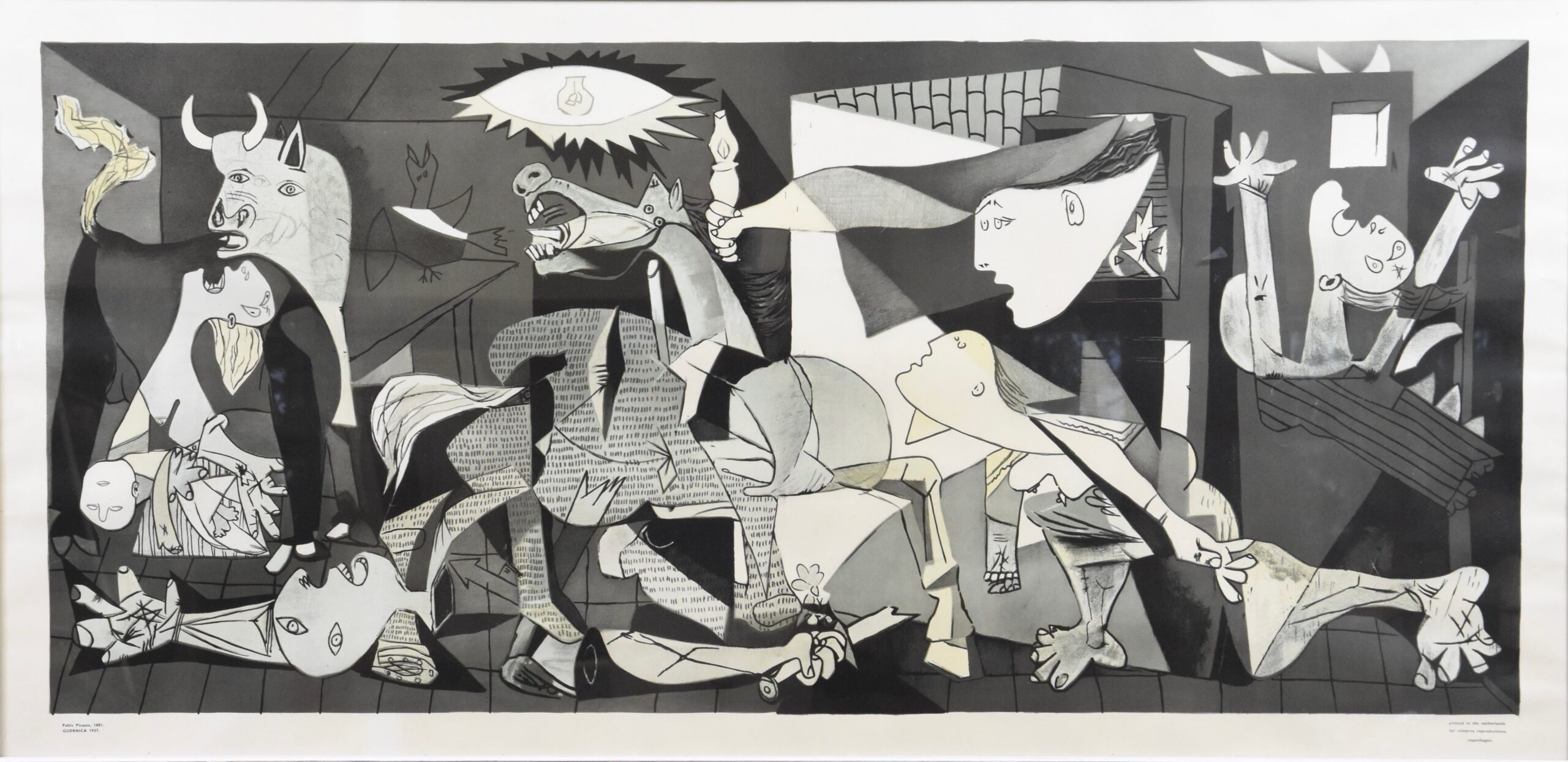
Guernica is both a town in Spain’s Basque Country and the painting Pablo Picasso made in response to its destruction, and untangling the two is where any study of his anti-war epic has to begin. The 3.49 by 7.76 metre canvas has hung in Madrid’s Museo Reina Sofía since 1992, has never been sold, and will almost certainly never reach an auction room, yet it sits at the centre of a print market, a tapestry trade and a live diplomatic argument that collectors can actually follow.
Picasso was not a political painter before 1937. He agreed, without much enthusiasm, to produce a mural for the Spanish Republic’s pavilion at that year’s Paris International Exposition, and only found his subject after reading George Steer’s dispatch on the bombing of Guernica. He worked from May into June in a Paris studio, compressing a massacre into grey, black and white.
None of that history is disputed. What divides collectors is what to do with a masterpiece that cannot be owned: how to read its imagery, how to weigh the objects Picasso did allow into circulation around it, and how to judge the market in tapestries and etchings that carry the same title.
Discover all in our:
Decoding Guernica: a collector’s deep dive into Picasso’s anti-war epic
Credit: TowardBeauty
The bombing that became a painting
At around 4.30pm on 26 April 1937, aircraft from Nazi Germany’s Condor Legion, working alongside fascist Italy’s air force in support of Franco’s Nationalists, bombed Guernica for close to two hours, on a market day, in a town with no meaningful military target. Steer reported it within days for The Times and the New York Times. Picasso read the coverage in Paris and set aside the etching project he had been working on to begin sketches for the mural instead.
He worked fast by his own standards, completing the canvas in a little over a month. Dora Maar photographed it through its successive states, leaving a documented record of a masterpiece changing shape almost daily.
Credit: Pablopicasso.org
Reading the symbols without an answer key
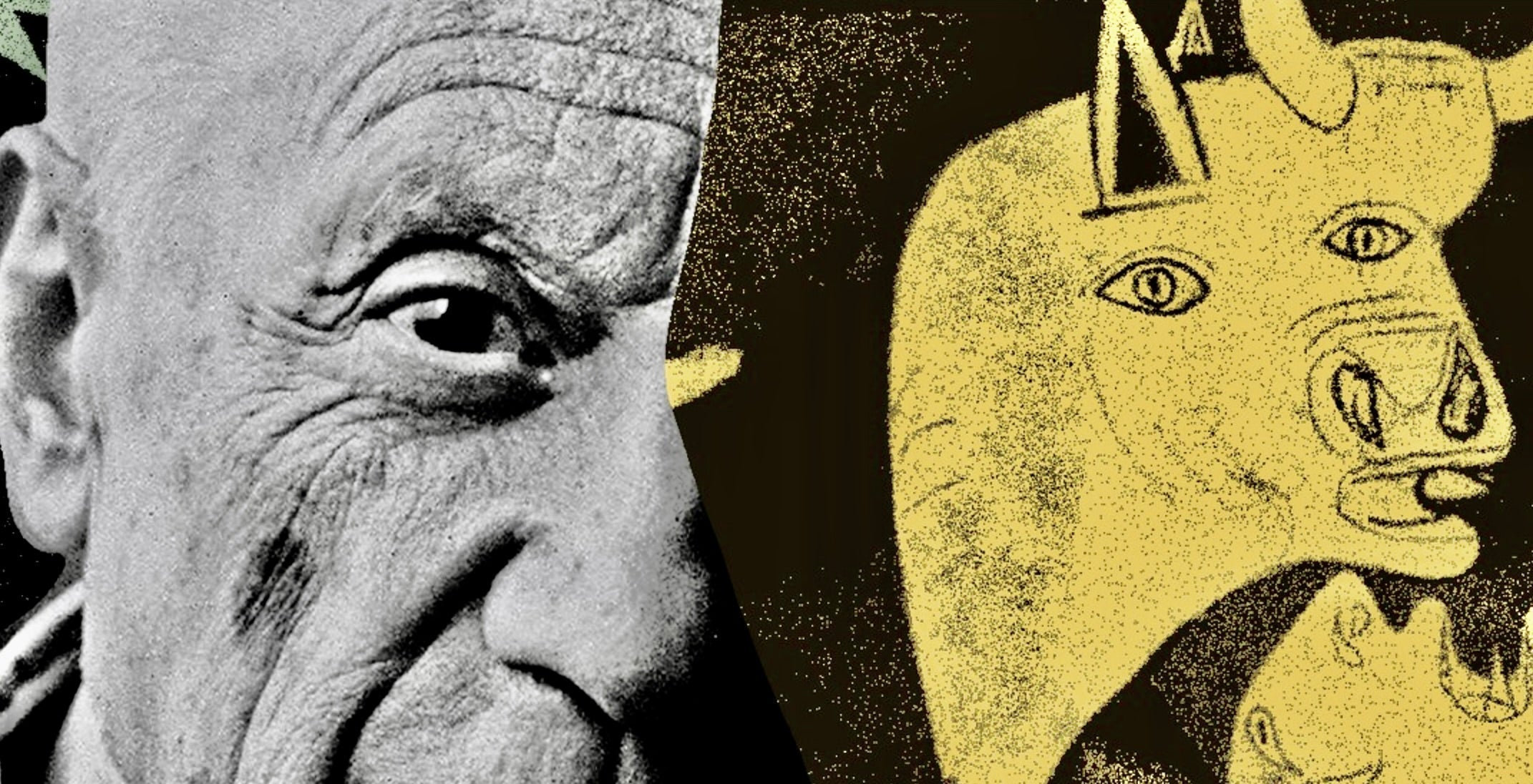
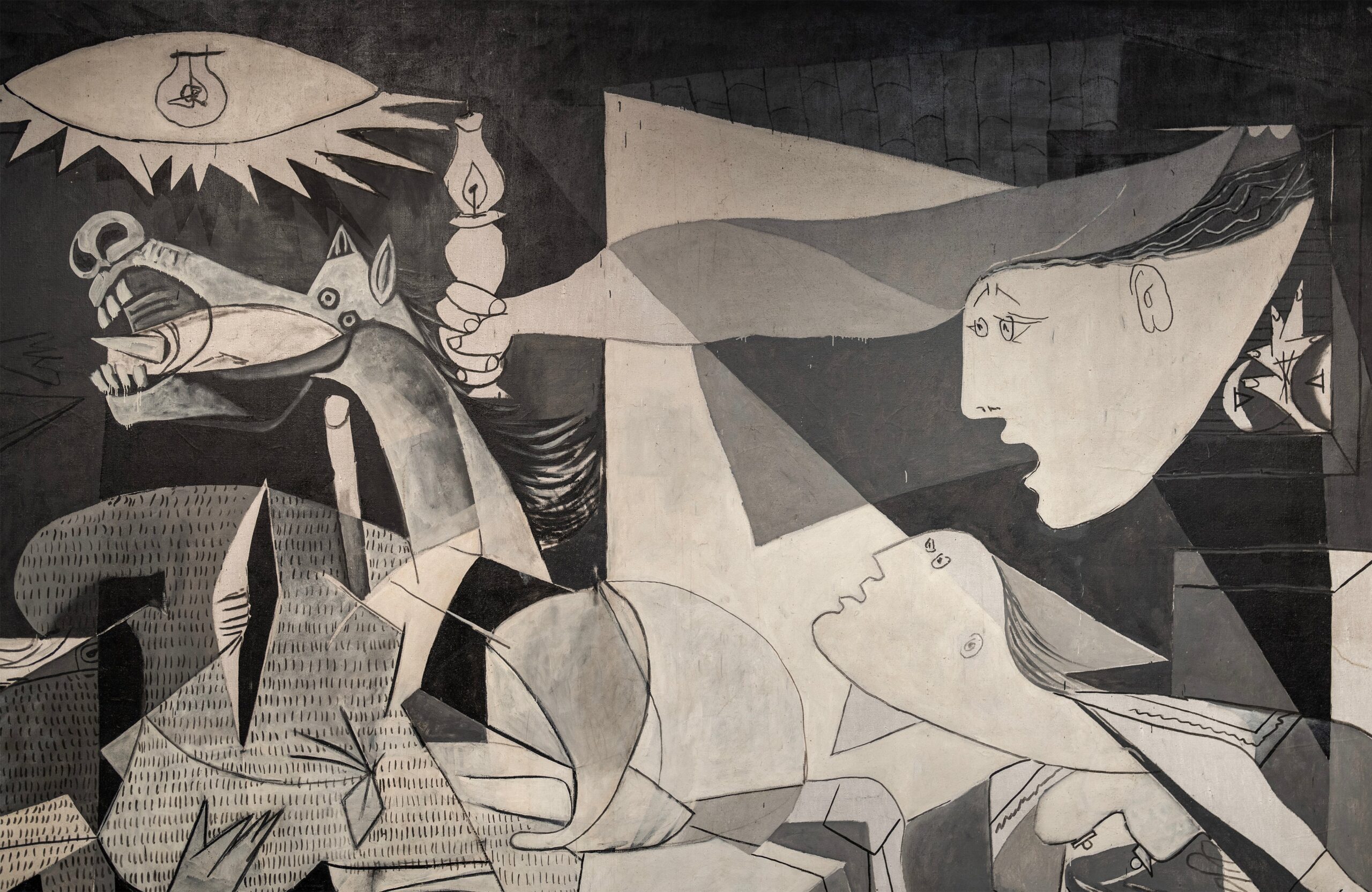
Guernica is full of recurring Picasso motifs: a bull, a dying horse, a lamp held aloft, a mother screaming over a dead child, a fallen soldier still gripping a broken sword. Readings circulate freely, from the bull as Spain, fascism, or Picasso himself, to the horse as the Republic or as suffering rendered general rather than specific. Picasso declined to settle any of it, and is recorded refusing to explain the bull and horse on the grounds that the public should do its own looking.
For a collector, that refusal matters. It is why the painting still generates books and lecture series ninety years on, and why dealers selling Guernica-adjacent prints lean on documented history rather than symbolism nobody can verify.
Exile, return, and a fresh custody dispute
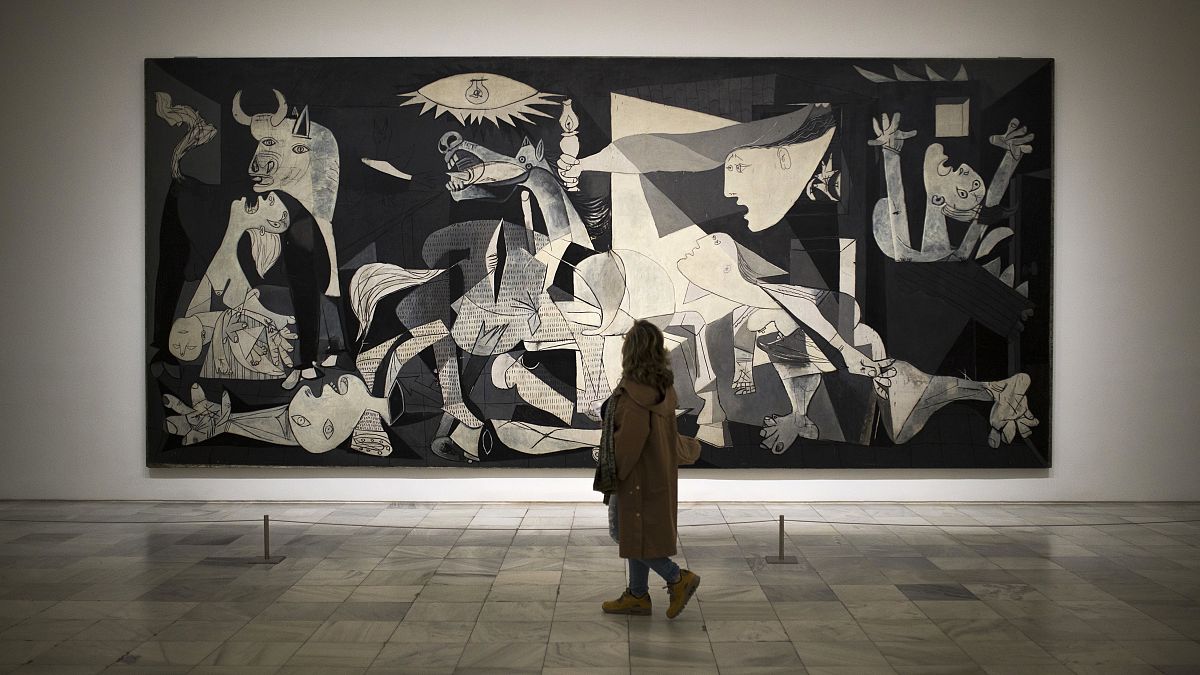
Picasso never let Guernica go to Spain while Franco lived. The Republican government bought the mural outright in 1937, but Picasso arranged for it to sit at New York’s Museum of Modern Art from 1939, then formalised that as an indefinite loan in 1958, on condition it return only once public liberties were restored. It landed in Madrid on 10 September 1981, on a scheduled Iberia flight whose captain broke the news to startled passengers, and hung behind bulletproof glass at the Casón del Buen Retiro before moving to the Reina Sofía in 1992, where it has stayed on the grounds that moving a ninety-year-old canvas of that size is itself a conservation risk.
That policy is being tested again in 2026. The Basque government has asked to borrow Guernica for Bilbao’s Guggenheim Museum from October this year to June 2027, marking the ninetieth anniversary of the bombing, and the Reina Sofía has so far held to its refusal to lend the work at all. It is a genuinely live argument, worth tracking for anyone building a collection around the painting.
Credit: Museo Reina Sofía, Madrid
What a collector can actually acquire
The nearest thing to owning a piece of Guernica‘s history is The Dream and Lie of Franco, the two etched plates Picasso produced between January and June 1937. The first fourteen scenes, made before the bombing, satirise Franco as a grotesque, shape-shifting figure; the final four, added on 7 June, are drawn directly from studies for the mural. Sold originally on postcard-sized sheets to fund the Republican government, the suite was later issued as a signed and numbered edition of 150, plus a larger unsigned edition of 850 printed by Roger Lacourière. A single sheet from that run, catalogued as Bloch 298 and Baer 616, carried a Sotheby’s estimate of £500 to £700 in a 2019 sale of prints from the collection of Picasso’s granddaughter, Marina Picasso, giving a useful benchmark for the lower end of this market.
Buyers should treat the Bloch and Baer catalogue numbers as the starting point for any purchase, check whether a sheet is pencil-signed or carries only the printed inkstamp Picasso allowed on the larger edition, and confirm the paper: genuine impressions were printed on Montval laid paper with chine collé. An “authentic Guernica etching” offered without those details is worth walking away from.
The tapestries: Guernica outside Spain
Because the painting does not travel, three woven copies have done much of the work of putting Guernica in front of audiences abroad. René and Jacqueline de la Baume Dürrbach wove all three at their Aubusson workshop, translating Picasso’s greys into warm browns and ochres at his direction. Nelson Rockefeller bought one in 1955; his family lent it to the United Nations in 1984, where it hung outside the Security Council chamber and became famous in its own right in February 2003, when officials covered it with a blue curtain rather than let it appear behind Colin Powell as he made the case for war in Iraq. After spending time on loan at the San Antonio Museum of Art and a brief return to the Rockefeller family in 2021, the tapestry was returned to the UN in February 2022, where it once again hangs outside the Security Council chamber. None of the three has ever come to public auction, but their exhibition history is the closest thing this market has to provenance.
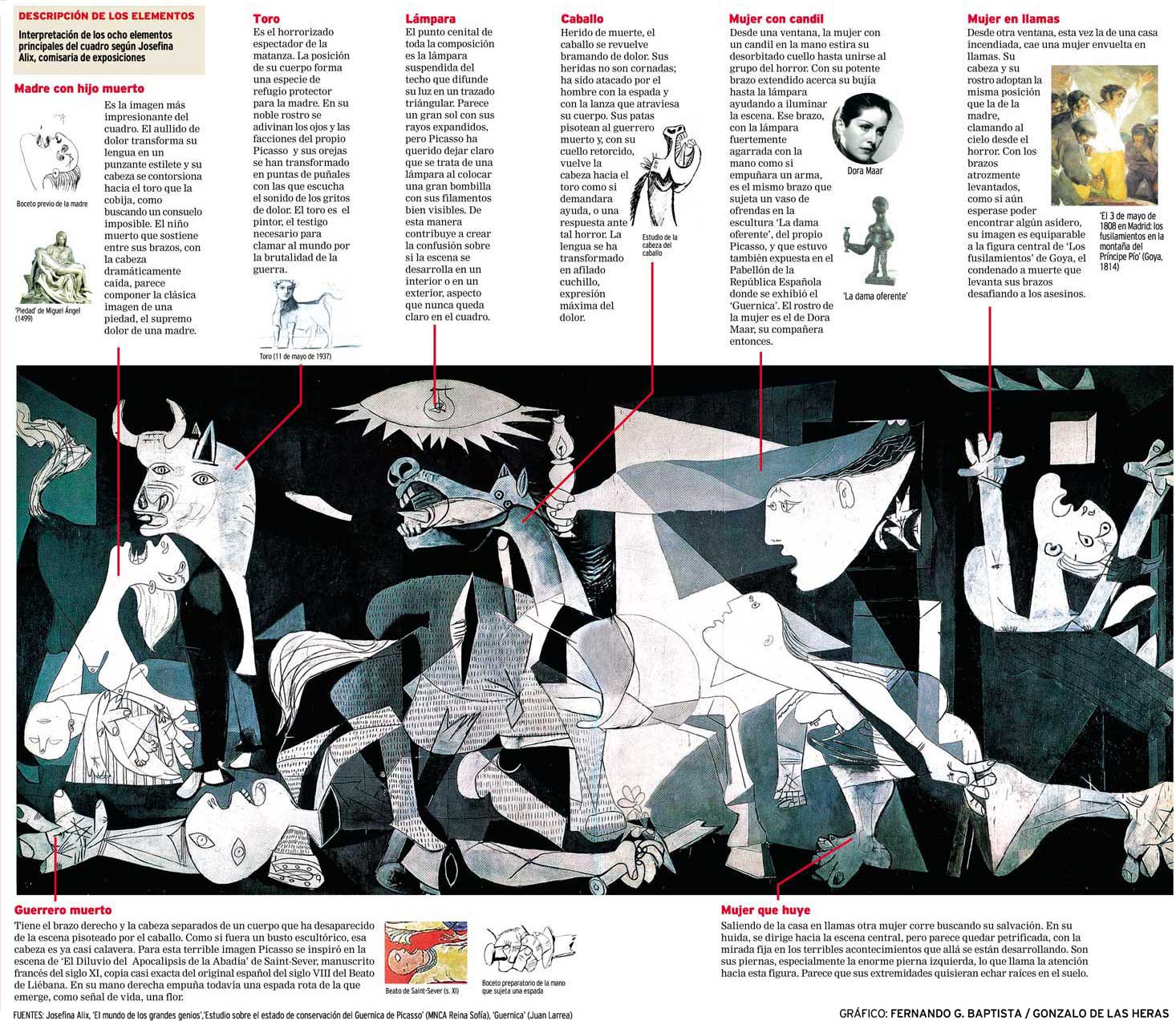
This infographic details the eight main elements of Guernica, based on the interpretation of exhibition curator Josefina Alix:
- Mother with dead child: Howling in agony with a stiletto-like tongue, her posture echoing Michelangelo’s classic Pietà.
- Bull: The horrified witness to the massacre. Its noble face resembles Picasso himself, serving as the painter’s cry against the brutality of war.
- Lamp: A central, sun-like bulb emitting triangular rays, deliberately creating spatial confusion about whether the scene is indoors or outdoors.
- Horse: Mortally wounded by a sword and spear, it turns toward the bull screaming with a dagger-like tongue, representing maximum pain.
- Woman with oil lamp: Bearing the face of Dora Maar, she leans from a window to illuminate the horrific scene with her candle.
- Woman in flames: Falling from a burning house with arms raised in horror, directly referencing the central figure in Goya’s ‘The Third of May 1808‘.
- Dead warrior: A decapitated and dismembered bust-like figure. His severed hand clutches a broken sword from which a single flower emerges as a sign of life.
- Fleeing woman: Rushing from the burning house but seemingly petrified by the events, her oversized leg appearing rooted to the ground.
Credit: elcorreo.com
The painting that can’t be bought, and the market that grew up around it
Guernica will not change hands again. The Reina Sofía treats it as untouchable even for domestic loans, let alone sale, and that permanence is what has pushed collector interest outward, into the etchings Picasso allowed to circulate, the tapestries he approved, and the exhibition history that keeps generating argument, as the 2026 Bilbao request shows.
What holds the market together is documentation rather than sentiment. A Dream and Lie of Franco sheet is worth buying for its edition number and its paper, not for a claim about what the bull means, because Picasso never gave an answer to that question. Anyone building a collection around Guernica is really collecting the evidence trail of a single, unrepeatable month in his studio, and that trail rewards exactly the kind of scrutiny most memorabilia markets try to discourage.