



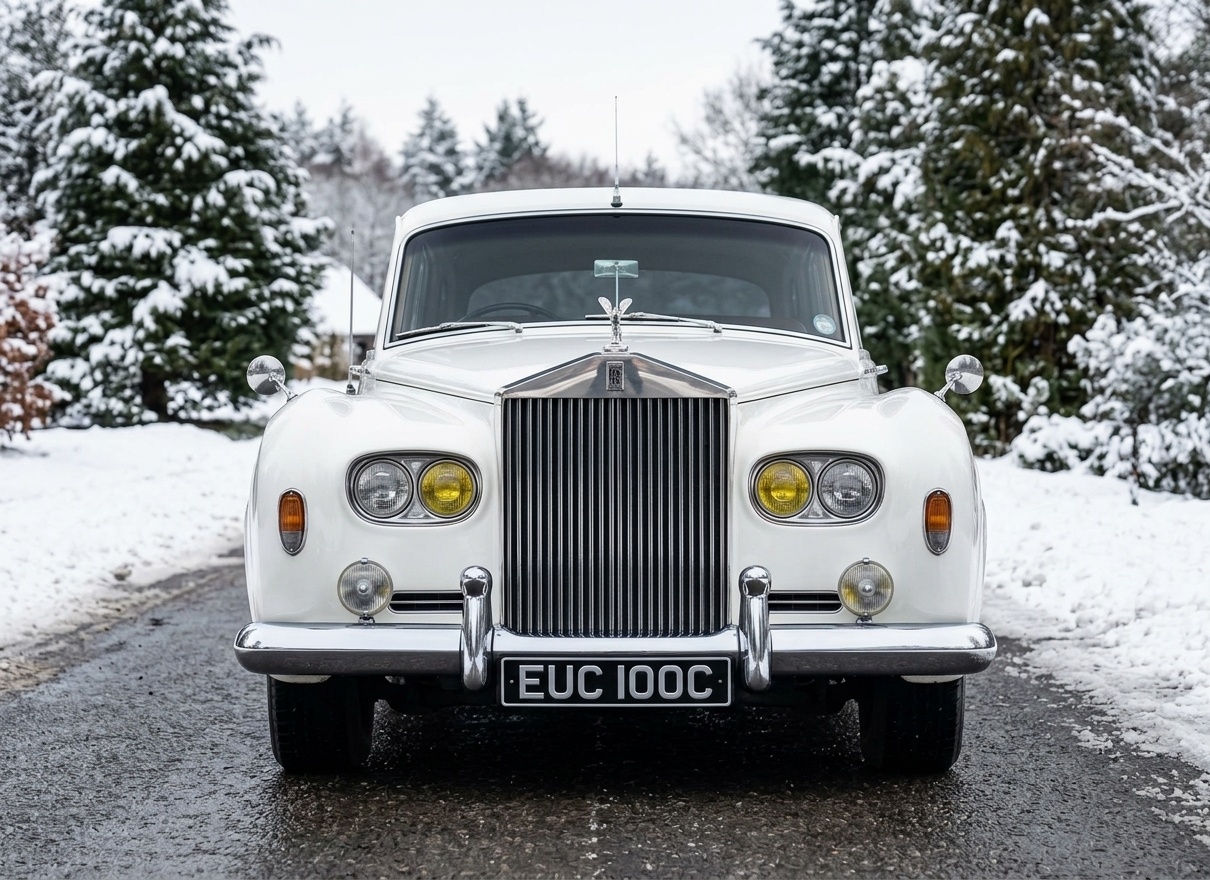
A gift is not always just a gift. Sometimes it carries an eloquent message, a metaphor, a symbol of transformation. Only John Lennon could have given this one: a silver lighter that had no place in his new life in white.
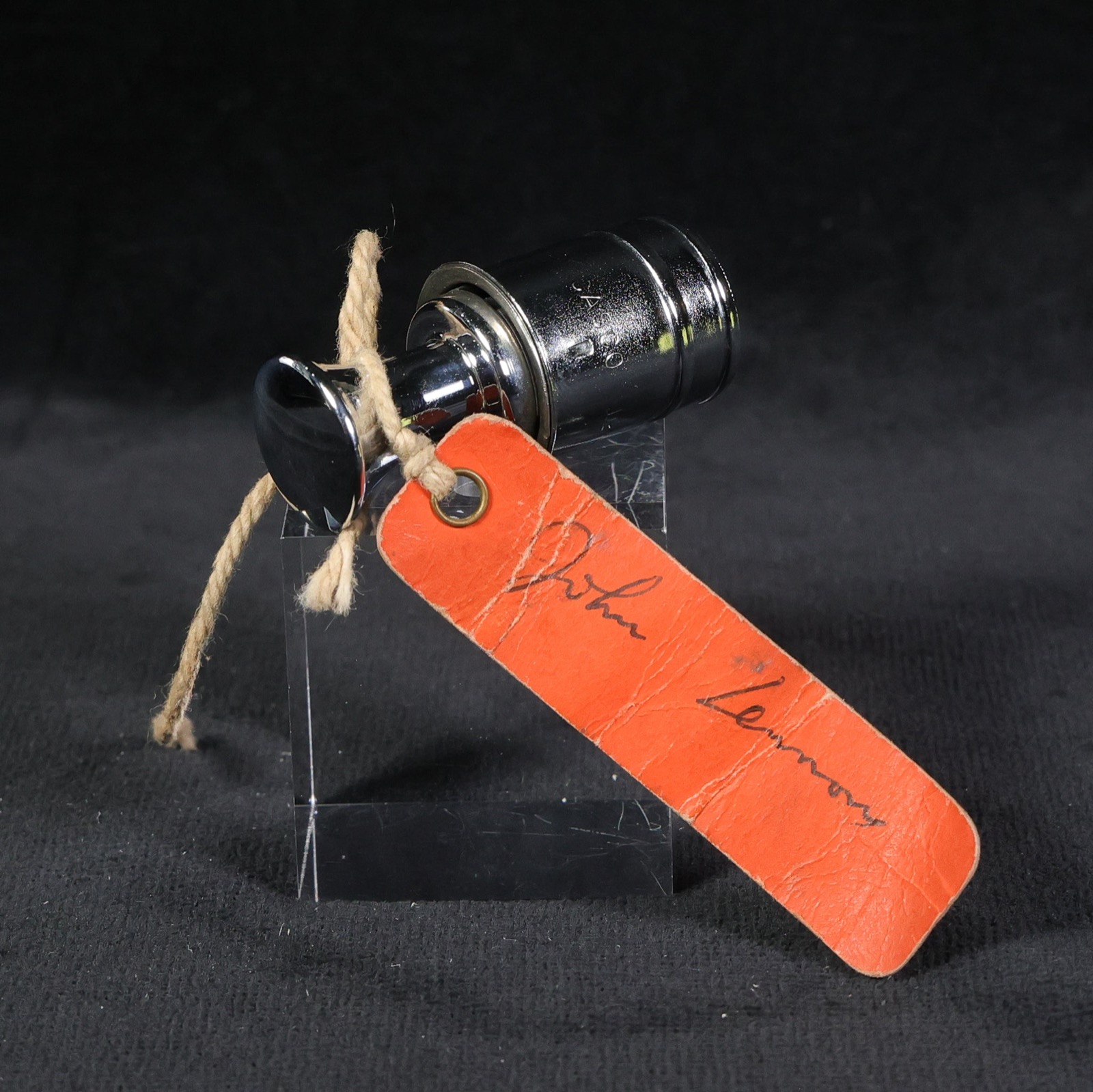
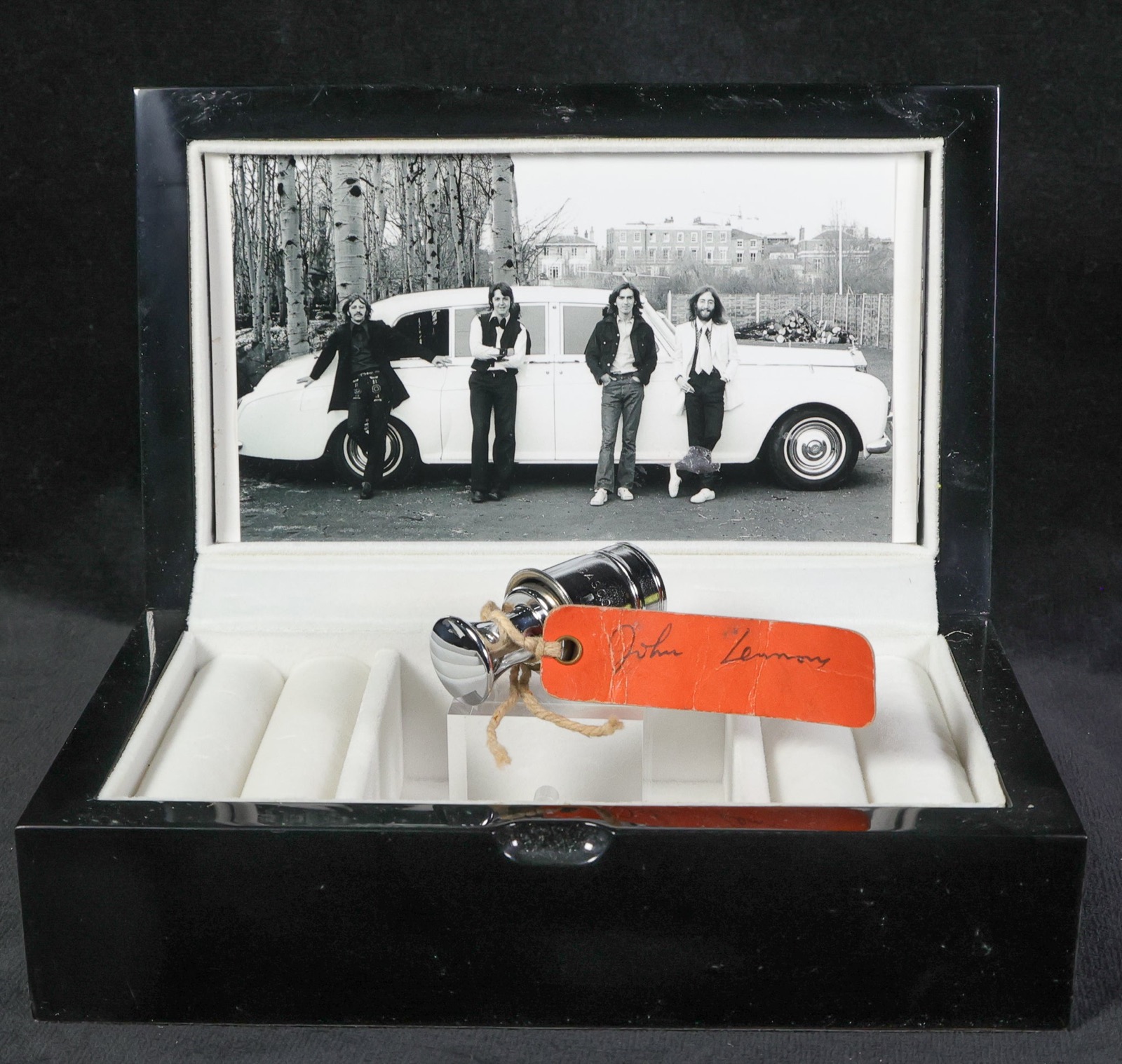
It comes from his Rolls-Royce Phantom V (EUC 100C). A red tag tied to it bears his signature in black ink.
By the time Lennon gave the lighter away, he had already taken a new path: one that would change not only his life, but the Beatles themselves.
The story of Lennon’s Rolls-Royce Phantom V (EUC 100C)
Steve Easton, the 18-year-old salesman who found the car, remembered what Lennon asked for: “he wanted everything white, the interior, upholstery the carpets and even the steering wheel”. The car was a 1965 Rolls-Royce Phantom V, registration EUC 100C, and its silver fittings had no place in the new scheme. A piece of John Lennon signed memorabilia shows where one of them went. It is the car’s silver cigar lighter, taken out while the car was being customised for Lennon. Lennon gave it to the head mechanic of a garage in Ascot, Berkshire, and signed the red tag tied to it, “John Lennon”, in black ink.
From the lighter, the story runs back to Yoko Ono, whose white art Lennon first saw at a London gallery in 1966, and further back to the car’s first owner, a Spitfire pilot who hired it out to film-makers. It runs forward through the car’s later years on screen and with the Beatles’ manager, Allen Klein, and it ends in Ascot, where the mechanic’s family kept the lighter and wrote down how they came by it. The sections below follow each thread.
A car cigar lighter is a removable, electrically heated plug that sits in a socket in the car. Pushed in like a button, it sends current through a thin, flat coil of nichrome strip. Within seconds the coil glows orange, a bimetallic strip bends and releases the catch, and the handle pops out, hot enough to light a cigar or a cigarette.
Discover all in our:
John Lennon signed memorabilia
Credit: Paul Fraser Collectibles
A red tag signed in black ink
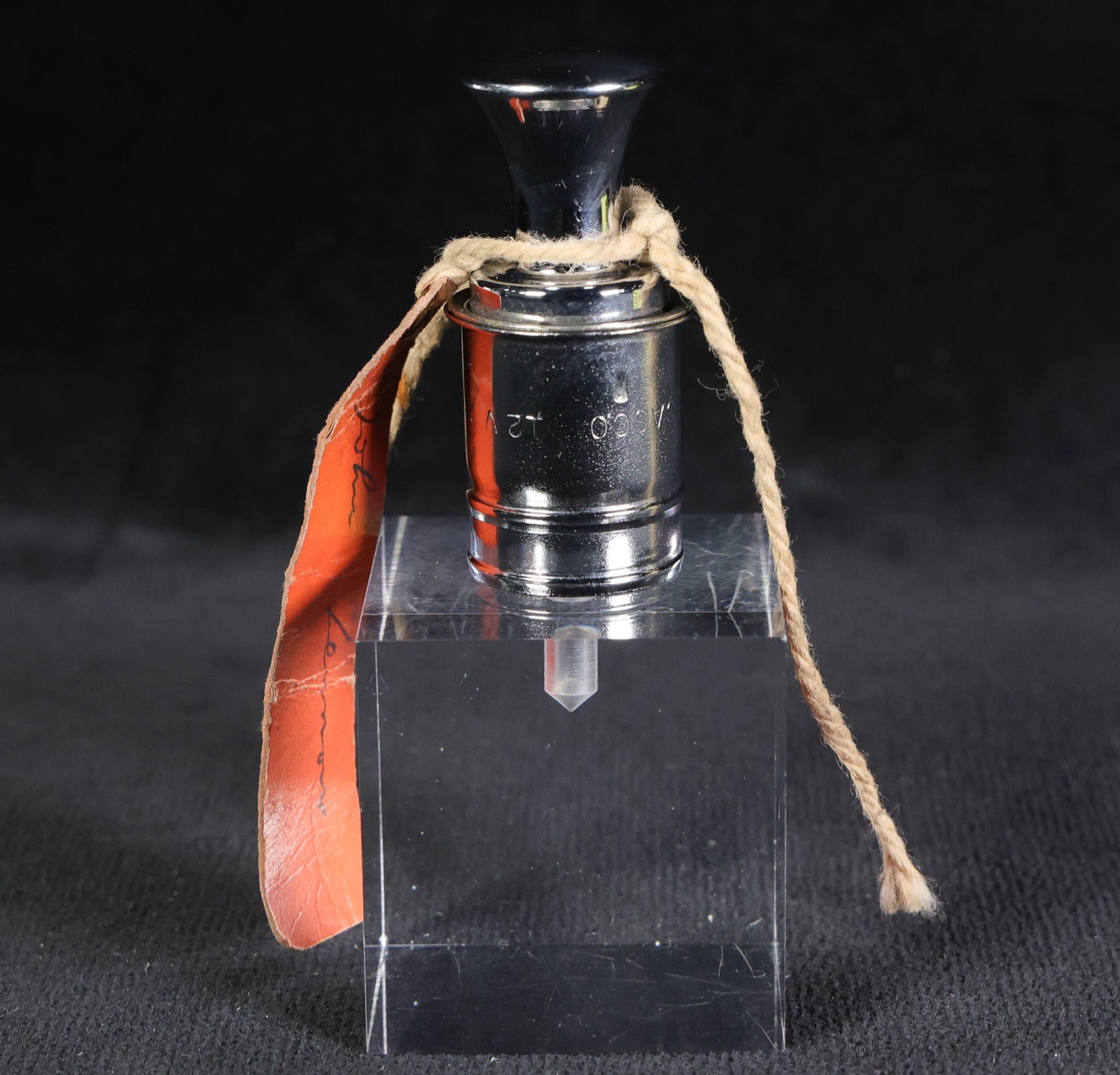
Natural twine is knotted round the neck of the lighter and threaded through a brass eyelet in a red tag. The tag is crazed with fine cracks and creased across its width. Lennon’s signature runs along it, a looping J and then a long, stretched “Lennon”. The reverse reads “(Mulliner) C54 699”, the name of the coachbuilders who worked on the car.
The lighter itself has a polished knob that flares out like the bell of a trumpet, made to be pushed home with a thumb. Its barrel is stamped “CASCO 12 V”. Casco, the Connecticut Automotive Specialty Company of Bridgeport, patented a car lighter in 1928 and developed the modern automatic version in 1956.
Credit: Paul Fraser Collectibles
White, from the Indica Gallery to the White Album
Lennon met Yoko Ono in November 1966 at the Indica Gallery, in the basement of the Indica Bookshop in Mason’s Yard, off Duke Street in Mayfair. Her exhibition, Unfinished Paintings and Objects, opened the next day, and much of it was white. Add Colour Painting was made of white wood panels, with brushes and paints set out on a white chair. Play It By Trust, also called White Chess Set, came with an instruction: “Play it for as long as you can remember who is your opponent and who is your own self.”
Lennon asked whether he could hammer a nail into one piece, and Ono said no. “She’s more interested in it looking nice and pretty and white for the opening,” he said later.
The relationship took time. Aaron Krerowicz, who writes on the Beatles, describes Ono as having “gradually and progressively” occupied Lennon’s thoughts from that first meeting until they became a couple in 1968. Ono had been a pacifist long before she met Lennon, and Krerowicz reads her white in that light: in the context of war, he writes, “white is the color of surrender”.
From 1968 the colour spread through Lennon’s work and home. The Beatles’ album of that year, The Beatles, is better known as the White Album for its plain white sleeve. Rolls-Royce describes the period as one of white clothes, of a Berkshire house decorated in bright white inside and out, and of “a distinctly minimalist aesthetic”. Lennon composed ‘Imagine’ on an all-white piano.
Credit: Eric Koch for Anefo, Nationaal Archief
A Spitfire pilot’s hire car
The car began as chassis 5VD63, which left the Rolls-Royce works at Crewe for the coachbuilders HJ Mulliner Park Ward on 22 December 1964. They bodied it as a seven-seat limousine, and Patrick Barthropp Ltd of London took delivery in May 1965, in two-tone black over green.
The firm’s co-founder, Wing Commander Paddy Barthropp, had joined No 602 Squadron, flying Spitfires, on 8 September 1940, and went into action for the first time on 15 September, at the climax of the Battle of Britain. Shot down near St Omer in May 1942, he was a prisoner of war until 2 May 1945. He left the RAF in December 1957 and started a chauffeur-driven Rolls-Royce hire business in London. One of his cars appeared in the Bond film Casino Royale.
The firm also supplied cars to film companies. In early 1966 a Rolls-Royce was needed for Georgy Girl, Silvio Narizzano’s comedy starring Lynn Redgrave and Charlotte Rampling, and 5VD63 went before the cameras under Barthropp’s personal registration, PPB1. The film was shot in black and white, which hid the car’s colours: its sides were “velvet green” and its roof, bonnet and boot “valentines black”.
Everything white, down to the steering wheel
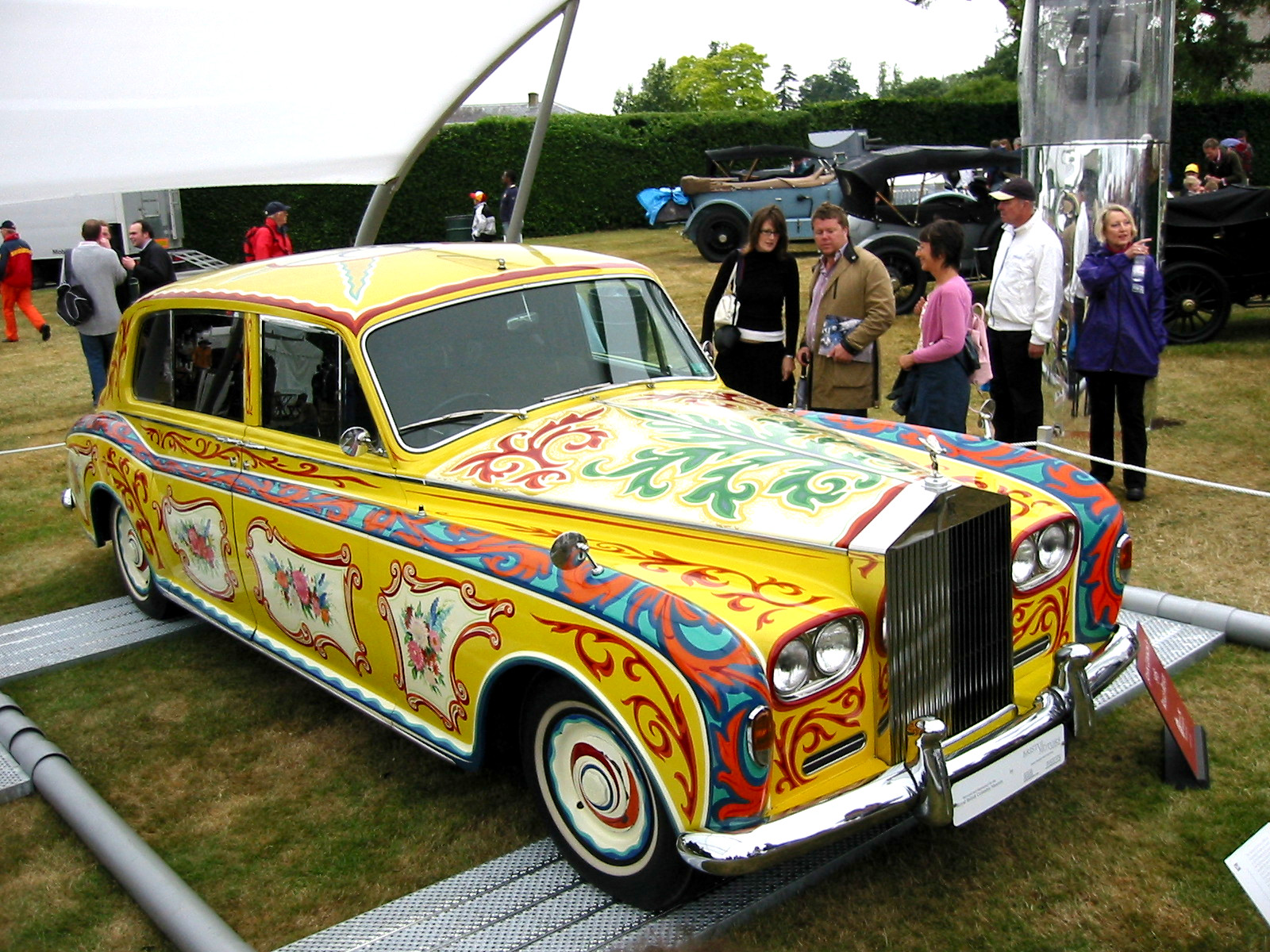
Lennon already had one Phantom V. He had commissioned it in December 1964, black all over, down to the windows, bumpers and hub caps, and in May 1967 he had it resprayed yellow and hand-painted with swirls of red, orange, green and blue.
For a second one, Lennon sent his driver, Les Anthony, to find a Phantom V second-hand. Easton, then a trainee salesman with Golden Wheels Garages in Sloane Avenue, Chelsea, found the Barthropp car and drove it to Lennon’s home at Weybridge in Surrey, where Lennon and Yoko Ono met him. Lennon decided almost at once that he wanted it, and that he wanted it white.
When this happened is disputed. Easton, as reported in 2016, put the sale in 1966, and so did Allen Klein’s driver, Alf Weaver, in his memoir. Rolls-Royce dates the purchase to 1968, to coincide with the White Album.
The car was made white inside and out, with white seat covers and a white steering wheel, and fitted with a sunroof, a Philips turntable, an 8-track player, a telephone and a television. Mulliner changed its silver fittings for gold to suit the scheme, and the silver cigar lighter came out of the car.
Credit: edvvc, CC BY 2.0, via Wikimedia Commons
On screen again, with Lennon and with Klein
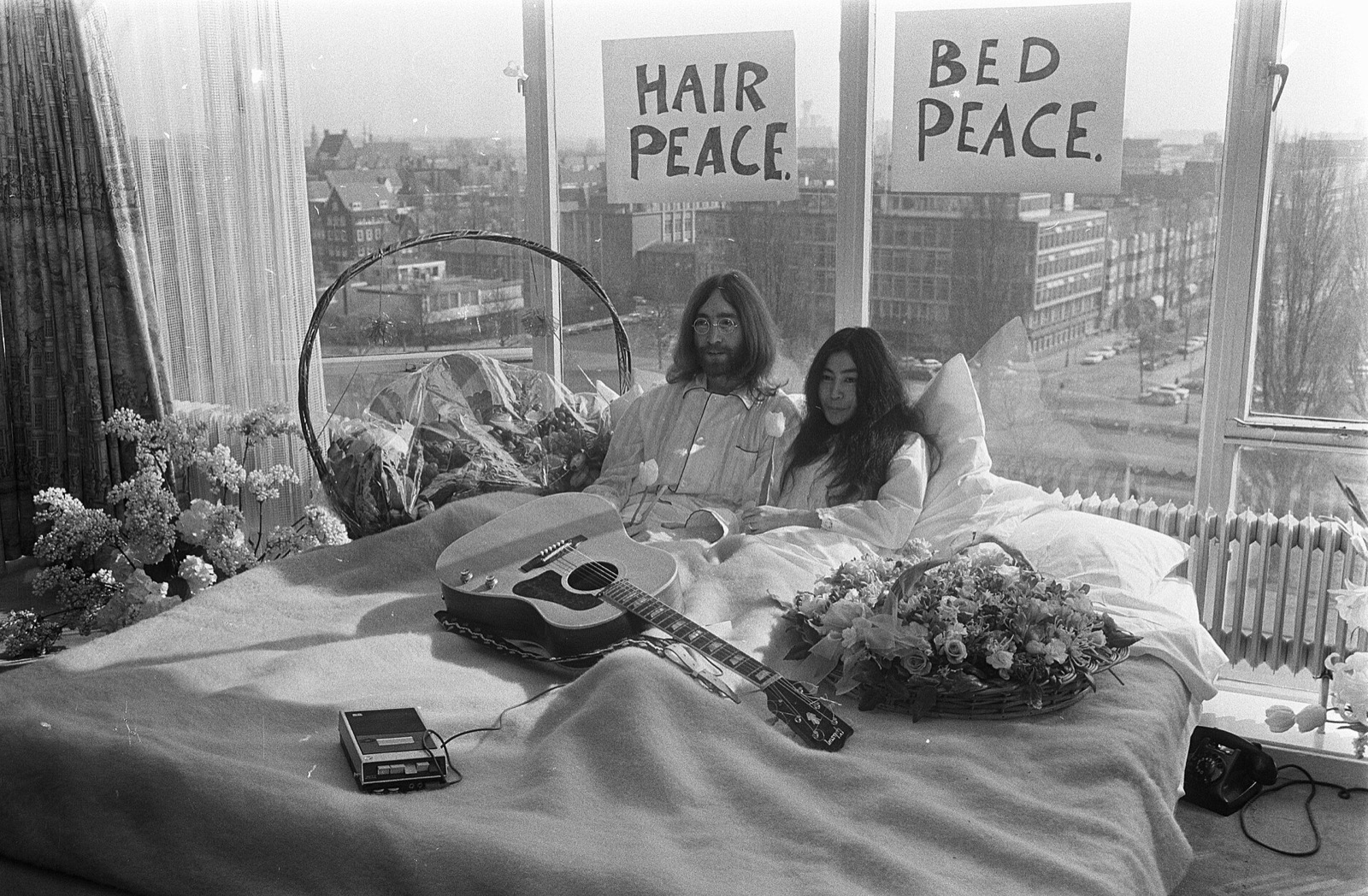
In March 1969 the white car went with Lennon and Ono to Amsterdam for their honeymoon bed-in. A fortnight after it came back, on 9 April 1969, it was the backdrop for one of the Beatles’ last photo sessions together. Rolls-Royce records that it appears in two films released in 1970. One is Let It Be, made from the Beatles’ January 1969 sessions, which features their unannounced rooftop concert, their last performance in public. The other is Performance, directed by Donald Cammell and Nicolas Roeg, with Mick Jagger.
In early December 1969 it carried the couple along snow-covered roads from a London studio to Lavenham in Suffolk. There, on 5 December, a balloon was launched for their film Apotheosis 2 while a BBC crew filmed them for the documentary 24 Hours: The World of John and Yoko. In footage of the drive, only one of the car’s headlights is working.
Lennon sold the car to Allen Klein, founder of ABKCO Records and the Beatles’ manager at the time. Rolls-Royce dates the sale to September 1969, while the 60×50 blog’s history of the car places the transfer towards the end of that year. Weaver collected it from Hoopers in Kilburn and drove it, on and off, for the next decade.
Klein went on to produce The Greek Tycoon, released in 1978 with Anthony Quinn and Jacqueline Bisset. When a scene needed a Rolls-Royce, his biographer Fred Goodman writes, Klein would not rent one. He “insisted on using the white Rolls he’d bought from John Lennon and kept in London” and had Weaver bring it to Greece.
Klein died in 2009, and the car passed to his son, Jody Klein. After eight years of restoration at Rolls-Royce and Bentley Garages in Bromsgrove, Worcestershire, it reappeared in 2016 at the Rolls-Royce Enthusiasts’ Club rally at Burghley House and won best in class.
Credit: Paul Fraser Collectibles
Head mechanic at a garage in Ascot
Lennon gave the lighter to a mechanic he had come to know at a garage in Ascot, Berkshire, five minutes’ drive from Tittenhurst Park, the house he and Ono bought on 4 May 1969 and moved into on 11 August. The mechanic’s family kept it, tag and all, and his daughter-in-law set down its story in the letter of provenance that comes with it:
My father in law was head mechanic at a garage in Ascot, Berkshire… this lighter was taken from a car that was being customised for John Lennon. He offered it to my father in law as they had formed an excellent relationship. To show its authenticity John Lennon signed the tag on the lighter.
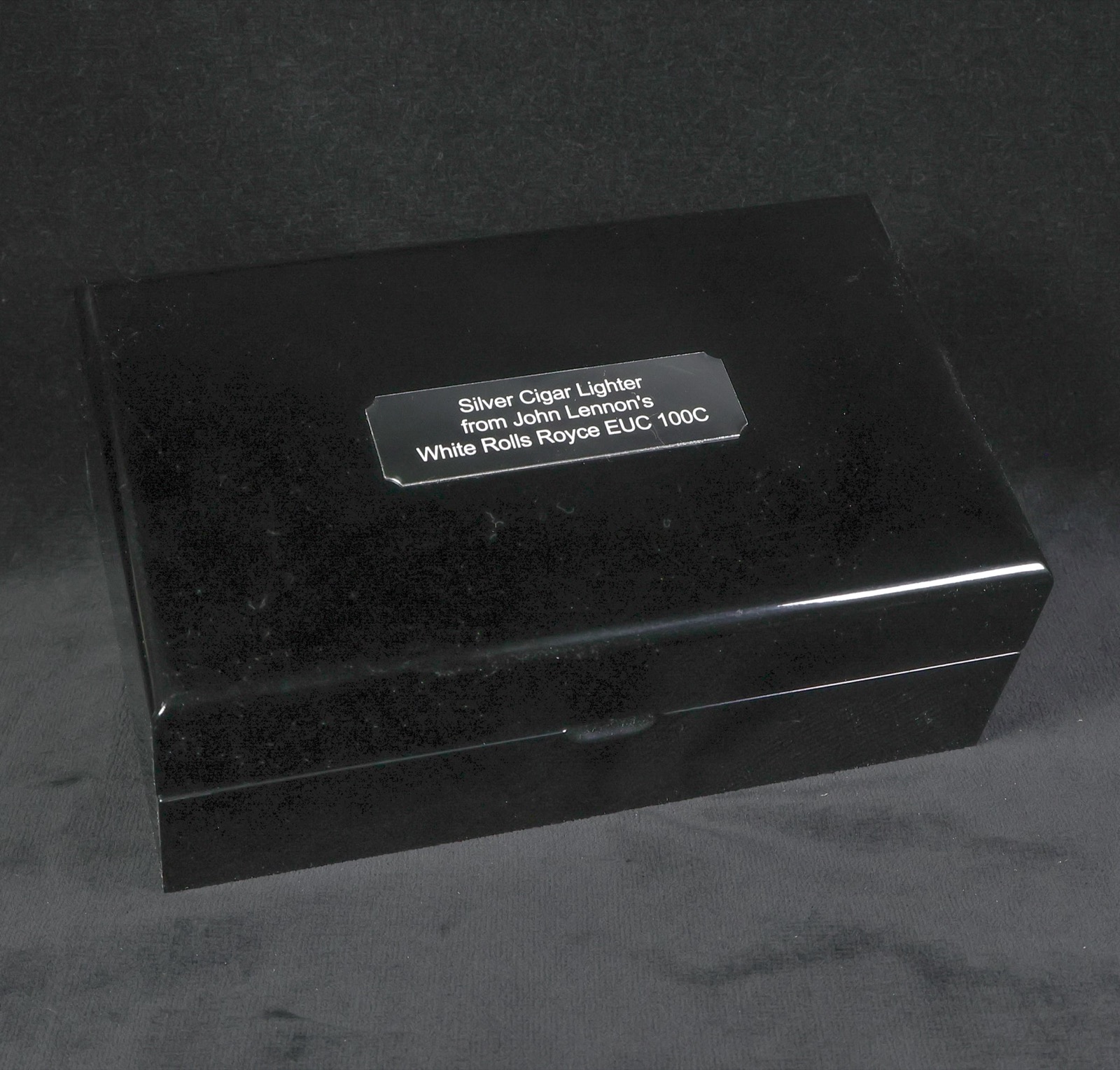
The lighter is kept in a black presentation box. A plaque on the lid reads “Silver Cigar Lighter from John Lennon’s White Rolls Royce EUC 100C”.
Credit: Paul Fraser Collectibles
What the white car left behind
Lennon wanted everything in EUC 100C white, down to the steering wheel, and the Klein family have restored the car to that specification. The silver lighter is what the change left over. It went to a head mechanic in Ascot, with Lennon’s signature on its tag to vouch for where it came from, and the mechanic’s family kept it.
The cigar lighter is now offered by Paul Fraser Collectibles for £15,995 (US$21,230.50), with photographs of the lighter, its signed tag and its presentation box.