



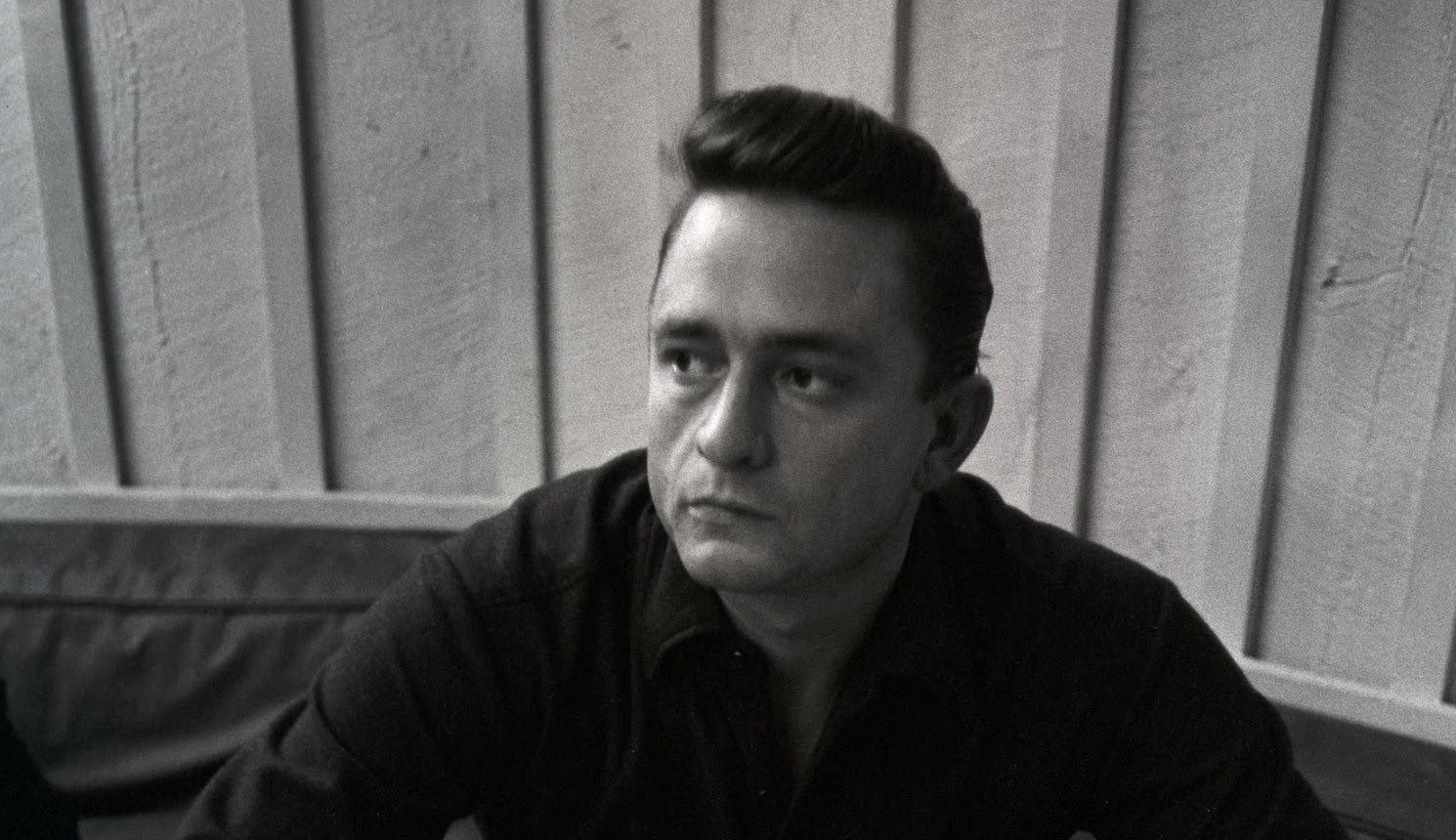
Johnny Cash memorabilia is a major category in country and Americana music collecting. For decades, Cash produced thousands of autographs, signing stage doors for eager fans while his “House of Cash” offices in Hendersonville, Tennessee processed mountains of mail with secretarial signatures, rubber stamps, and copies. These items, cherished by their original recipients, hold little monetary value. Promotional photos, fan club newsletters, and Columbia records with these types of “signatures” often sell for under $200.
In this market, real value depends on estate history, not on mass-produced “memorabilia”.
Unlike many artists who lost or sold important personal and musical items, Cash’s most important possessions were preserved and catalogued as if they were in a museum.
Then, in September 2004, Sotheby’s New York auction house sold all contents of The Estate of Johnny Cash and June Carter Cash over three days. This auction, which included everything from Cash’s Grammy Awards to his custom Martin guitars, reshaped the value of Cash’s possessions worldwide.
Today, collectors and private archives tend to avoid typical autographed items and instead seek artefacts that connect back to either the 2004 Sotheby’s auction or later sales by Julien’s Auctions.
Anything with clear institutional history and proof of use during Cash’s prime years (the 1950s Sun Records rise, the late-1960s prison recordings, or the 1990s American Recordings revival) can fetch five or six figures.
This guide covers the most historically significant Cash artefacts on the market, with real-world auction values and advice on how to identify and verify authentic material.
Discover all in our:
Collectors guide to Johnny Cash memorabilia
1. 1954 Martin D-18 acoustic guitar: the Grand Ole Opry debut instrument (1954 to 1956, $100,000 to $192,000+)
Although Cash became known for his black acoustic guitars later in his career, the most historically significant instrument from his early life was a standard natural-finish 1954 Martin D-18.
Cash bought this guitar at the start of his professional career and used it as his primary recording and stage instrument between 1954 and 1956. This was the same period when he auditioned for Sam Phillips at Sun Records and recorded American classics including “Hey, Porter”, “Folsom Prison Blues”, and “I Walk the Line”.
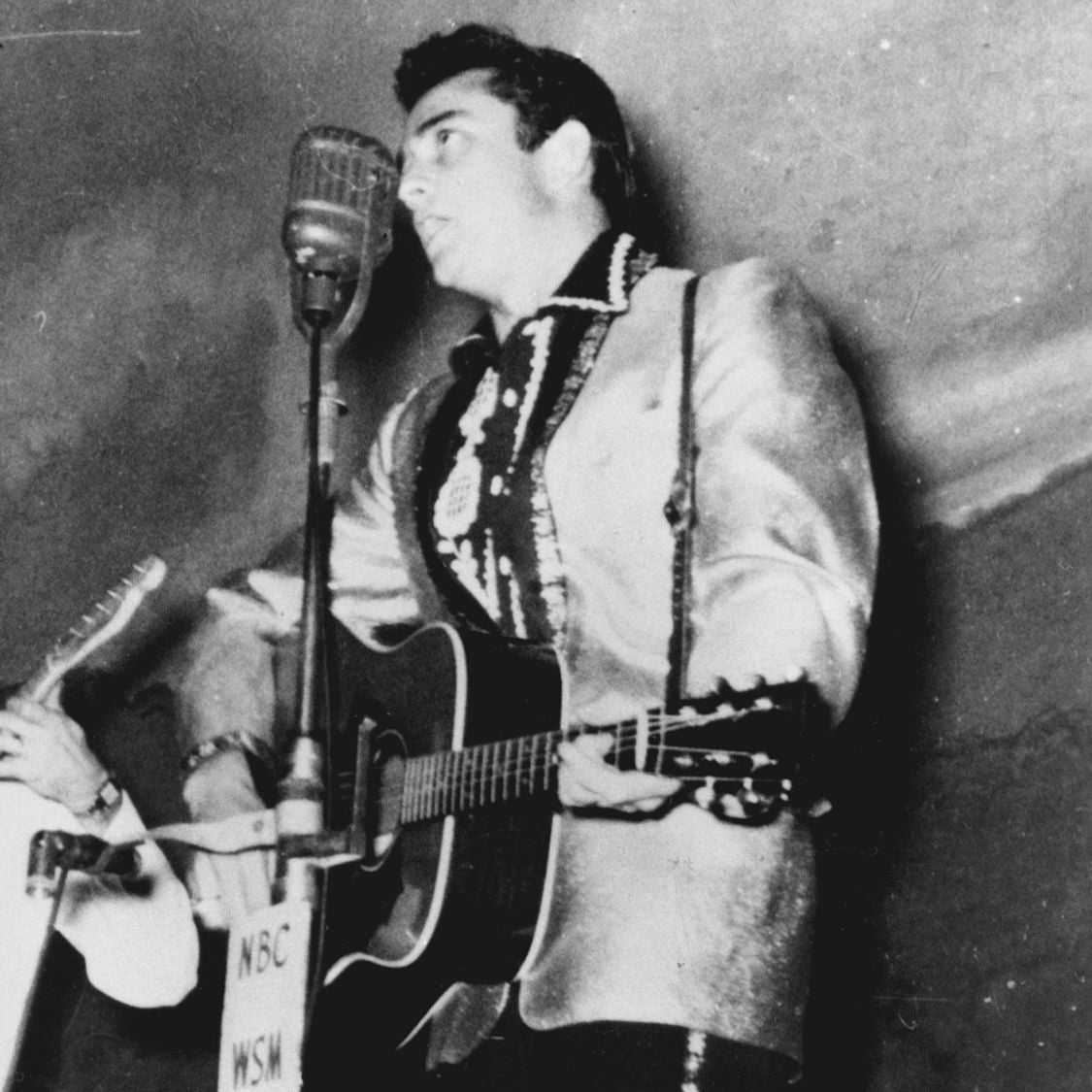
This was the guitar Cash took on stage for his historic debut at the Grand Ole Opry on 7 July 1956, where he first met his future wife, June Carter. With its heavy play wear and family history, this foundation of country and rockabilly history sold at Julien’s Auctions in May 2026 for $192,000, nearly doubling its presale estimate of $100,000.
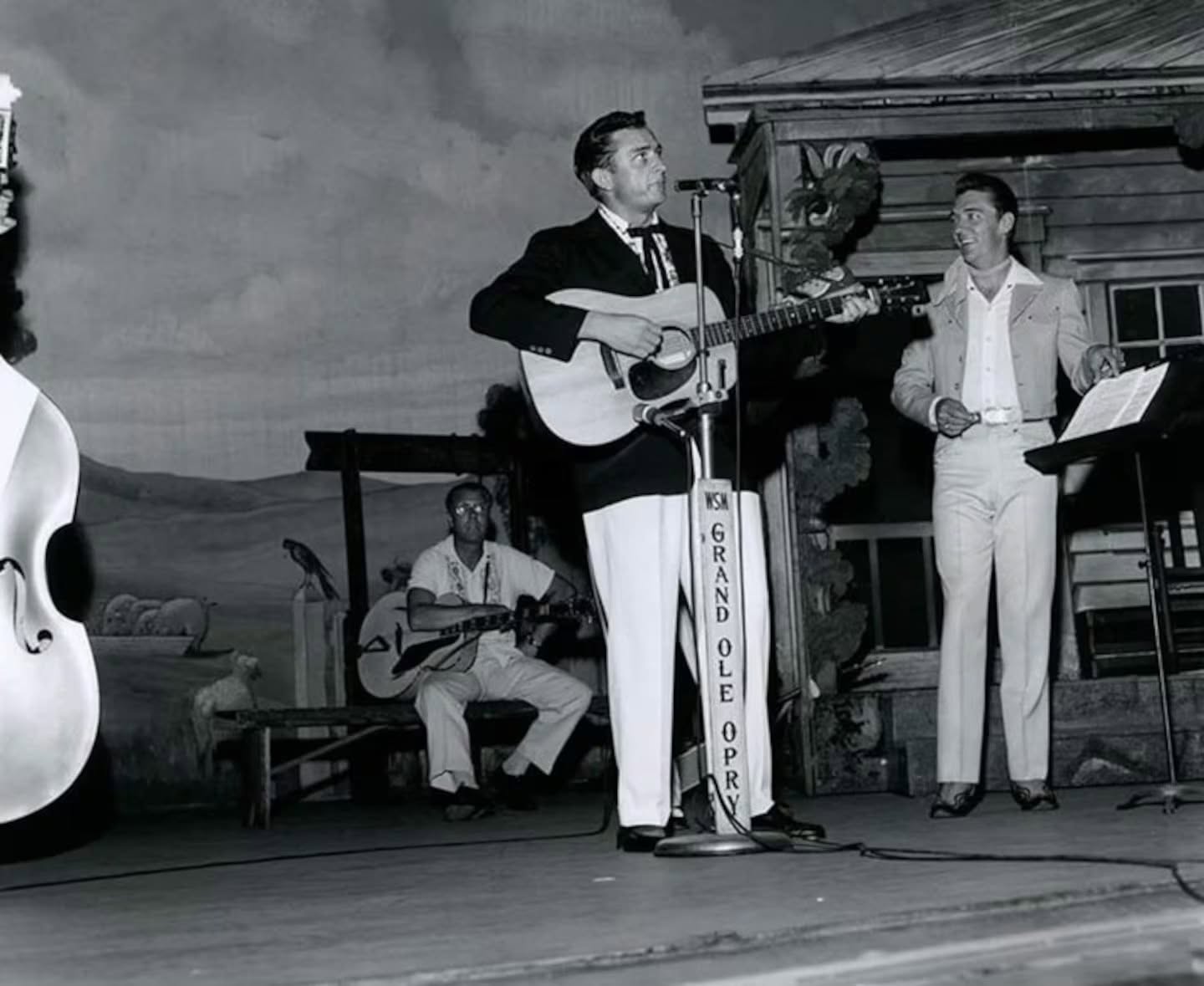
Credit: Kansas City Guitar Club
2. 1986 ‘Class of ’55’ spoken word Grammy Award: joint rockabilly trophy (1986, $150,000 to $187,200+)
While standard music industry awards and sales plaques from Cash’s later career often sell for modest four-figure amounts, primary Grammy Awards given to the artist are highly valued historical items. At the September 2004 Sotheby’s auction of the Estate of Johnny Cash and June Carter Cash, this specific Grammy trophy (awarded jointly to Johnny Cash, Carl Perkins, Jerry Lee Lewis, Roy Orbison, Sam Phillips, Rick Nelson, and producer Chips Moman for the album Class of ’55: Memphis Rock & Roll Homecoming) went far beyond its presale estimate of $7,000.
Intense bidding came from collectors recognising it as a significant rockabilly artefact. The award sold for $187,200, making it the most expensive item in the entire 800-lot estate auction.
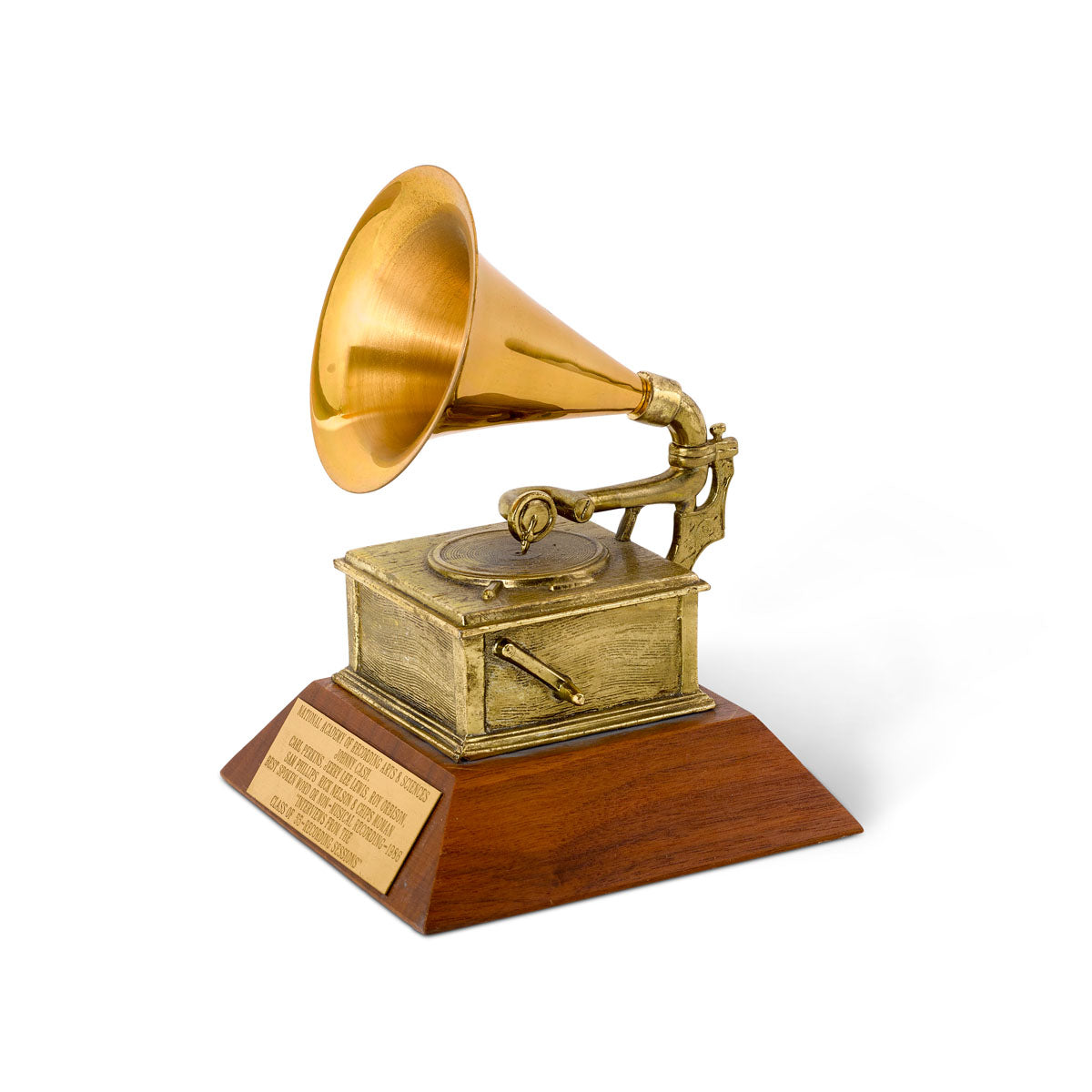
Credit: smithandsinge.
3. 1997 C.F. Martin D-42JC signature model black acoustic guitar: Prototype #3 (1997, $100,000 to $131,200+)
Throughout his 50-year career, Cash preferred Martin dreadnought acoustics in polished black lacquer. In the late 1990s, C.F. Martin & Co. collaborated with Cash to create a limited-edition signature model, the D-42JC, featuring a black finish, abalone pearl star inlays across the fretboard, and a label signed by Cash and C.F. Martin IV.
Before the limited commercial run of 80 guitars was available, Martin produced three prototypes for Cash’s approval. Cash kept Prototype #1 at home and used Prototype #3 in his studio during his later collaboration with producer Rick Rubin. With proven use from his personal collection, Prototype #3 sold for $131,200 at the 2004 Sotheby’s auction, while standard production models from the commercial run today trade between $10,000 and $20,000 in good condition.
Credit: GuitarWorld
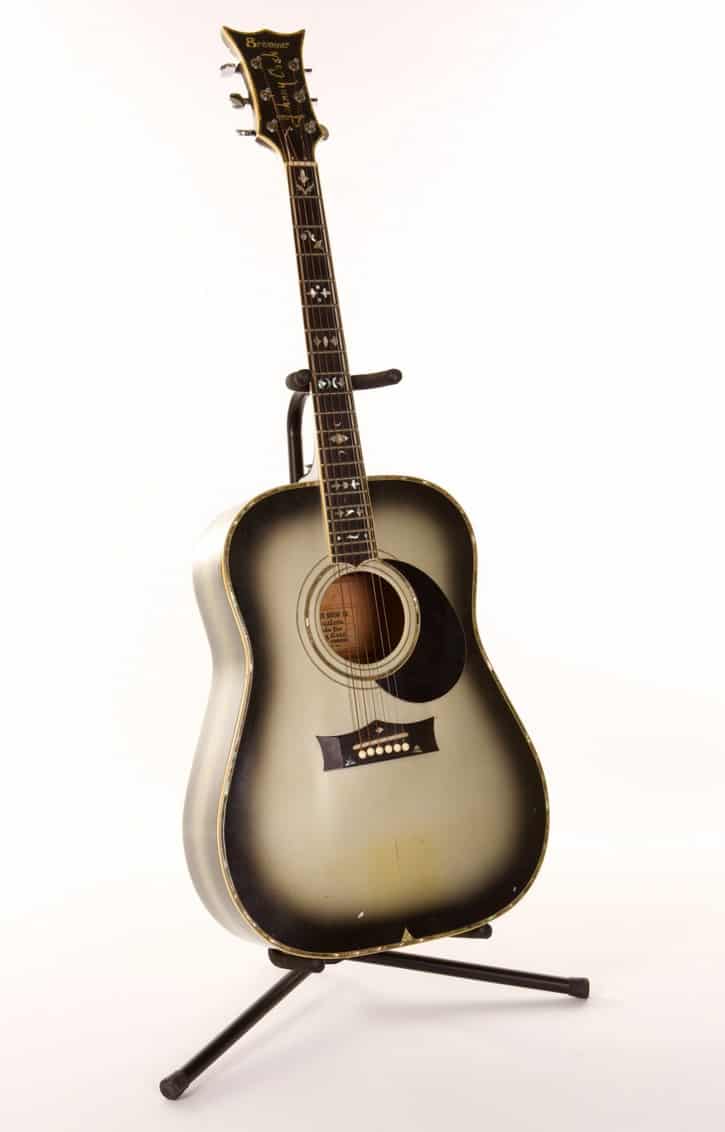
4. 1960s Billy Grammer custom acoustic guitar: ‘The Johnny Cash Show’ tour bus guitar (1960 to 1971, $30,000 to $131,200+)
Billy Grammer was a well-known Grand Ole Opry performer and guitar maker who co-founded the Grammer Guitar Company in Nashville in 1965. To promote his brand, Grammer built a custom acoustic guitar for Cash, featuring a distinctive sunburst finish, a unique pickguard shape, and a mother-of-pearl fretboard block inscribed with “Made For Johnny Cash”.
This guitar travelled with Cash on his tour bus during the late 1960s. It was frequently used on the set of his weekly ABC variety series, The Johnny Cash Show (1969 to 1971), where he welcomed musical guests like Bob Dylan and Ray Charles. This guitar sold for $131,200 at Sotheby’s in September 2004, setting a standard for custom Nashville-built guitars, while other verified Grammer guitars from Cash’s collection have sold for $29,440 or more at Julien’s Auctions.
Credit: Country Music Hall of Fame
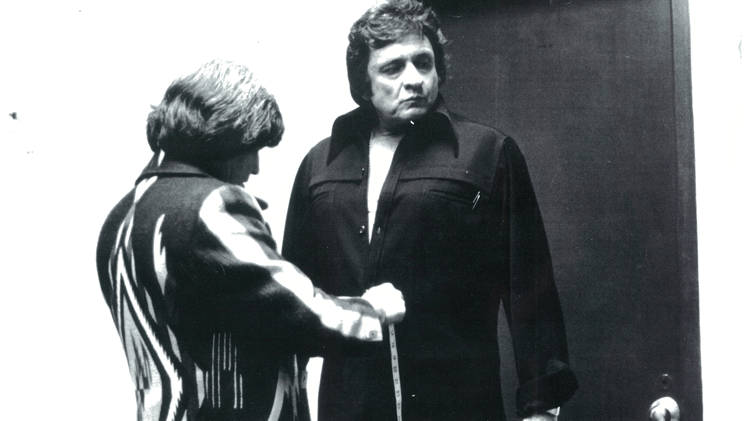
5. Manuel Cuevas black fringed duster coat: the ‘Hurt’ music video wardrobe (1994 to 2003, $16,000 to $27,600+)
Manuel Cuevas served as Cash’s exclusive wardrobe designer for decades, creating the tailored black coats and suits that defined his style. While standard stage-worn suits from Manuel’s Nashville shop generally sell for $7,000 to $10,000 at auction, garments tied to important cultural moments fetch high prices.
The most valuable textile in Cash’s story is the black fringed duster coat he wore in Mark Romanek’s MTV video for Nine Inch Nails’ “Hurt”, filmed at Cash’s House of Cash museum shortly before his death in 2003. That coat sold for $27,600 at Sotheby’s in 2004. Another custom black coat worn by Cash on the album covers of American Recordings (1994) and Unchained (1996), with photographic proof from Tamara Reynolds, sold for $16,250 at Julien’s Auctions.
Credit: Country Music Hall of Fame
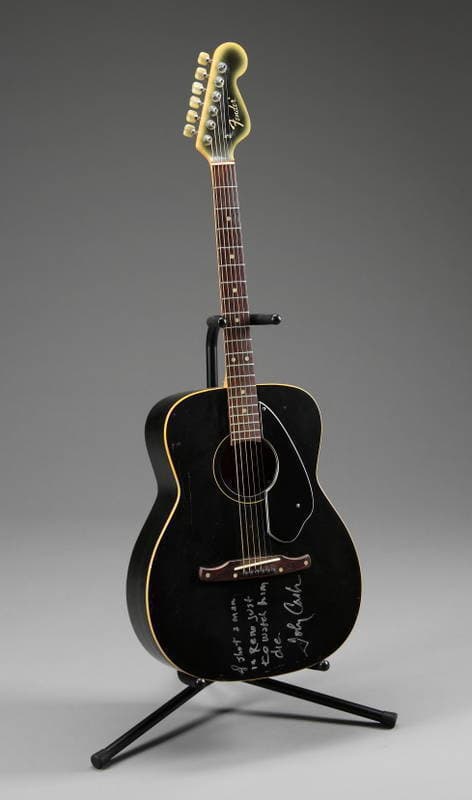
6. 1960s custom Fender acoustic: the ‘I Shot a Man in Reno’ inscribed guitar (1960s to 1977, $50,000 to $62,500+)
Cash signed thousands of promotional items with a simple marker script, so standard autographs have minimal value unless linked to a historically significant object. In the 1960s, Cash played a black custom Fender acoustic guitar during live performances across the US and at the Grand Ole Opry.
In 1977, Cash gave this instrument to his daughter, Cindy Cash. To personalise the gift, he used a silver paint marker to inscribe a line from “Folsom Prison Blues”: “I shot a man in Reno just to watch him die. Johnny Cash.” This acoustic sold for $62,500 at Julien’s Auctions in December 2010 due to its stage use, family history, and Cash’s handwritten lyric.
Credit: Julien’s Auctions
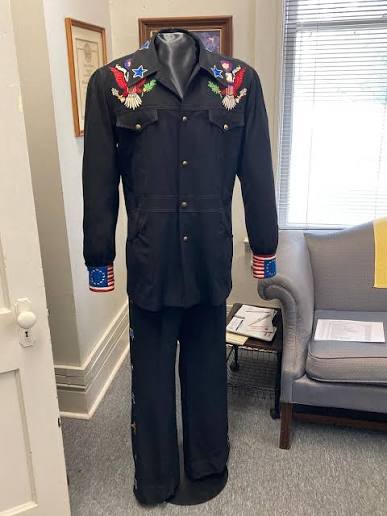
7. 1976 Nudie Cohn custom American Bicentennial wardrobe (1970 to 1976, $11,000 to $25,000+)
Before Manuel started his own brand, he worked with Nudie Cohn, who owned “Nudie’s Rodeo Tailors” in North Hollywood, California. Nudie changed country music fashion with flashy, rhinestone-studded outfits. While Cash usually avoided rhinestones for plain black gabardine, he occasionally made exceptions for Nudie’s patriotic designs during national events.
For the American Bicentennial in 1976, where Cash served as Grand Marshal of the United States Bicentennial Parade in Washington, D.C., Nudie created a custom collection of red, white, and blue shirts and suits. Surviving examples of Cash’s Nudie garments represent a bold change from his typical look; a Nudie star-and-moon outfit sold for $13,750 at Julien’s Auctions, while his 1976 Bicentennial Nudie shirts have sold for between $15,000 and $25,000 among collectors of Western fashion.
Credit: Cleveland County Herald
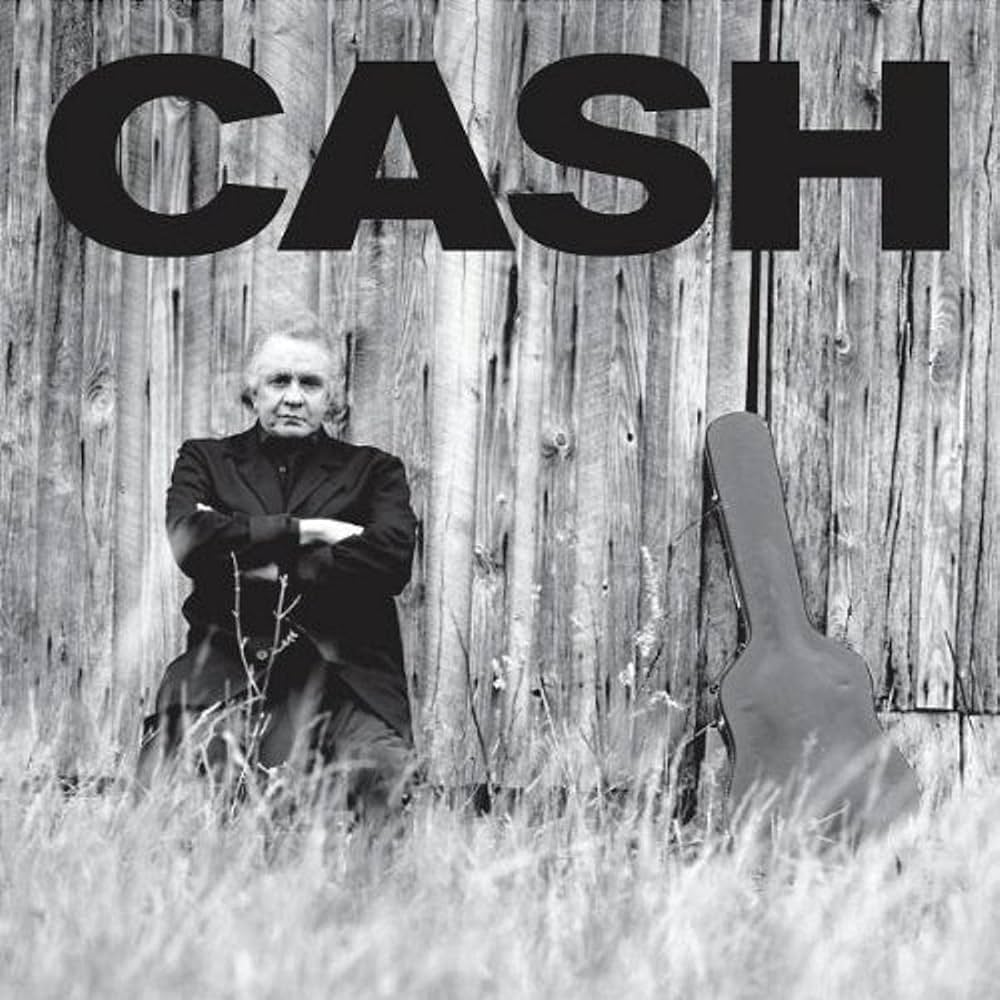
8. 1998 ‘Unchained’ Grammy Award: Best Country Album trophy (1998, $60,000 to $84,000+)
After a decade of commercial decline in the 1980s when Cash was dropped by Columbia Records, his 1990s collaboration with producer Rick Rubin for the American Recordings label sparked a major revival in his career. His second collaboration with Rubin, Unchained (1996), recorded with Tom Petty and the Heartbreakers as his studio band, won the 1998 Grammy Award for Best Country Album.
This award marked his comeback against the commercial Nashville music scene that had let him go a decade earlier. The Unchained Grammy trophy, a symbol of his artistic revival, sold for $84,000 at the 2004 Sotheby’s auction.
Credit: Amazon
9. Folsom Prison & San Quentin relics: stage jackets and gatefold vinyl (1968 to 1969, $800 to $6,000+)
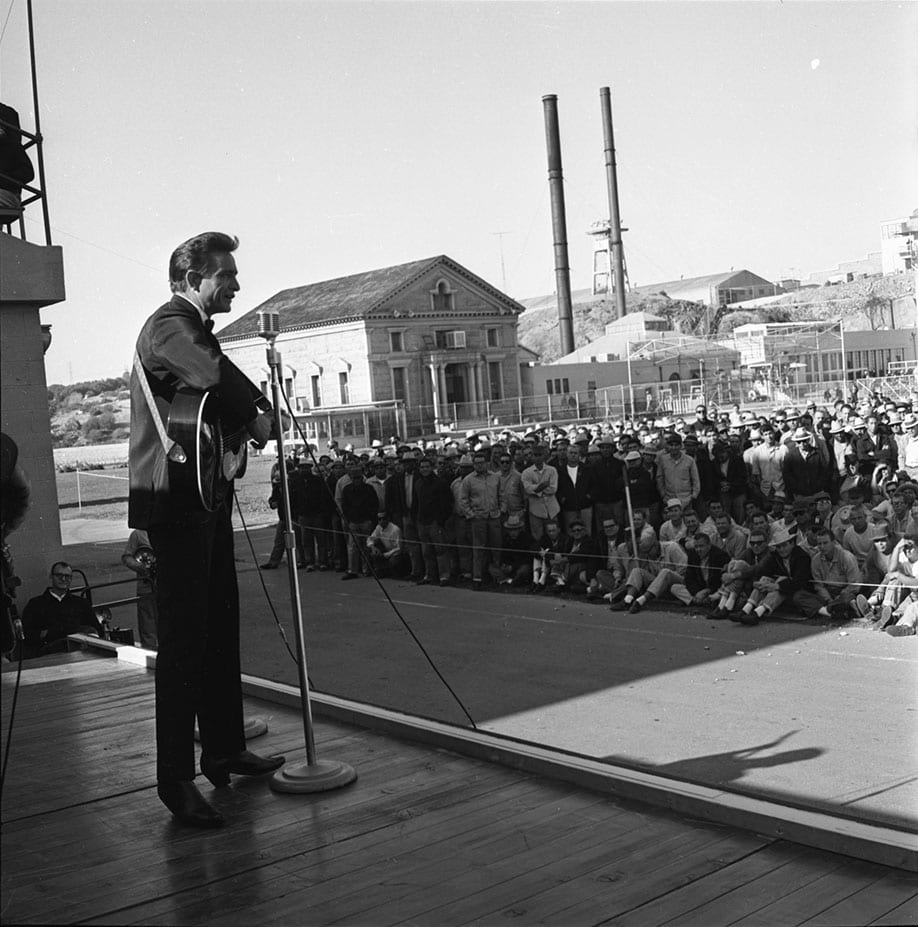
Cash’s live prison albums, At Folsom Prison (1968) and At San Quentin (1969), solidified his role as an advocate for the marginalised. They also turned him into the top-selling recording artist in the world, briefly surpassing The Beatles in 1969. Artefacts from these two concerts are highly sought after by archivists.
After his performance on 13 January 1968 at Folsom State Prison in California, a prison administrator gave Cash an authentic striped inmate canvas jacket. Cash kept this jacket in his private collection for 35 years until it sold for $6,000 at Sotheby’s in 2004. For vinyl collectors, standard heavily played 1968 Columbia stereo pressings (CS 9639) sell for $20 to $40. However, original gatefold pressings, co-signed on the inner sleeve by Johnny Cash and June Carter Cash, can command between $800 and $2,500 or more when they come with full forensic encapsulation from PSA/DNA or JSA, depending on sleeve condition.
Credit: UC Davis Library
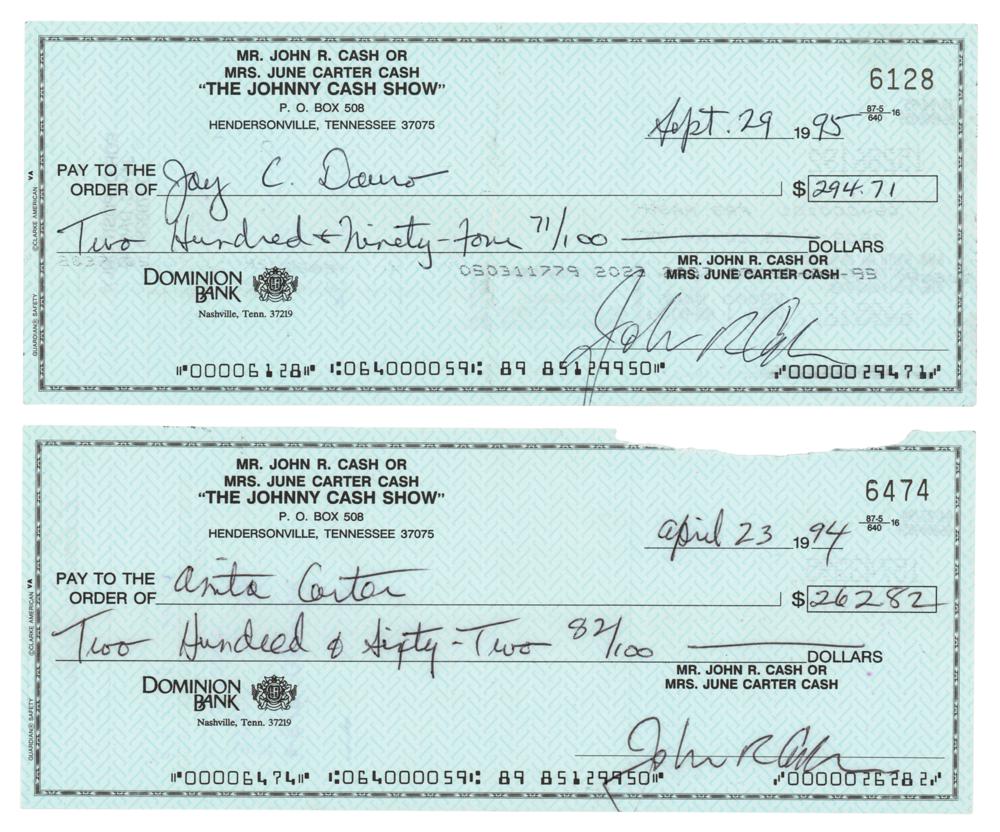
10. Personal bank cheques and House of Cash ephemera (1960s to 1990s, $200 to $4,500+)
For collectors who can’t access six-figure stage instruments or clothing, Cash’s personal banking ledgers offer a reliable way to obtain authentic memorabilia. Throughout his career, Cash handled his payroll, tailor bills, and charitable donations through business accounts at banks in Hendersonville and Nashville. Because bank cheques are federal financial instruments processed through physical clearinghouses, they have undeniable authenticity, avoiding the forgery risks associated with regular autographed photos.
The market evaluates these cheques based on the payee. Standard utility payments or cash disbursements from his “House of Cash, Inc.” account sell at Julien’s Auctions for $200 to $400 each. However, cheques made out to historically significant figures, like payments to June Carter Cash ($780+), Waylon Jennings ($1,200+), or Nudie Cohn for stage clothing ($1,500+), receive substantial premiums. Complete chequebooks and ledger archives from the 1960s have sold at Sotheby’s and Julien’s for $3,500 to $4,500+.
The history of Johnny Cash, Sun Records, and the House of Cash
Johnny Cash memorabilia reflects the changes in the American music industry after World War II. Born into a cotton-farming family in Arkansas in 1932, J.R. Cash absorbed the gospel music of the rural South and traditional folk songs from Mexican border radio stations. After serving four years in the United States Air Force in Landsberg, West Germany, where he bought his first acoustic guitar and wrote early versions of “Folsom Prison Blues”, Cash moved to Memphis, Tennessee, in 1954.
Memphis was the centre of a music revolution led by Sam Phillips, the founder of the independent Sun Records label and the Memphis Recording Service at 706 Union Avenue. Operating on a tight budget with a single-track Ampex tape recorder, Phillips wanted to replace the polished sound of traditional pop music with raw, rhythmic authenticity. When Cash auditioned in 1955 with guitarist Luther Perkins and bassist Marshall Grant, known as the Tennessee Two, Phillips signed them immediately. The distinctive “boom-chicka-boom” sound they created, partly by putting a piece of dollar-bill paper between the strings of Perkins’s Fender Esquire guitar to mimic a snare drum, became the foundation of rockabilly.
During this time at Sun Records (1955 to 1958), Cash shared small stages, tour vehicles, and promotional events with fellow Sun artists Elvis Presley, Carl Perkins, and Jerry Lee Lewis, a group known as the “Million Dollar Quartet”. Memorabilia from this early Memphis period is very rare. Since Sun was a small regional operation before national distribution, early 78 RPM and 45 RPM shellac records, locally printed concert posters, and promotional booking contracts were made in small quantities and saw significant wear in Southern dance halls.
In 1958, Cash left Sun Records for Columbia Records in New York, beginning a 30-year partnership that turned him from a regional rockabilly star into an internationally known folk-country artist. To manage his growing business, television rights, and extensive recording catalogue, Cash established the “House of Cash” in 1970 on a 14-acre estate in Hendersonville, Tennessee, near Nashville. This location served as his corporate office, publishing office, private multi-track recording studio, and public museum, becoming a self-contained archival centre.
Unlike many of his contemporaries, whose possessions were lost to bankruptcy or mismanagement, Cash and his office team carefully catalogued and stored his master tapes, stage instruments, custom wardrobe from Manuel, and letters from US Presidents within the Hendersonville facility.
When Johnny Cash and June Carter Cash died within four months of each other in 2003, this well-preserved corporate archive laid the groundwork for the historic 2004 Sotheby’s estate auction. That sale showed how mid-century American country and rockabilly items had become a recognised asset class in the international fine-art and archival markets, meeting the same strict standards for provenance and valuations traditionally associated with fine art and historical artefacts.
Beyond stage gear: the world of handwritten manuscripts, Sun acetates, and studio rarities
While guitars, custom jackets, and commercial vinyl pressings are the public face of collecting, a more specialised area of collecting focuses on unique documents, pre-production studio recordings, and literary manuscripts. Cash was a prolific writer who often created while on the road. His handwritten papers provide an intimate look into his creative process and can be worth as much as musical instruments.
1. Handwritten working lyrics and personal poetry (1960 to 2003, $1,500 to $28,800+)
Cash rarely used a typewriter. He wrote lyrics, personal thoughts, and prose on yellow legal pads, hotel stationery, and lined notebooks. These manuscripts are valuable because they show his revisions, crossed-out lines, and notes in the margins.
The market distinguishes between two manuscript types. Working drafts of commercial songs and deeply personal, unpublished poems have different values. Standard handwritten lyric sheets for songs like “City Jail”, “Moses”, or “Spiritual Chapter 10” often sell for $1,300 to $3,000 at auction with House of Cash provenance certificates. However, unique literary pieces can fetch far higher sums. A handwritten poem called “If Thy Heart Be Cold”, featuring a deep exploration of faith and mortality, sold for $28,800 at Julien’s Auctions, breaking its presale estimate of $800. The sale reflected strong demand for his literary work.
2. Sun Records 78s, 45s, and custom studio acetates (1955 to 1958, $1,000 to $10,000+)
In the vinyl collecting world, standard commercial Columbia Records pressings from the 1960s and 1970s were made in the millions and have little financial value without documented signatures. However, the earliest pressings produced by Sam Phillips at Sun Records between 1955 and 1958 are significant sound artefacts. Cash’s first single, “Hey, Porter” / “Cry. Cry. Cry.” (Sun 221), was released in June 1955 on both 45 RPM vinyl and fragile 78 RPM shellac. Because 78 RPM shellac discs break easily and were quickly phased out in the late 1950s, surviving Sun 78s in Near Mint condition can sell for $1,000 to $2,000.
At the top of audio rarity are original Sun Records studio acetates, direct reference discs cut on lacquer-coated aluminium blanks by Sam Phillips. These were made so Cash could listen to a recording session on his home phonograph. These delicate, single-sided metal discs, which bear handwritten Sun Recording Service labels, deteriorate quickly under the weight of a tonearm. Surviving playable acetates of early alternate versions or unreleased Sun recordings can command over $10,000 from specialised collectors.
3. Signed contracts, bail bonds, and legal ephemera ($1,500 to $30,000+)
The legal documents of Cash’s tumultuous career have become an important part of his memorabilia market. Cash’s “outlaw” persona stemmed from real encounters with law enforcement, giving official legal documents with his signature significant historical value. Standard performance contracts from the 1960s signed by Cash and booking agents sell for $1,500 to $2,500.
However, documents related to his well-known legal troubles achieve high museum-grade values. For example, a signed bail bond document from Cash’s arrest on 1 March 1969 in El Paso, Texas, or Miami, Florida, came to light at Julien’s Auctions. Bearing his signature during his Folsom Prison outlaw peak, this unique collection could fetch between $20,000 and $30,000. Collectors place a high value on documents connected to the Man in Black’s rebellious reputation.