




In 1933 Albert Einstein, the world’s greatest theoretical physicist and a German Jew, made the decision to stay in the United States as the Nazis took over his homeland. Some of the items he left behind will be sold at an auction in England next month.
Three items Einstein entrusted to friends are listed for sale at Dominic Winters Auctioneers in Cirencester, and will be sold in their October 8 sale.
Topping the bill is Einstein’s beloved violin, named Lina, that is expected to make as much as £300,000. Alongside it are a bicycle saddle (£50,000) and a book (£3.000).
Einstein loved music. “If I were not a physicist, I would probably be a musician,” he once said.
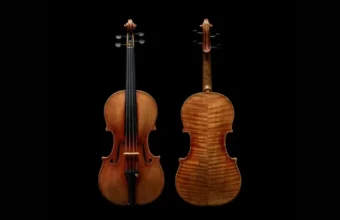
He played violin from childhood and this is believed to be the first instrument he bought for himself, in Munich in 1894, the year it was made by Anton Zunterer. The name Lina is scratched into the body of the instrument, and Einstein gave all his violins this name, probably derived from the German violine.
In that year, Einstein, aged 15, left the German Empire for Switzerland, where he did much of his studying. He didn’t return to Germany until 1914 and abandoned his German citizenship until 1917.
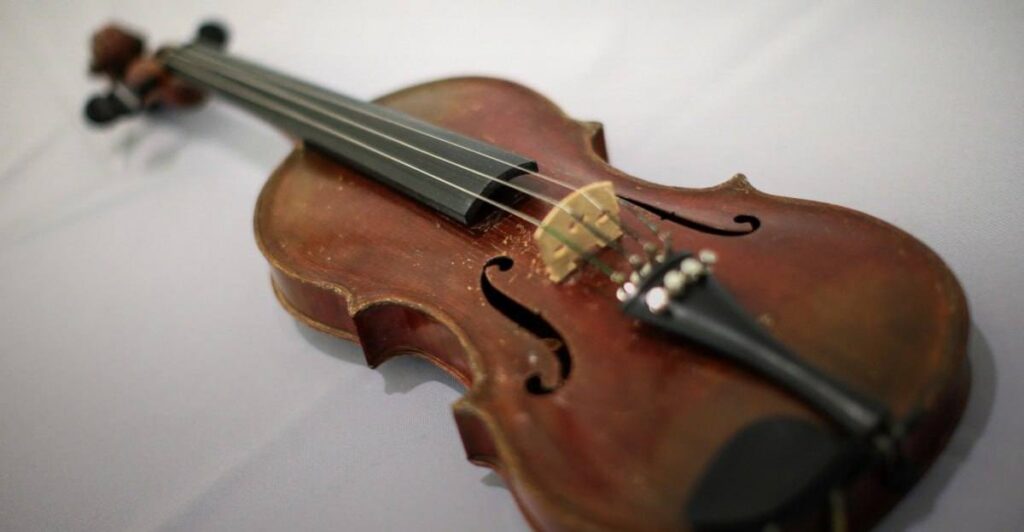
The instrument is in very good condition and has not been played for a long period. Einstein would not have enjoyed parting with it, he loved music. Image courtesy of Dominic Winters.
When he returned to Germany he’d published the theory of relativity and changed the world.
By 1932, he was an international celebrity. But, while he was celebrated in US universities and Hollywood parties, Germany was no longer safe for him. On the way back from an American tour in 1933, he learned of the Enabling Act, which gave Hitler dictatorial powers, and walked to the German embassy in Brussels to surrender his German passport.
Before leaving he had given his violin to his friend, Max von Laue, another Nobel Prize-winning physicist.
With it, a bicycle seat and an 1843 book on Descartes and Spinoza that Einstein’s father had given him.
Von Laue survived the war. In 1952, he gave his Einstein mementos to a fan of the scientist called Margaret Hommrich. They remained in her family until this sale.
Chris Albury, senior auctioneer for Dominic Winter, said: “According to the family, [the violin had) not been played for many, many decades.”
Einstein is extremely collectible. His important papers are hugely valuable. In 2021, a working copy of the Theory of Relativity sold for $12 million.
While sales of instruments are rare, they also hit high figures, like the American made violin that achieved £372,000 in 2018.
This violin, with its poignant, significant story is likely to play a siren song for Einstein collectors.