



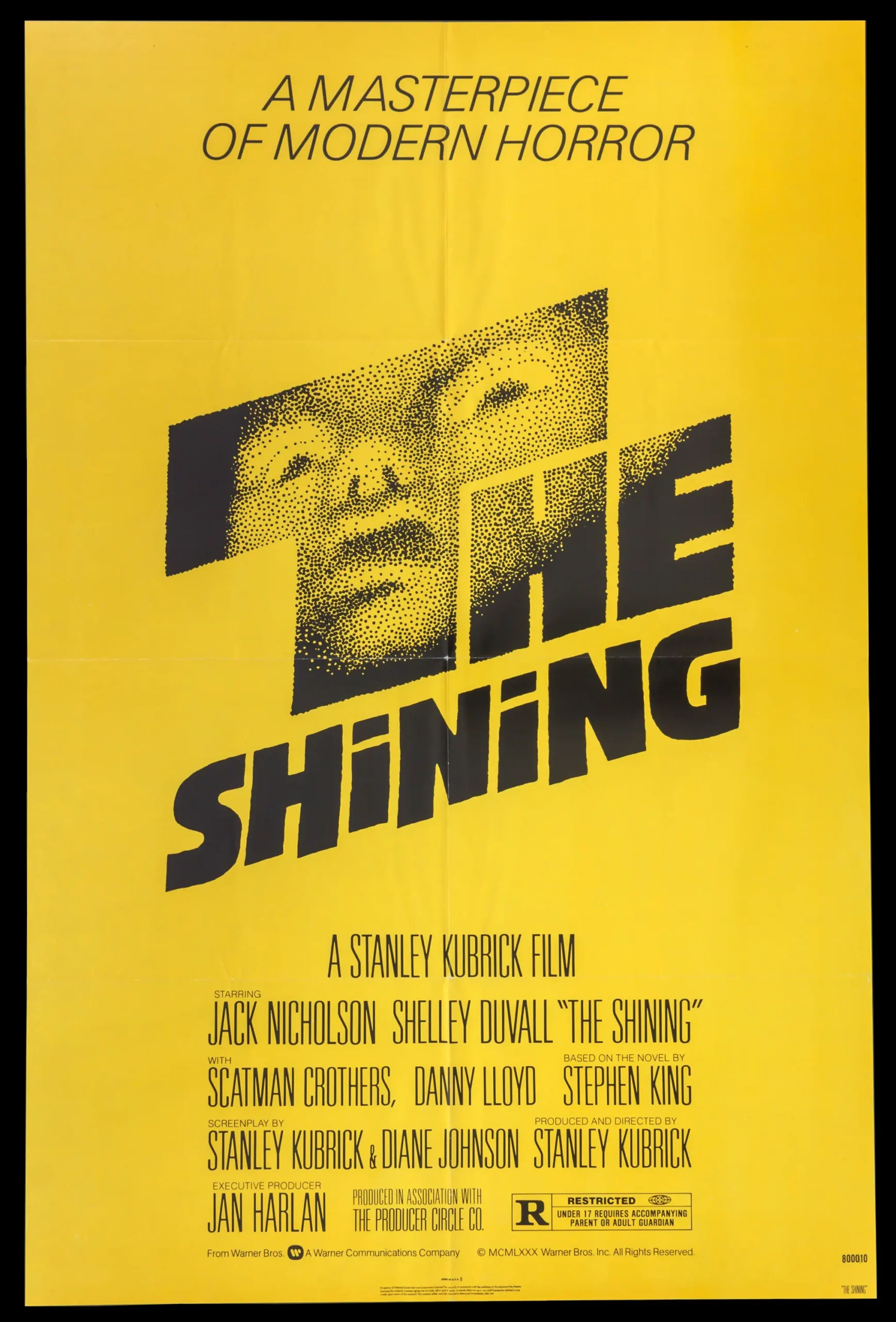
One of the most recognisable scenes in cinema history is that of The Shining, where Jack Nicholson (as Jack Torrance) carries an axe through the Overlook Hotel, hacks through the locked door protecting his wife Wendy and shouts “Here’s Johnny!”.
But where does the scene come from? What book was the film based on? And why did Stanley Kubrick decide to make it into a film?
The book Stephen King wrote
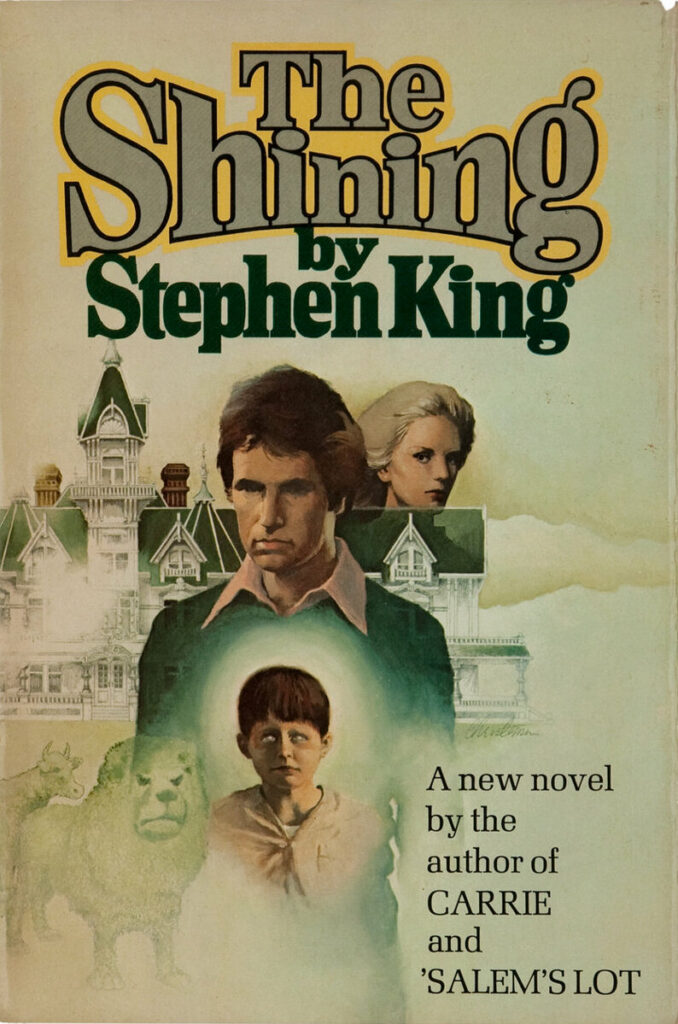
King’s official website records The Shining as released in January 1977. It follows Jack Torrance, Wendy and their son Danny as they take up the winter caretaker’s job at the isolated Overlook Hotel. Danny possesses a psychic ability known as “the shining”, while Jack hopes to write and confront his alcoholism and anger.
The idea began with a real hotel visit. In late September 1974, King and his wife Tabitha stayed at the Stanley Hotel in Estes Park, Colorado, just before it closed for winter. He dreamed of his young son running through the corridors while being chased by a fire hose, and had the basic idea for the novel by the end of the night.
Kubrick at Elstree
When The Shining went into production, Stanley Kubrick was already a major filmmaker. Born in New York in 1928, he worked as a photographer for Look magazine before moving to Britain in the early 1960s. He had already made Dr. Strangelove, 2001: A Space Odyssey, A Clockwork Orange and Barry Lyndon.
Kubrick and novelist Diane Johnson wrote the screenplay. The film was made mainly at EMI Elstree Studios in Borehamwood between 1978 and 1979, with extensive hotel and maze sets built in England. The American Film Institute records that production ended in April 1979 and that the film opened in New York and Los Angeles on 23 May 1980.
Garrett Brown, the Steadicam’s inventor, recalled working at Elstree for most of a year. The camera could follow Danny’s tricycle through the corridors and move through the maze without a conventional dolly. The result is a building with its own geometry, its corridors too large, too long and not quite connected.
Jack Nicholson before the Overlook
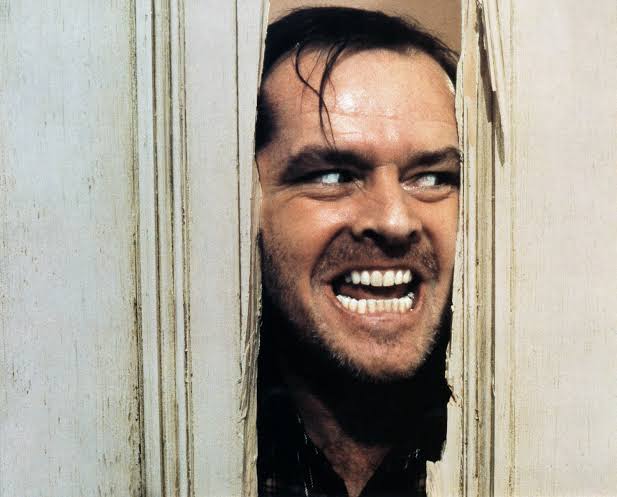
Jack Nicholson was not a newcomer when he played Jack Torrance. His breakthrough came with Easy Rider in 1969, followed by leading roles in Five Easy Pieces, The Last Detail and Chinatown. In 1976, he won the Academy Award for Best Actor for One Flew Over the Cuckoo’s Nest.
Jan Harlan, Kubrick’s executive producer, later said that Nicholson was the director’s only choice for the lead. Nicholson arrived with a familiar screen presence: quick, funny, volatile and capable of making a damaged character watchable. His Jack therefore enters the story already unsettled.
Nicholson improvised “Here’s Johnny!”, borrowing the introduction used by Johnny Carson on The Tonight Show. The line was not in the shooting script, but it became the sound attached to the door, the axe and the film’s most reproduced scene.
Why Stephen King objected
The novel and film share the hotel, family and threat of Jack’s violence, but they do not tell the same story. King’s Jack begins as a man struggling to hold himself together, while the Overlook’s history works on him. Kubrick’s film is more interested in the possibility that the hotel has exposed something already present.
King’s response was complicated. Accounts of a private screening shortly before release suggest that his first reaction was favourable, and he later praised Nicholson’s work. His public criticism soon became sharper. In an interview reported by The Christian Science Monitor, he said, “Kubrick’s direction is good, but it’s heartless. Technically the movie is flawless, and the acting is great, but it’s not very scary.”
He objected most strongly to Jack’s character. In King’s view, Nicholson seemed disturbed from the beginning, so the film lost the tragic movement from a troubled father to a man overtaken by the hotel. King also disliked the treatment of Wendy, played by Shelley Duvall, and the replacement of the novel’s living topiary animals with the hedge maze.
King later described the adaptation as “a great big beautiful Cadillac with no motor inside”. King wanted the audience to care about a family being destroyed. Kubrick made a colder film about isolation.
The version King made himself
King’s own version was not a film but a television miniseries. Stephen King’s The Shining aired on ABC over three nights in April and May 1997. King wrote the teleplay and served as executive producer; Mick Garris directed, with Steven Weber, Rebecca De Mornay and Courtland Mead in the main roles.
The six-hour production was filmed at the Stanley Hotel and followed the novel more closely than Kubrick’s version, restoring more of the family’s history, Jack’s alcoholism and the supernatural explanation. Contemporary reviews disagreed. Variety praised its pacing and emotional detail, while The Washington Post dismissed it.
Kubrick’s archive at auction
Kubrick died in 1999. The first auction of his personal archive, hundreds of items in all, will take place at Bonhams in London on 3 February, after public exhibitions in New York, Los Angeles and Paris and a final showing in London from 18 January.
The Shining is well represented. The sale includes the two sky-blue dresses worn by the Grady twins when they invite Danny to “come play with us” as he pedals his tricycle through the Overlook’s corridors. The tricycle itself is not included, but a clapperboard from the film is, one of four from Kubrick’s productions, alongside those from 2001: A Space Odyssey, Barry Lyndon and Eyes Wide Shut.
There are also Kubrick’s scripts, with his annotations, drawings and alternative scenes, among them those he used while making The Shining, 2001: A Space Odyssey and Lolita, and his personal script for Spartacus (1960). His director’s chair is valued at up to £12,000. The lot expected to fetch the most is the “star child”, the model of a cosmic foetus from the final scene of 2001, estimated at up to £800,000.
Claire Tole-Moir, head of popular culture at Bonhams, chose Kubrick’s chess set as the lot that best shows his character: “He valued chess for its combination of strategy, patience, discipline and intellectual precision – qualities that would become hallmarks of his film-making.” During breaks in filming, she added, he would play against members of the cast and crew.
Why the axe was made from foam
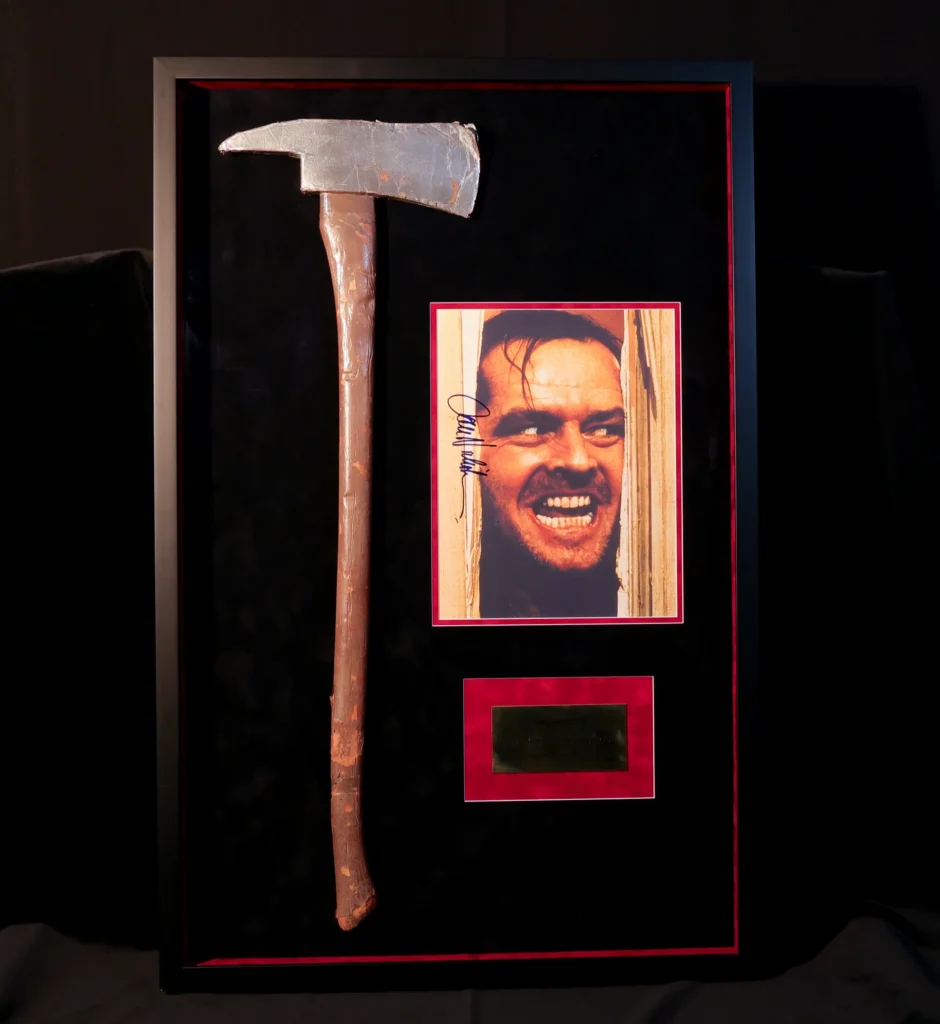
The production needed more than one axe. The real wooden hero axe was suitable for shots in which Jack struck a door. For longer takes, wider views and scenes with Duvall or Danny Lloyd, who played Danny, a lighter stunt version reduced the risk and the strain of carrying a heavy tool. The axe is also the weapon Jack uses to kill Dick Hallorann, played by Scatman Crothers.
The current Paul Fraser Collectibles listing describes one such stunt axe as hard polyfoam, 89 centimetres long, with a faux-wood handle and a head covered in silver tape. It records paint loss and wrinkling in the tape. The lightness allowed a dangerous-looking object to move safely through long shots.
The distinction between hero and stunt props explains why several surviving axes can have credible production connections. Propstore described a stunt axe sold in December 2025 as one of several lightweight versions made for safer action work. It sold for £176,400 including the buyer’s premium, after nine bids against an estimate of £50,000 to £100,000. A similar foam-and-resin axe sold in New Jersey in 2022 for £144,000 including the buyer’s premium. A special effects axe from the film is also among the lots in Bonhams’ Kubrick sale. These are auction results, not a valuation of every axe associated with the film.
The knife in the kitchen
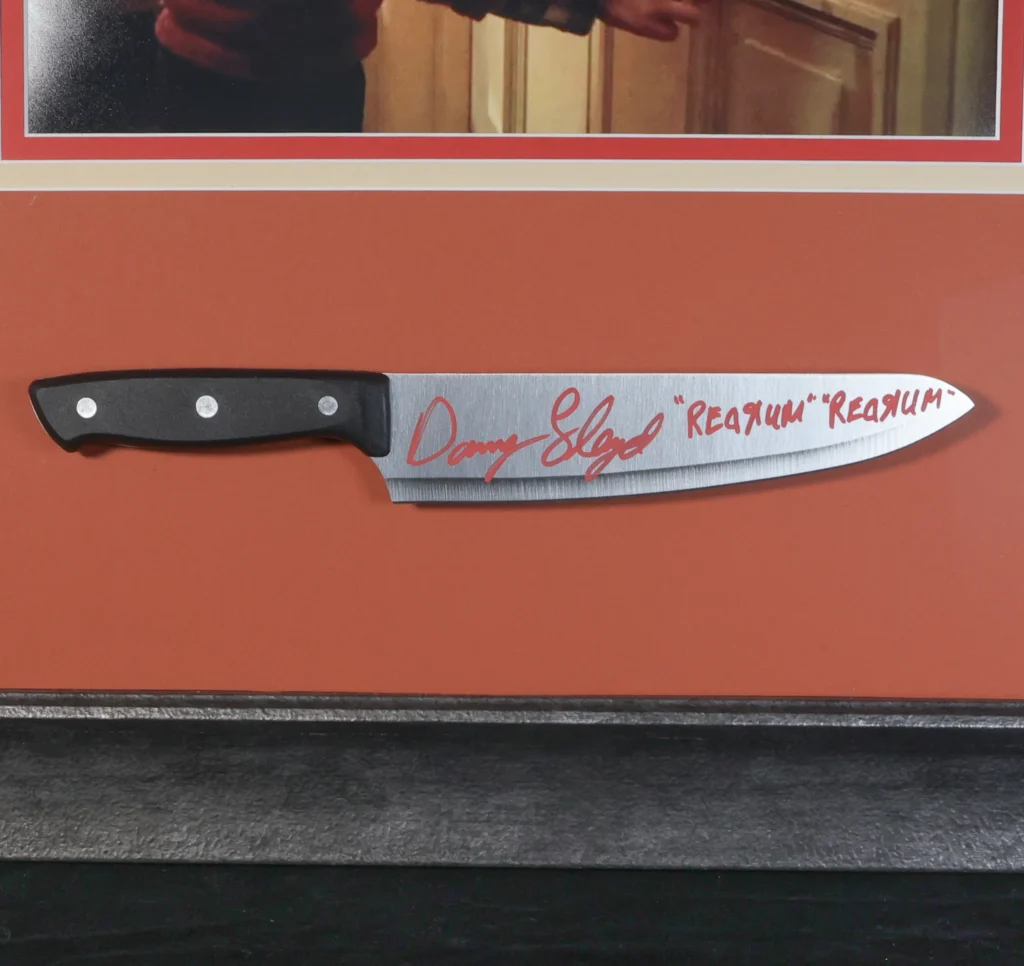
The second object comes from a quieter scene. In the kitchen, Hallorann explains the shining to Danny while knives point towards the boy. The current dealer description identifies this knife as one of 10 used in that arrangement and gives its length as 12.75 inches.
Danny Lloyd signed the knife years after filming, writing “Danny Lloyd ‘Redrum’ ‘Redrum'” in red pen. The frame also includes a photograph of Danny holding a different knife from the Redrum sequence, signed in red. The screen-used object and the signed image are related parts of the display, not the same knife shown twice.
At the time of writing, the two objects are listed by Paul Fraser Collectibles: