



In May 1927, a twenty-five-year-old airmail pilot from Minnesota climbed into a single-engine monoplane that had been built in barely two months, took off from New York, and did not land again until he reached Paris, just over 33 hours and 3,600 miles later. Charles Lindbergh had the Spirit of St. Louis built for one purpose: to win the $25,000 Orteig Prize, offered to the first aviator who could make that exact journey, New York to Paris, without stopping. Six men had already died trying to win it before him. Lindbergh did it alone, and within days he was the most famous man on earth, a fame that would follow him, and cost him, for the rest of his life.
Almost everything that survives of that aircraft, and of Lindbergh’s own effects, now sits in museum collections. Three things from that story have never before been offered for sale: parts from the aircraft’s engine and structure, a signed fragment of the fabric that covered its airframe, and a handwritten letter from Lindbergh himself. Paul Fraser Collectibles is now offering all three together as a single collection, each traced through its own documented history: the aircraft parts through a Wright Aeronautical engineer who worked on the plane both before and after its historic flight, the fabric through a member of Lindbergh’s own welcoming committee, and the letter through independent forensic authentication.
Pieces of the aircraft itself
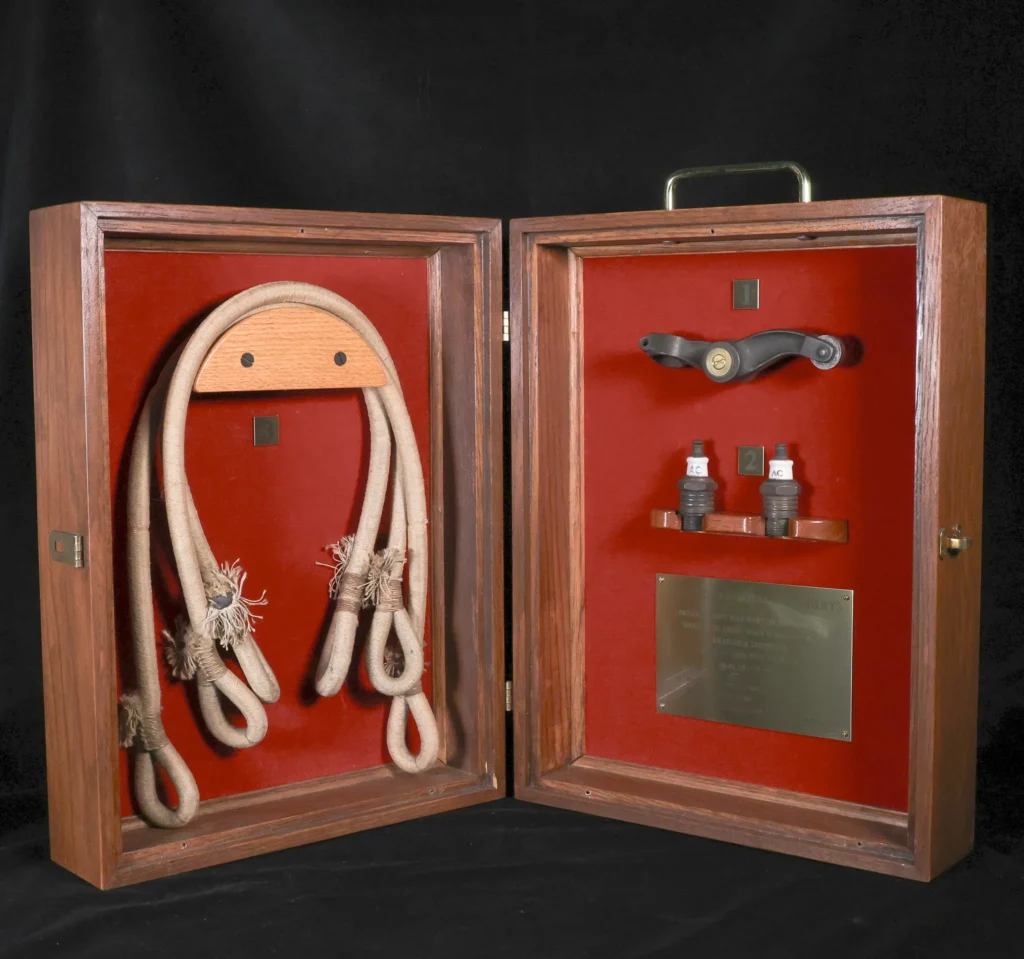
The largest element of the collection is a group of parts taken directly from the Spirit of St. Louis, presented together in a custom oak case measuring 17 by 12½ by 6 inches, complete with an explanatory plaque.
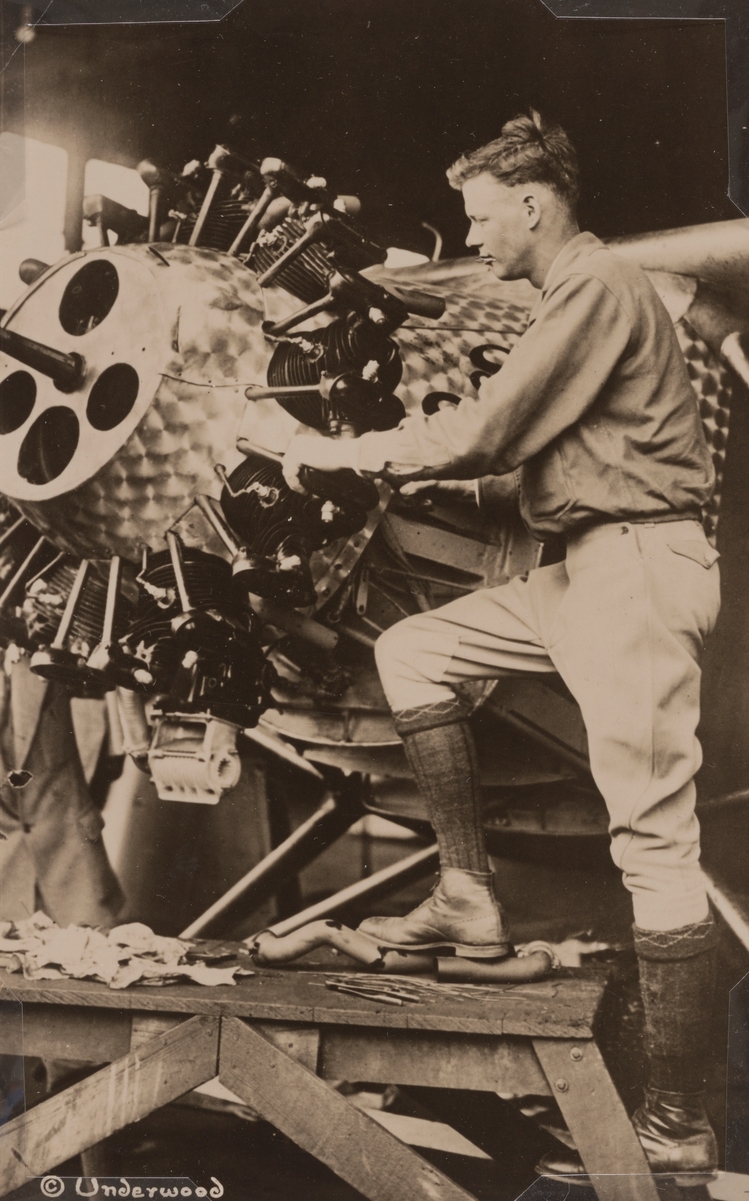
At its centre is a rocker arm, serial number 7331, from the very engine that powered Lindbergh’s aircraft across the Atlantic. Inside a piston engine, a rocker arm is a mechanical lever, pushed by rods connected to the camshaft, which pivots to press down on the intake and exhaust valves at precisely the right moment in each cycle. It is a small component, but the engine does not run without thousands of correctly timed movements like it.
Alongside it sit two AC Type N spark plugs, the threaded electrical devices screwed directly into the tops of the cylinder heads on the Wright J-5C “Whirlwind” engine mounted at the aircraft’s nose. Each plug’s job was to fire the spark that ignited the compressed fuel-and-air mixture inside the cylinder, the basic combustion event repeated many thousands of times over the course of the flight.
The final elements are three shock-absorber bungee cords, the heavy-duty cording that served as standard shock-absorption technology in 1920s aviation. These were mounted on the underside of the aircraft, either wrapped tightly around the main landing gear above the front wheels or attached to the tail skid at the rear of the plane.
All of these parts trace back to Kenneth Lane, one of only four Wright Aeronautical Company employees who worked on the Spirit of St. Louis. Lane fine-tuned the aircraft at Curtiss Field on Long Island in the days before the Paris flight, and he returned to it again on 4 July 1927, this time for repairs carried out at Teterboro, New Jersey, to ready the aircraft for the tour of all forty-eight states that Lindbergh was about to undertake. It was during that repair work that Lane removed the parts now in this collection.
A signed fragment of the aircraft’s skin
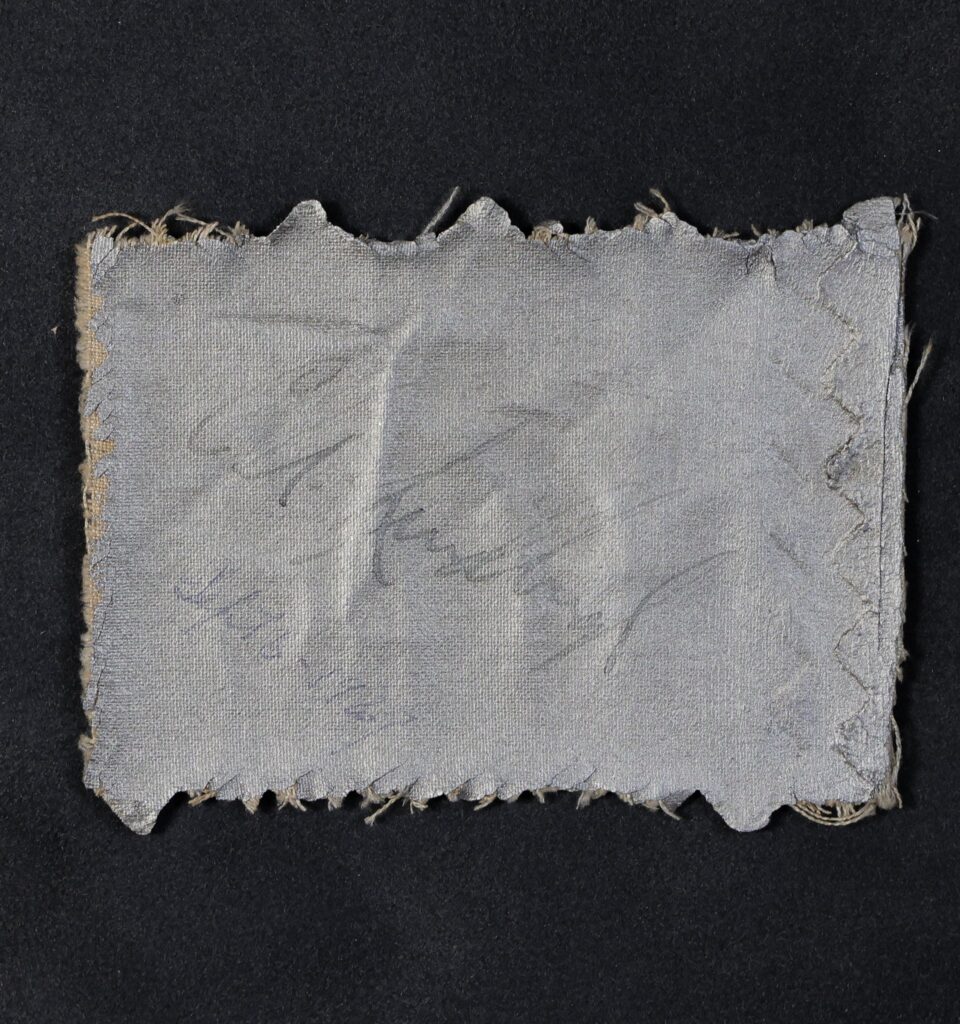
The second element of the collection is a fragment of the Spirit of St. Louis’s actual outer covering. Aircraft of the 1920s were not built with solid aluminium exteriors: the Spirit of St. Louis had a lightweight metal-and-wood skeleton wrapped entirely in heavy-duty, aviation-grade cotton cloth, and this fragment was cut from the aircraft during repairs carried out after it landed. Small pieces of the Spirit of St. Louis’s fabric have appeared at auction before, but one of this size, at roughly 2 by 3 inches, is rare, and a signed piece of this size is rarer still.
The fragment is signed “C. A. Lindbergh” in fountain pen, in the aviator’s own hand. Beside the signature, in a different hand, is the date “Sept 6 – 1927”, the day Lindbergh flew from Butte to Helena, Montana, during the three-month tour of all forty-eight states funded by the Daniel Guggenheim Fund for the Promotion of Aeronautics.
The cloth was acquired by James E. Morrow, a member of the welcoming committee for that leg of the tour and a relative of Lindbergh’s future wife, Anne Spencer Morrow. Morrow later gave the fragment to his daughter, Vera M. Morrow, who had herself stood beside him at Lindbergh’s ticker-tape parade through Manhattan that June. Vera was born in 1907 and died in 2004, and the fragment passed down through that single family line for the whole of the time in between.
A letter that reveals what fame cost him
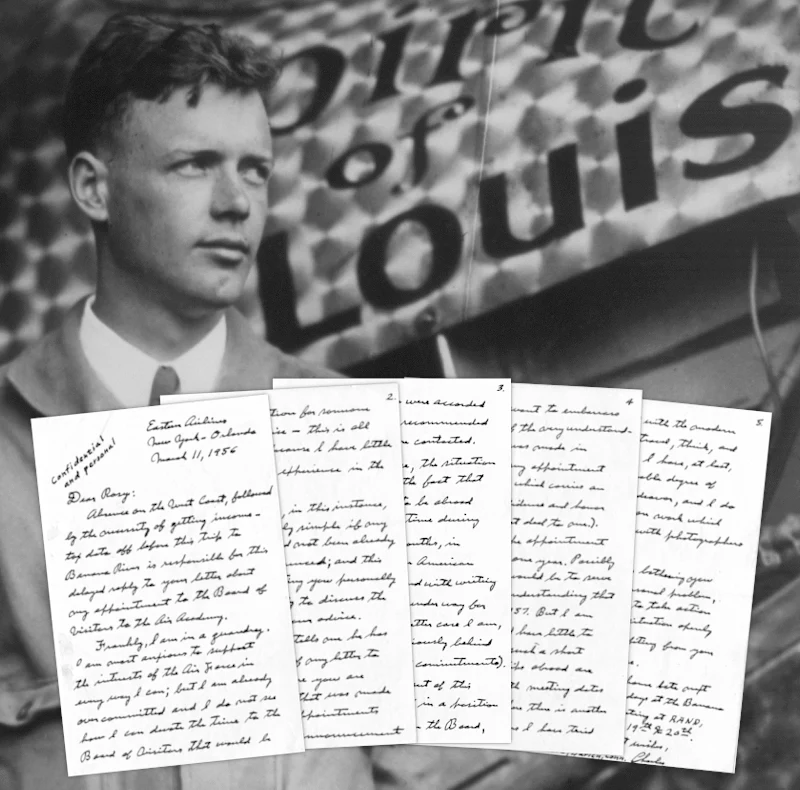
The third element is different in kind: a five-page handwritten letter, each page measuring 5.5 by 8.25 inches, dated 11 March 1956, nearly three decades after the flight that made Lindbergh famous, and it shows that the struggle fame had brought him was still very much alive.
After the flight, Lindbergh became arguably the most famous person in the world, swarmed by crowds wherever he went. He was an intensely private man, and press attention only intensified after the kidnapping and murder of his son in 1932, so that by 1956 he had spent nearly half his life trying to escape the fame the Spirit of St. Louis had brought him. The letter, headed “Confidential and personal” and addressed to Lieutenant General Emmett O’Donnell, Deputy Chief of Staff of Personnel of the Air Force, declines an appointment to the Board of Visitors at the Air Force Academy, an institution whose site Lindbergh himself had helped select only two years earlier. Among the reasons he gives, in his own hand, is this:
“And there is another complication; for years I have tried to avoid contact with the modern Press, so I can travel, think, and work, effectively. I have, at least, achieved a reasonable degree of success in this endeavor, and I do not want to take on work which involves contact with photographers and reporters.”
The letter survives in fine condition, with file holes at the left edge and a few tiny associated tears, neatly repaired from the reverse. Unlike the physical aircraft parts, its authenticity rests on professional forensic examination rather than a family chain of custody: it has already been certified by both PSA/DNA and historical document authenticator John Reznikoff.
The man who became too famous to photograph
Lindbergh was twenty-five years old and largely unknown outside aviation circles when he landed at Le Bourget airfield outside Paris. He was a former airmail pilot who had risked his own savings on an aircraft built in under two months, and he became, almost overnight, the most famous man alive. Four million people turned out in New York just to see him, including the crowds at his ticker-tape parade through Manhattan that June, where a young Vera Morrow stood beside her father to watch him pass. Time magazine made him its first ever Man of the Year, and a special Act of Congress awarded him the Medal of Honor, an honour almost never given outside combat.
Then came the tragedy that would define the rest of his life. On 1 March 1932, his twenty-month-old son, Charles Jr, was taken from his crib at the family’s New Jersey home. The child’s body was found in nearby woods ten weeks later. American newspapers called it the Crime of the Century, and the public outcry led Congress to make kidnapping a federal crime. By 1935, unable to bear the crowds and the press outside their door, the Lindberghs fled to Europe in secret, not returning to live in America again until 1939.
Fame never loosened its grip after that. Lindbergh spent the rest of his life avoiding cameras and reporters, a struggle laid bare in the very letter now offered in this collection: twenty-nine years after his flight, he was still turning down a senior Air Force appointment rather than expose himself to photographers again. He guarded his private life so completely that even his own children did not know he was secretly raising three more families in Europe alongside his wife, Anne. The truth only emerged in 2003, almost thirty years after his death.
Authenticating the collection
A rocker arm, a signed scrap of fabric and a handwritten letter cannot be authenticated in the same way, and each element of this collection carries the form of evidence appropriate to it.
The engine and airframe parts carry corroborating evidence beyond Kenneth Lane’s own role in removing them. During the same 1927 repair work, Lane kept other pieces of the aircraft for himself. In the 1970s, he donated a shock cord, a spark plug and a fragment of fairing strip to the Charles A. Lindbergh Historic Site in Minnesota, where they remain today. He gave further items to the San Diego Aerospace Museum, since lost in a fire, and donated a survival kit from the flight to the Smithsonian, where it remains on display. Writing to Spirit of St. Louis historian Ev Cassagneres in 1973, Lindbergh himself confirmed a cushion shown to him as identical to the one he used on the flight, and described other items as, in his own words, “almost certainly” ones he had carried.
The signed fabric fragment carries its own independent verification: the 6 September 1927 date beside Lindbergh’s signature matches the documented day of his flight from Butte to Helena on the Guggenheim tour, and the piece passed directly from James E. Morrow to his daughter Vera, establishing an unbroken family line of ownership. The 1956 letter, by contrast, has no family chain behind it at all: its authenticity rests entirely on the forensic examination carried out by PSA/DNA and by John Reznikoff.
The complete collection is backed by a formal Certificate of Authenticity and a Lifetime Moneyback Guarantee of Authenticity.
A museum-grade piece of aviation history
Paul Fraser Collectibles is offering the complete collection as a single acquisition: the engine and airframe parts in their custom oak case, the signed and dated fabric fragment, and Lindbergh’s five-page handwritten letter, priced at £125,000 ($168,500). The offer includes free insured worldwide delivery, a 28-day returns period, and the option to spread the cost over a layaway plan of 12 to 18 months.
Almost every other trace of the Spirit of St. Louis and its pilot belongs to institutions, among them the Smithsonian and the Lindbergh Historic Site in Minnesota. These are the only parts of the aircraft ever to have been offered for sale, alongside a letter that captures, in Lindbergh’s own words, what that fame ultimately cost him, and once this collection is sold, that will remain true for good.
Check out the complete description of this collectible at Paul Fraser