




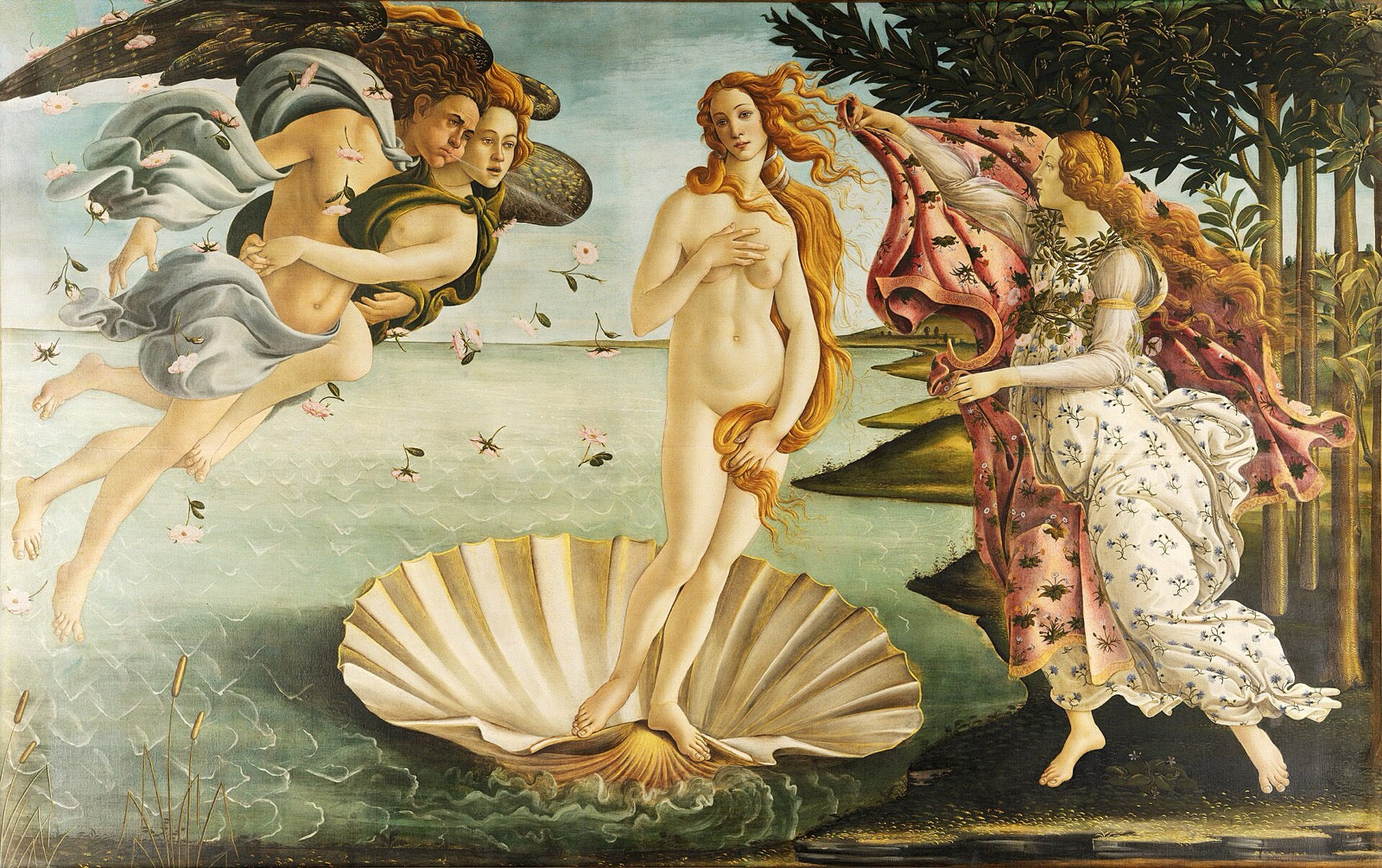
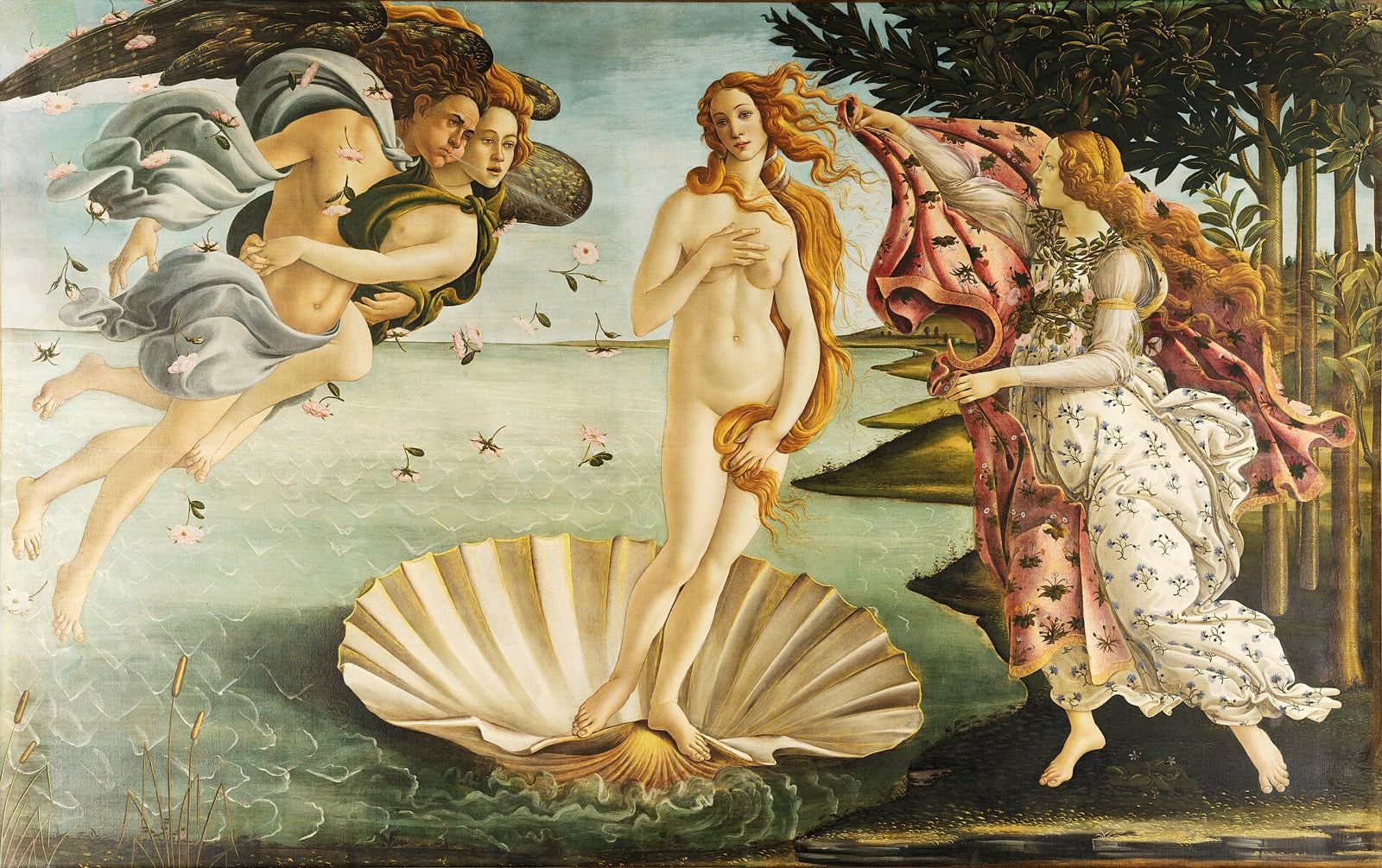
Botticelli’s Birth of Venus has hung in the Uffizi Gallery in Florence since 1815, but Sandro Botticelli painted it roughly three centuries earlier, around 1484 to 1486, in tempera on a canvas measuring 172.5 by 278.5 centimetres. Most people who queue to see it know the outline of the scene: Venus stands on a giant scallop shell, blown ashore by the wind, about to be dressed by a waiting attendant. Fewer notice how much of that scene was built to be read, not simply looked at.
The painting was, in all likelihood, made for a small and highly educated audience. It is probably a Medici commission, though nothing was written about it before the historian Giorgio Vasari described seeing it at the family’s Villa di Castello around 1550, and its intended meaning would have been obvious to a household steeped in classical philosophy in a way that is not obvious to someone glancing at a reproduction today.
Read closely, the picture is dense with symbols drawn from classical myth, Renaissance philosophy and Medici family pride, several of which are easy to miss on a first look. The sections below work through the painting’s main details roughly in the order Botticelli intended them to be read: patron and philosophy first, then the myth itself, then the smaller touches that reward a longer look.
Discover all in our:
Botticelli’s Birth of Venus: uncovering the hidden symbolism you probably missed
A commission built for a Neoplatonist’s classroom
The Birth of Venus is usually dated to between 1484 and 1486 and was, in all probability, commissioned by a member of the Medici family, perhaps the young Lorenzo di Pierfrancesco de’ Medici, a cousin of Lorenzo the Magnificent. Botticelli drew on two literary sources: the ancient Homeric Hymn to Aphrodite, and the Stanze per la giostra, a poem by the Medici court writer Agnolo Poliziano, whose description of a relief showing Venus’s birth closely matches the composition Botticelli painted.
Florence in the 1480s was steeped in the Neoplatonic philosophy taught by Marsilio Ficino, which held that Venus had two natures: a heavenly Venus, standing for divine and spiritual love, and an earthly Venus, standing for physical desire. Under that reading, the goddess rising naked from the sea is not an erotic figure at all. She is the visible form of ideal beauty, and looking at her was supposed to lift the viewer’s soul a little closer to the divine, an idea Florentine philosophers of the period took quite literally.

Credit: Attributed to Cristofano dell’Altissimo, public domain via Wikimedia Commons
The wind, the shell and a birth drawn from myth
Venus arrives at the island of Cyprus standing on an oversized scallop shell, blown across the water by Zephyrus, the west wind, shown here embracing a female companion usually identified as Chloris or Aura. The wind itself is drawn as thin lines radiating from Zephyrus’s mouth, a visual shorthand rather than an attempt at realistic weather. The scallop shell was, in the ancient world, an established symbol of fertility and of the female principle, and it doubles as a mark of pilgrimage, standing in for Venus’s journey from a divine realm into the human one.
Roses tumble through the air around the wind gods. According to the myth Botticelli was illustrating, the flowers came into being at the exact moment Venus was born, so their presence in the painting is not decorative filler. It marks the birth as an event that reshaped the natural world, tying beauty and love together from the very first instant.
Credit: Sandro Botticelli, public domain via Wikimedia Commons
The cloak that never quite reaches her
On the right, a woman usually identified as one of the Horae, the classical goddesses of the seasons, specifically the Hora of spring, waits on the shore holding out a flower-patterned cloak to cover Venus. She wears a girdle of roses at her waist and a myrtle garland at her neck. In the grass at her feet grow violets, long used in classical and Renaissance imagery as a symbol of modesty.
The gesture matters as much as the objects themselves. Venus has not yet been clothed. She is caught at the exact threshold between raw, divine beauty and its entry into the material, human world, and Botticelli freezes that instant rather than resolving it, leaving Venus permanently on the point of being covered rather than actually covered.
A pose copied from ancient marble
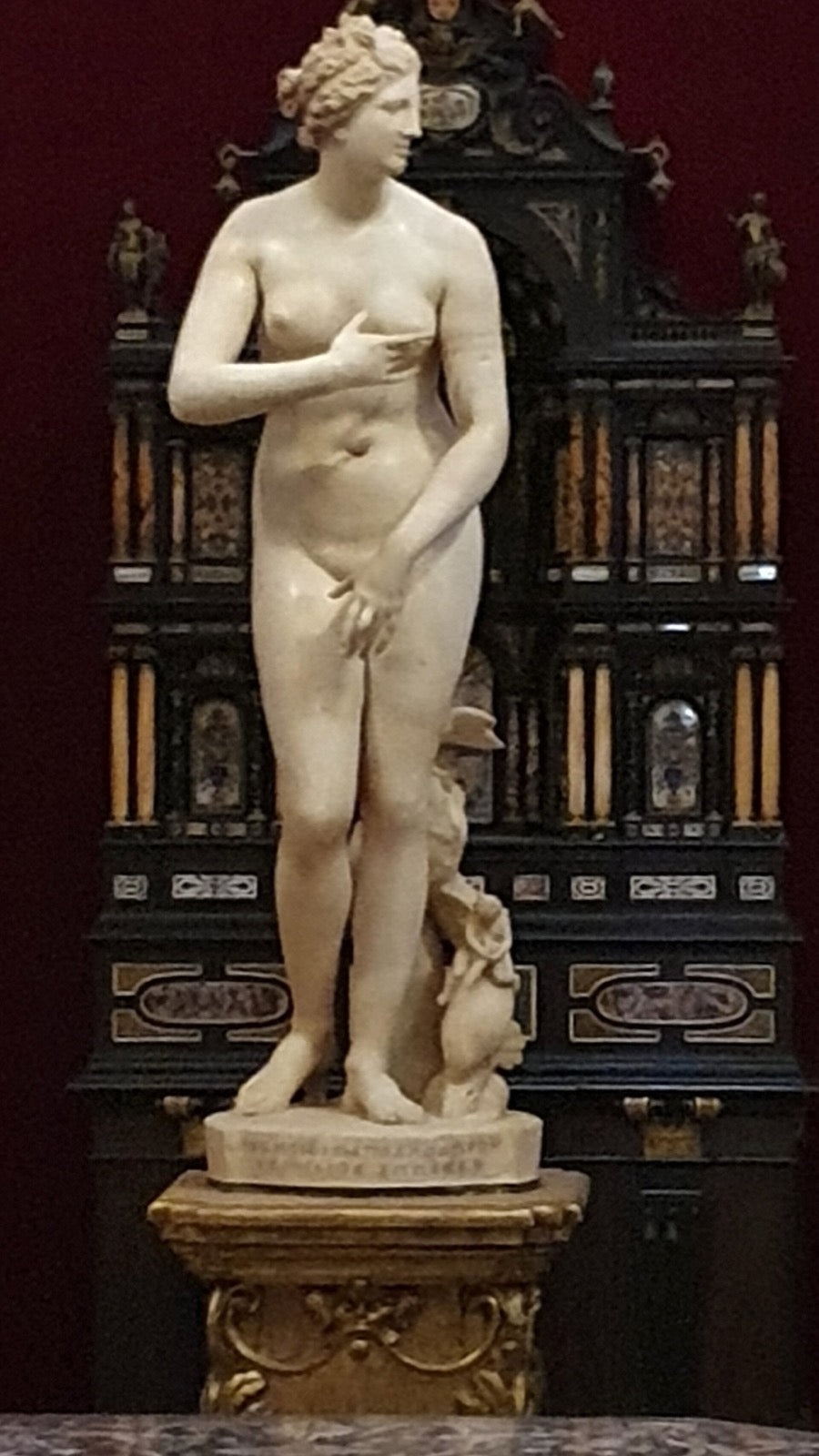
Venus stands in the Venus Pudica, or modest Venus, position inherited directly from classical sculpture: one hand gathers her hair across her body, the other reaches towards her hips, in a gesture that conceals without quite concealing. The type traces back to Praxiteles’s Aphrodite of Knidos and, closer to Botticelli’s own Florence, to the Venus de’ Medici, a Roman marble copy the Medici family itself owned and that Botticelli would have had every opportunity to study.
Popular tradition holds that Botticelli modelled Venus’s face on Simonetta Vespucci, a noblewoman celebrated as the great beauty of 1470s Florence, who died in 1476 at the age of 23, roughly a decade before the painting was finished. It is a persistent story, but historians are clear that the identification is not documented anywhere from Botticelli’s own lifetime and belongs to later tradition rather than to established fact.
Credit: Yair Haklai via Wikimedia Commons (CC BY-SA 4.0)
The flaws Botticelli left in on purpose
Measured against real anatomy, Venus’s body does not work. Her neck and torso are elongated well beyond what a human frame allows, to the point that the art historian Kenneth Clark described her figure as entirely without aplomb, meaning it has no genuine vertical balance. None of the figures in the painting cast a shadow, and the sea itself is rendered as a regular, almost woven pattern of small waves rather than anything resembling real water. Botticelli was not attempting realism. He was building a world governed by imagination rather than observation.
Gold leaf runs through the picture as a marker of what mattered most: it picks out strands of Venus’s hair and her eyes, and it outlines the stylised orange trees behind the Hora. Those orange trees are not neutral scenery. Their old Italian name, mala medica, echoes the Medici family name closely enough that the Uffizi itself reads them as a coded Medici emblem, worked into the mythological scene as a quiet signature from whichever member of the family paid for the painting.
Credit: CEphoto, Uwe Aranas via Wikimedia Commons (CC BY-SA 3.0)
A private philosophy lesson that outgrew its original audience
Every element covered here, the shell, the wind gods, the cloak, the pose, the gold leaf, was aimed at a household trained by Marsilio Ficino to read a naked goddess as a philosophical argument rather than a decorative nude. That original audience would have recognised the Medici orange trees and the Neoplatonic doubling of Venus almost instantly.
Five centuries later, the coded reading has largely fallen away, and the painting is judged almost entirely on the strength of its surface: the pose, the colour, the odd, weightless grace of a figure whose anatomy could never actually stand. That the picture still works on that level, stripped of the philosophy it was built to carry, says as much about Botticelli’s skill as a painter as any of the symbolism underneath it.